• TalkBass has been independent since 1998. Add your voice.
    Create a free account to reply to discussions, view embedded media, and browse with fewer display ads.
    Join freeLog in
    Want zero display ads or expanded classifieds tools? Compare plans.

Double Bass Stagg EUB megathread

Admission - I have not read this entire thread.
Question - Does Stagg still make an EUB with a rosewood fingerboard, and, if so, what is that model name/number?

Background - I played a new Stagg yesterday in a local shop, and except for the lack of precise onboard tone control (just the single "Sub Bass" pot), found the instrument to play surprisingly well; I was expecting to hate it, but I didn't. I love the rosewood fingerboard on my Alembic, and prefer real quality ebony and rosewood fingerboards on string basses. I've also seen recommendations in this thread and others that, if one is going to pick up a Stagg, try and get one with a rosewood fingerboard. After searching various listings and Stagg's site, I can't find mention of that option.

Anyone?
Hmm...
I bought mine essentially new (Older, non-bassist, musician received it new, as a gift, and never touched it. Sold to me for half price.), but I don't know how old it is. I always assumed the fingerboard was 'ebonized' rosewood.
What other material might it be?

Also, thinking of filing the A and D bridge slots as they are somewhat high as the bridge radius doesn't exactly match the fingerboard.
Anybody have any thoughts on this?
 
Hmm...
I bought mine essentially new (Older, non-bassist, musician received it new, as a gift, and never touched it. Sold to me for half price.), but I don't know how old it is. I always assumed the fingerboard was 'ebonized' rosewood.
What other material might it be?

Also, thinking of filing the A and D bridge slots as they are somewhat high as the bridge radius doesn't exactly match the fingerboard.
Anybody have any thoughts on this?
The fingerboard could be painted maple or other hardwood that's cheaper than rosewood or ebony.
As far as filing the A and D slots in the bridge, a couple things to consider...that would make arco playing more difficult, as the four strings would now be closer to the same plane and it would be harder to keep the bow cleanly on onr string. If you don't intend to ever play arco, you can ignore that. The other is that the response of the string can be hampered if it sits inside a slot too far or is pinched. When I fit bridges to any violin, viola, cello, or bass, after I file the string notches the correct height and shape, I then shape the top of the bridge so that at least half the string diameter is above the notch, and then feather/taper the bridge.
 
  • Like
Reactions: BlacksHole
The bridge curvature is already low on a Stagg. Comparable to an acoustic 5-string DB. Don’t make that any flatter unless you never sell the instrument and don’t ever to use a bow. (Bowing is important to hear your intonation better and be able to correct sloppy finger placement.)

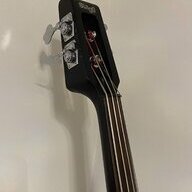
The black painted neck with integrated fingerboard is any cheap and/or unpleasant looking wood coated with a thin black epoxy. Hard to get high points planed without ruining the coating.

The rosewood fingerboard is glued on, brown and coated with a colorless transparent laquer. To plan it the laquer might need to be removed, but it is easier and looks better than on the completely black neck. It is also possible to finish the planed fingerboard with boiled linseed oil which typically does not generate any new high spots as a epoxy or laquer finish might do.

The shape of the fingerboard and it’s camber can vary a lot with the Staggs. I never had luck adjusting the trussrod as the neck is too thick and hard to be able to bend anything there. Others seemed to have more luck, but you cannot eliminate a high spot that way.

The Stagg is a cheaply mostly machine made instrument where no real quality control beyond the obvious was made.
With a few tweaks it can be OK, but the prices are a bit high for what you get nowadays.

The bridge has too much metal and therefor too much mass. It’s one of the things I would replace with a purely wooden fixed bridge. It’s your decision if you want to ruin it, it is also coated with black epoxy and you never know what’s below it. For a better look you might need to remove the whole black epoxy coating and scrape off black stuff that got into the wood.
The really bad thing is that the bridge is symmetric. The lower strings need more clearance under the strings than the higher ones.
There was hardly any DB player involved in construction, so don’t expect too much from it.
 
The fingerboard could be painted maple or other hardwood that's cheaper than rosewood or ebony.
As far as filing the A and D slots in the bridge, a couple things to consider...that would make arco playing more difficult, as the four strings would now be closer to the same plane and it would be harder to keep the bow cleanly on onr string. If you don't intend to ever play arco, you can ignore that. The other is that the response of the string can be hampered if it sits inside a slot too far or is pinched. When I fit bridges to any violin, viola, cello, or bass, after I file the string notches the correct height and shape, I then shape the top of the bridge so that at least half the string diameter is above the notch, and then feather/taper the bridge.
Thanks.
The radius, even if matched to the fingerboard, would have plenty of arc for bowing. However, I don't really do much bowing so that wouldn't be much of a concern. I'm more concerned with bridge damage.
The bridge curvature is already low on a Stagg. Comparable to an acoustic 5-string DB. Don’t make that any flatter unless you never sell the instrument and don’t ever to use a bow. (Bowing is important to hear your intonation better and be able to correct sloppy finger placement.)

The black painted neck with integrated fingerboard is any cheap and/or unpleasant looking wood coated with a thin black epoxy. Hard to get high points planed without ruining the coating.

The rosewood fingerboard is glued on, brown and coated with a colorless transparent laquer. To plan it the laquer might need to be removed, but it is easier and looks better than on the completely black neck. It is also possible to finish the planed fingerboard with boiled linseed oil which typically does not generate any new high spots as a epoxy or laquer finish might do.

The shape of the fingerboard and it’s camber can vary a lot with the Staggs. I never had luck adjusting the trussrod as the neck is too thick and hard to be able to bend anything there. Others seemed to have more luck, but you cannot eliminate a high spot that way.

The Stagg is a cheaply mostly machine made instrument where no real quality control beyond the obvious was made.
With a few tweaks it can be OK, but the prices are a bit high for what you get nowadays.

The bridge has too much metal and therefor too much mass. It’s one of the things I would replace with a purely wooden fixed bridge. It’s your decision if you want to ruin it, it is also coated with black epoxy and you never know what’s below it. For a better look you might need to remove the whole black epoxy coating and scrape off black stuff that got into the wood.
The really bad thing is that the bridge is symmetric. The lower strings need more clearance under the strings than the higher ones.
There was hardly any DB player involved in construction, so don’t expect too much from it.
Maybe I got lucky (I've heard these are inconsistent), but I've owned both Clevinger and NS Design and this Stagg is a good instrument and a hell of a values in comparison.
Also: Truss Rod??
I haven't located any truss rod. Were there different models?
Thanks again.
 
Yes, the Stagg EDB has evolved a bit over time. On the last one that a friend of mine has bought I haven‘t found one.
Probably because it won‘t work on a thick neck.
The truss rod on mine is accessible behind the nut.

But the bridge is still bad with its symmetrical string height and too much mass from the metal and wood.

Put a sponge behind the afterlength to stop them resonating.
 
Admission - I have not read this entire thread.
Question - Does Stagg still make an EUB with a rosewood fingerboard, and, if so, what is that model name/number?

Background - I played a new Stagg yesterday in a local shop, and except for the lack of precise onboard tone control (just the single "Sub Bass" pot), found the instrument to play surprisingly well; I was expecting to hate it, but I didn't. I love the rosewood fingerboard on my Alembic, and prefer real quality ebony and rosewood fingerboards on string basses. I've also seen recommendations in this thread and others that, if one is going to pick up a Stagg, try and get one with a rosewood fingerboard. After searching various listings and Stagg's site, I can't find mention of that option.

Anyone?

I do think they can be ordered with rosewood. I had bought mine used and it has a pau ferro fingerboard, but I think that was during the period of restricted rosewood.

Good luck
 
Hi all. For those that hate batteries as much as I do, I have found a solution that works well for me - a 9 volt battery eliminator that fits into the battery compartment and then into a power strip by my amp .
Check the BatteryEliminatorStore.com for the BE-9v-Audio-AC:9 volt battery eliminator. It's made specifically to use with instruments, pedals, and audio equipment.
With a Dremel, I simply cut a 1/8 inch space in the upper left corner of the battery compartment cover for the wire and now I'm always plugged in and ready .
$ 60.00 is a small price to pay for the convenience.
I hope this is helpful. Bill
 
  • Like
Reactions: DaBassman
Hi all. For those that hate batteries as much as I do, I have found a solution that works well for me - a 9 volt battery eliminator that fits into the battery compartment and then into a power strip by my amp .
Check the BatteryEliminatorStore.com for the BE-9v-Audio-AC:9 volt battery eliminator. It's made specifically to use with instruments, pedals, and audio equipment.
With a Dremel, I simply cut a 1/8 inch space in the upper left corner of the battery compartment cover for the wire and now I'm always plugged in and ready .
$ 60.00 is a small price to pay for the convenience.
I hope this is helpful. Bill
Photos?
 
Hi, love the demos I've seen of this bass. Can someone tell me the width of the fingerboard at the nut and bottom? is the neck thick? I saw someone online had reshaped it. If it's not too much trouble, what is the circumference of the neck from the factory? like around low G? this thread is awesome by the way!
 
The neck width at the nut is 42mm, twice as wide (84mm) at the very bottom of it. Not sure how useful a neck's circumference number is, but at the point of note G on E string it's 155mm measured with flexible tape around the neck. Obviously circumference getting smaller toward the nut and bigger away from it. Hope this helps.
 
  • Like
Reactions: stevecirrus
As an Amazon Associate, TalkBass may receive commissions from qualifying purchases made via links on this site.
  • Like
Reactions: DaBassman
Hi, I got a stagg last month and have two fairly dumb questions.

First, it's about the same height as me, and I haven't lowered the end pin at all, just left it screwed in. Is that a problem? It doesn't rattle.

Second. I've read through most of this thread, including many relating to various aspects of the battery...on mine, the power light does not come on until an instrument cable goes into the socket. Even if it's not attached to anything. Does that mean that it's really off if a cable is not present, or does this just turn off the power light, not the power itself?

Thanks, you all are the best.
 
Second. I've read through most of this thread, including many relating to various aspects of the battery...on mine, the power light does not come on until an instrument cable goes into the socket. Even if it's not attached to anything. Does that mean that it's really off if a cable is not present, or does this just turn off the power light, not the power itself?

This is a standard feature for basses with active electronics.
A cable has to be in the socket for the preamp to be on. Without a cable in the socket, the preamp is off.

Typically, when a TS cable is inserted into the jack it connects preamp ground to (-) battery terminal and turns the preamp on.
I say "typically" because I have never seen a different method but that doesn't mean that there is not.
 
Hi, I got a stagg last month and have two fairly dumb questions.

First, it's about the same height as me, and I haven't lowered the end pin at all, just left it screwed in. Is that a problem? It doesn't rattle.

...

Most people think the nut should be around eye level, so you might want to take a bit of the endpin out. This is typical for a DB but also a good habit for EUB. Your instrument should have a position so that you can easily reach the half position on the fingerboard (first fret on guitar) but as well keep the bow horizontal between the end of the fingerboard and the bridge.
Even if you only play pizz, plucking at the end of the fingerboard gives you a better impulse for each note than higher up.
You might be lucky like me with the endpin. The endpins of my Staggs don’t rattle in or (partially) out.

On my Stagg I don’t use the left shoulder wire because cloth sticks to the rubber when going into thumb position.
I bended the upper wire of the body support over the whole straight length, so that the upper part doesn’t press more into the body than the lower one.

Also some rubber foam around the part that presses against the body keeps the support better in place.

A piece of foam under the afterlengths avoids ringing there.

Happy playing!
 
This is a standard feature for basses with active electronics.
A cable has to be in the socket for the preamp to be on. Without a cable in the socket, the preamp is off.

Typically, when a TS cable is inserted into the jack it connects preamp ground to (-) battery terminal and turns the preamp on.
I say "typically" because I have never seen a different method but that doesn't mean that there is not.

I've got an electric cello and several electric violins, and they've all got 'on/off' switches. They all have sockets for line out, headphones and mike.

Most people think the nut should be around eye level, so you might want to take a bit of the endpin out. Happy playing!

With the endpin retracted all the way the nut is very slightly above my eyes, so if it isn't hurting anything I'll leave it that way. I haven't even tried the supports because they obviously wouldn't hit me where they were designed to. Already did the foam, residual habit from mandolins.

Using the cello bow and all seems ok, but there's a reason I wear headphones (i.e., somebody maybe I'll reach 'not good' level.)