• TalkBass has been independent since 1998. Add your voice.
    Create a free account to reply to discussions, view embedded media, and browse with fewer display ads.
    Join freeLog in
    Want zero display ads or expanded classifieds tools? Compare plans.

Steinberger form factor

Jul 8, 2010
837
46
So this is just a quick question; I've been idly curious about this: what are some basses that have the same practical application as the Steinberger headless? I.e. very compact and out of the way for a crowded stage, perhaps with banks of keys to navigate? Not "just" headless, if that makes sense.

Just wondering what all is out there at different price points.

 
There are a number of travel basses that are significantly smaller, though I haven’t seen one I’d play out with. Then of course you have Kala U-Bass and it’s clones. The Ibanez Mikro gets a lot of love on TB, it sounds great, and it’s tiny. All the Steinberger clones like the Cort, Hohner, etc fit the form factor, but are pale shadows of the real deal. The original Steinberger L2’s have gotten crazy priced, but the XP-2 and some of the later models with the Strat shaped bodies (the M series) are great basses, with hard rock maple bodies, graphite composite necks, and the original tuners, EMG pups, etc. I own a 1986 XP-2, absolutely fantastic, nearly indestructible bass. They can still be had for $1200-1500, and worth it. The Hohner and Cort clones usually less than $500. Ibanez Mikro less than $200, probably the best bang for buck, small, light, short scale, sounds great.
 
Hohner B2
96rd8n0n3agmf7fjmva00kdd0g.jpg


Washburn Bantam
washburn-bantam-headless-241244.jpg


Kramer "The Duke"
dukebass.jpg
 
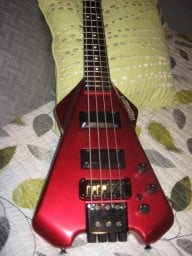
Not exactly the same as the Steinberger and copies, but the "spiritual successor" if you will: Status Streamline

6333stream-5-22.jpg


From the Status website:

The Streamline Bass is a one-piece, woven graphite composite instrument.

Its compact design may be light-weight but it is a true, professional bass guitar which delivers all the quality you would expect from any Status Bass.

The 24 fret fingerboard has a regular 34" scale. Only the body is smaller to make it more convenient when travelling or in a space restricted gigging or studio situation.

An elongated upper body makes the balance perfect when used with a regular guitar strap but, to make sure the upper fret access is not restricted, the back of the neck and body has a deep recess.
 
There are a number of travel basses that are significantly smaller, though I haven’t seen one I’d play out with. Then of course you have Kala U-Bass and it’s clones. The Ibanez Mikro gets a lot of love on TB, it sounds great, and it’s tiny. All the Steinberger clones like the Cort, Hohner, etc fit the form factor, but are pale shadows of the real deal. The original Steinberger L2’s have gotten crazy priced, but the XP-2 and some of the later models with the Strat shaped bodies (the M series) are great basses, with hard rock maple bodies, graphite composite necks, and the original tuners, EMG pups, etc. I own a 1986 XP-2, absolutely fantastic, nearly indestructible bass. They can still be had for $1200-1500, and worth it. The Hohner and Cort clones usually less than $500. Ibanez Mikro less than $200, probably the best bang for buck, small, light, short scale, sounds great.

I would like to add that deals are out there for XP2s. I just picked up one from 1986 in practically mint condition with a hardshell case for <$1000 USD. Only a week in, and I'm in love with this incredible instrument. No idea why they don't seem to be going for more money. Aside, when I bought it owner mentioned he hadn't played it in a long time, we took it out of the case, and it was still perfectly in tune. I then drove it the around 500 km home through various humidity shifts and still perfectly in tune when I plug it into my tuner. Do these things ever go out of tune? Mind blowing how stable it is...

(sorry to derail the thread)
 
I have a Hohner headless - I don't think you can buy those new these days, probably only used ones now. I bought mine for $200 a few years ago, now I think they're around $400 used? Best bet if you want an inexpensive headless is the Steinberger Spirit.
Other basses I've owned that are pretty compact, well I did have a Cort headless (terrible quality) and also the Cort Curbow which isn't headless but has a very small body. Bass almost fits in a guitar gig bag even though it's full scale.
 
Er, one of these,but good luck trying to find one!
No kidding about it's namesake...Rub it in Mr. Riverhead, lol..Awesome bass.
Ever since I found a Riverhead Spector bass quite by chance a while back, I've been keeping an eye out for these basses, the Unicorn or the Phantom. Come to think of it, I haven't seen any other used Riverhead bass in my neck of the woods. Riverhead the brand is no more, Bacchus (Japan) was the brand the parent company, Deviser decided to go with in the late 90s, although I believe they restarted the Riverhead name brand recently but it's not the same, more of Fender style basses and not MIJ.
Here's the aptly named Unicorn with the Phantom on the left. Sadly, not my picture.
riverhead.jpg
 
I would like to add that deals are out there for XP2s. I just picked up one from 1986 in practically mint condition with a hardshell case for <$1000 USD. Only a week in, and I'm in love with this incredible instrument. No idea why they don't seem to be going for more money. Aside, when I bought it owner mentioned he hadn't played it in a long time, we took it out of the case, and it was still perfectly in tune. I then drove it the around 500 km home through various humidity shifts and still perfectly in tune when I plug it into my tuner. Do these things ever go out of tune? Mind blowing how stable it is...

(sorry to derail the thread)
Wanker,
Your experience is typical of Steinbergers, at least the ones with carbon-graphite necks. Once the strings have finished their initial stretch, they don't lengthen in storage. The graphite neck is impervious to humidity and any normal range of temperatures (leaving your bass in a hot car doesn't count!), and the straight-pull micrometer tuners don't impart any twist to the strings, so there just isn't any of the normal effects that cause a bass to fall out of tune. You could argue that the wood body XP and M Series versions will expand/contract differentially than the graphite neck, and I'm sure they do, but If I can't hear the difference in tuning, it's kinda moot. I think my record was 6 months in storage, and it came out perfectly in tune. Incredible. I got tired of the 80's comments about the "flying vee" body shape, and I like to dabble in amateur luthiery, so I built a mahogany body for XP-2, kept the original rock maple body, pickguard, knobs, Nomex gig bag, etc in storage in case I ever decide to sell it (not likely). Here it is today, fits in a standard guitar HSC:
 
Wanker,
Your experience is typical of Steinbergers, at least the ones with carbon-graphite necks. Once the strings have finished their initial stretch, they don't lengthen in storage. The graphite neck is impervious to humidity and any normal range of temperatures (leaving your bass in a hot car doesn't count!), and the straight-pull micrometer tuners don't impart any twist to the strings, so there just isn't any of the normal effects that cause a bass to fall out of tune. You could argue that the wood body XP and M Series versions will expand/contract differentially than the graphite neck, and I'm sure they do, but If I can't hear the difference in tuning, it's kinda moot. I think my record was 6 months in storage, and it came out perfectly in tune. Incredible. I got tired of the 80's comments about the "flying vee" body shape, and I like to dabble in amateur luthiery, so I built a mahogany body for XP-2, kept the original rock maple body, pickguard, knobs, Nomex gig bag, etc in storage in case I ever decide to sell it (not likely). Here it is today, fits in a standard guitar HSC:


You did an amazing job, wow, does that ever look fantastic (makes me want to pick it up and play it) kudos! To be honest one of the things that really attracted me to the XP2 was the flying vee straight out of the 80s shape of the body. How does it sound with the new mahogany body you built? Does it make a big difference?

I can't say enough good things about this little bass. Makes no sense how much of a tone monster it is from such a small package. Steinberger knocked it out of the park in my opinion.
 
  • Like
Reactions: Gilmourisgod
You did an amazing job, wow, does that ever look fantastic (makes me want to pick it up and play it) kudos! To be honest one of the things that really attracted me to the XP2 was the flying vee straight out of the 80s shape of the body. How does it sound with the new mahogany body you built? Does it make a big difference?

I can't say enough good things about this little bass. Makes no sense how much of a tone monster it is from such a small package. Steinberger knocked it out of the park in my opinion.
Well, not to get into a tonewood debate, but.... I consider myself a Tonewood Agnostic. In the absence of any real science applied to it, I'm unconvinced how much difference the wood makes, vs. strings, electronics, etc. By transferring EVERYTHING, including the relatively new strings, from a rock maple body to a mahogany body, I inadvertently performed a tonewood test of sorts. It sounds a little different, and in a way you'd expect if the body wood has an effect on tone: it's "warmer", a little more bassy, with less of the "snap" I associate with hard rock maple. I don't have any before and after recordings to prove it, nor do I care. I've owned this bass since 1986, I know what it sounded like before, and what it sounds like now, and its different. That said, I'm still Agnostic!
 
Well, not to get into a tonewood debate, but.... I consider myself a Tonewood Agnostic. In the absence of any real science applied to it, I'm unconvinced how much difference the wood makes, vs. strings, electronics, etc. By transferring EVERYTHING, including the relatively new strings, from a rock maple body to a mahogany body, I inadvertently performed a tonewood test of sorts. It sounds a little different, and in a way you'd expect if the body wood has an effect on tone: it's "warmer", a little more bassy, with less of the "snap" I associate with hard rock maple. I don't have any before and after recordings to prove it, nor do I care. I've owned this bass since 1986, I know what it sounded like before, and what it sounds like now, and its different. That said, I'm still Agnostic!

Super interesting. Thanks for the reply!
 
Marek Dabek of Stradi Instruments in Poland makes some really cool travel sized basses. He has a proven record of high quality instruments. The travel basses don't seem to appear on the Stradi website, but he posts them in his Facebook account. These ones will be set up as a piccolo bass and you'd use an octaver pedal to bring it into the bass range.

Stradi FB Page
Stradi

Stradi Travel bass


Marleaux makes a cool Soprano model in the Consat shape. Similar to Stradi it will be set up like a piccolo bass and you'd accompany it with an octaver pedal.

Marleaux site
Link Removed

Soprano model info page
Link Removed

Another that captured my attention are from VB Custom Travel Basses. These are basses strung up with bass strings (not as piccolo for use with an octaver pedal.) They're being made in Turkey. When I inquired about a price for a 5-string travel bass, his quotation was $600USD.

FB Page
Vb Custom Travel & Exercise Guitars

Example of one of their basses:
 
  • Like
Reactions: mikewalker