
Enjoy the benefits of a premium membership!
Upgrade Account
-
TalkBass has been independent since 1998. Add your voice.
Create a free account to reply to discussions, view embedded media, and browse with fewer display ads.
Join free Log in
Want zero display ads or expanded classifieds tools? Compare plans.
You are using an out of date browser. It may not display this or other websites correctly.
You should upgrade or use an alternative browser.
You should upgrade or use an alternative browser.
"Step neck basses"
- Thread starter paste
- Start date
More options
Who Replied?


Not much, but from the book American Basses:
Read Custom instruments (the one in the pic was given to Victor Wooten).
4 Strings in the lower position
5 Strings in the middle of the neck (frets 6 to 10)
6 Strings in the upper register (frets 11 to 24)
The Step neck concept was created by Michael Hulsey and licensed to Jack Read
Read Custom instruments (the one in the pic was given to Victor Wooten).
4 Strings in the lower position
5 Strings in the middle of the neck (frets 6 to 10)
6 Strings in the upper register (frets 11 to 24)
The Step neck concept was created by Michael Hulsey and licensed to Jack Read

I believe the builder is named Jack Read and is/was based in Massachusetts (not sure if he still is making instruments). A friend of mine had one of his guitars.


Bryan R. Tyler
TalkBass: Usurping My Practice Time Since 2002
Staff member
Administrator
Gold Supporting Member
Supporting Member
- May 3, 2002
- 28,948
- 20,936
- Disclosures
- Reviewer: Bass Player Magazine
That pic is the only bass I've seen with that, and I've never seen Vic play it. Lots of banjos/etc. like that, but it's never caught on with basses.



I don't understand...
Also, where does the fifth string come in? Is it a low B or a high C string? Are the four strings at the nut tuned standard, to E-A-D-G? Or are they tuned B-E-A-D, and each additional string is higher?
Also, where in the world would you buy strings for something like that?
Also, where does the fifth string come in? Is it a low B or a high C string? Are the four strings at the nut tuned standard, to E-A-D-G? Or are they tuned B-E-A-D, and each additional string is higher?
Also, where in the world would you buy strings for something like that?

Why? I see no advantage to this.
I'm thinking the idea is that you play the low notes on the lower strings so it plays alike a 4 string there and then as you go up to higher notes is starts to play like a 5 string and finally as you are going for chords in the highest range it's like a 6 string.
My personal feeling is that the whole idea is based on a mistake. Namely that you'll only be using say the C string for the highest notes. My experience is that even though the C string further down has notes covered by other strings, you STILL need the full length of the string on occasion. Plus it seems to me that switching neck widths up and down the neck would drive you nuts. I'm thinking may the maker felt that people who aren't comfortable with wide necks would find this more comfy to play, but I very much doubt that will be true.

Anyone seen/know anything about theese weird looking basses? Havent seen/heard theese around TB before
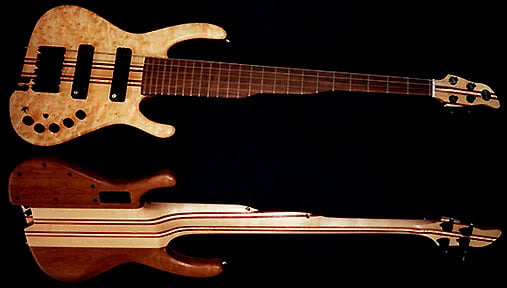
Pushing the limits of bass playing just one step farther. How come we never see guitars like this. Deep down are some bassists just bored frustrated guitarists?
I often wonder what more I'd ever be able to do with all the extra strings and fret board that I can't do with the four or five I've always played with.

Looks like a great execution of a stupid idea.
From a functional design standpoint I can't imagine how effective the truss rod would even be considering it's most likely centered between the D and A strings. It would have very little if any impact on the upper strings in the wider part of the neck. 30 years from now that neck design most likely will have warped and twisted due to non balanced tension control.
The breakover angle on those treble strings at the ball end is incredibly sharp. Looks like a recipe for frequent string breakage.
From a playability stand point it if you really had to have this kind of neck it would have made much more sense to step down the bass side of the neck and use short scale bass strings and a tuner key at the neck (aka banjo) at least that way your left hand could function normally on slides and runs.
Oh well, at least the luthier was thinking outside the box, unfortunately he wasn't thinking enough.
From a functional design standpoint I can't imagine how effective the truss rod would even be considering it's most likely centered between the D and A strings. It would have very little if any impact on the upper strings in the wider part of the neck. 30 years from now that neck design most likely will have warped and twisted due to non balanced tension control.
The breakover angle on those treble strings at the ball end is incredibly sharp. Looks like a recipe for frequent string breakage.
From a playability stand point it if you really had to have this kind of neck it would have made much more sense to step down the bass side of the neck and use short scale bass strings and a tuner key at the neck (aka banjo) at least that way your left hand could function normally on slides and runs.
Oh well, at least the luthier was thinking outside the box, unfortunately he wasn't thinking enough.
Bryan R. Tyler said:That pic is the only bass I've seen with that, and I've never seen Vic play it. Lots of banjos/etc. like that, but it's never caught on with basses.
Me neither!!! But in Jim Roberts book American Basses (1st edition) it makes mention of it being Vic's.
I guess that's one way to reduce neck dive...
Don't get the concept myself. I mean, there's really only 5 notes that a 6-er can make that you couldn't manage on a similarly fretted 4 or 5. But the existance of the high-C gives you the option of making a lot of notes on a longer string, where there's more room for the harmonics to shine. To say nothing of chord combinations. This instrument basically limits those options.
Don't get the concept myself. I mean, there's really only 5 notes that a 6-er can make that you couldn't manage on a similarly fretted 4 or 5. But the existance of the high-C gives you the option of making a lot of notes on a longer string, where there's more room for the harmonics to shine. To say nothing of chord combinations. This instrument basically limits those options.

I'm thinking the idea is that you play the low notes on the lower strings so it plays alike a 4 string there and then as you go up to higher notes is starts to play like a 5 string and finally as you are going for chords in the highest range it's like a 6 string.
My personal feeling is that the whole idea is based on a mistake. Namely that you'll only be using say the C string for the highest notes. My experience is that even though the C string further down has notes covered by other strings, you STILL need the full length of the string on occasion. Plus it seems to me that switching neck widths up and down the neck would drive you nuts. I'm thinking may the maker felt that people who aren't comfortable with wide necks would find this more comfy to play, but I very much doubt that will be true.
Agreed. For what I use my 6-7 strings, this is more limiting than anything else. My technique jives with larger necks, so I'm perfectly happy with normal necks.
By the same logic, shouldn't they have gotten rid of the neck/frets beyond the 5th fret of the low B?

Latest posts
-

-
De-fretting - How much fretboard chipping/removal is expected on a Jatoba neck?
- Latest: bass player 53
-

-

-
