
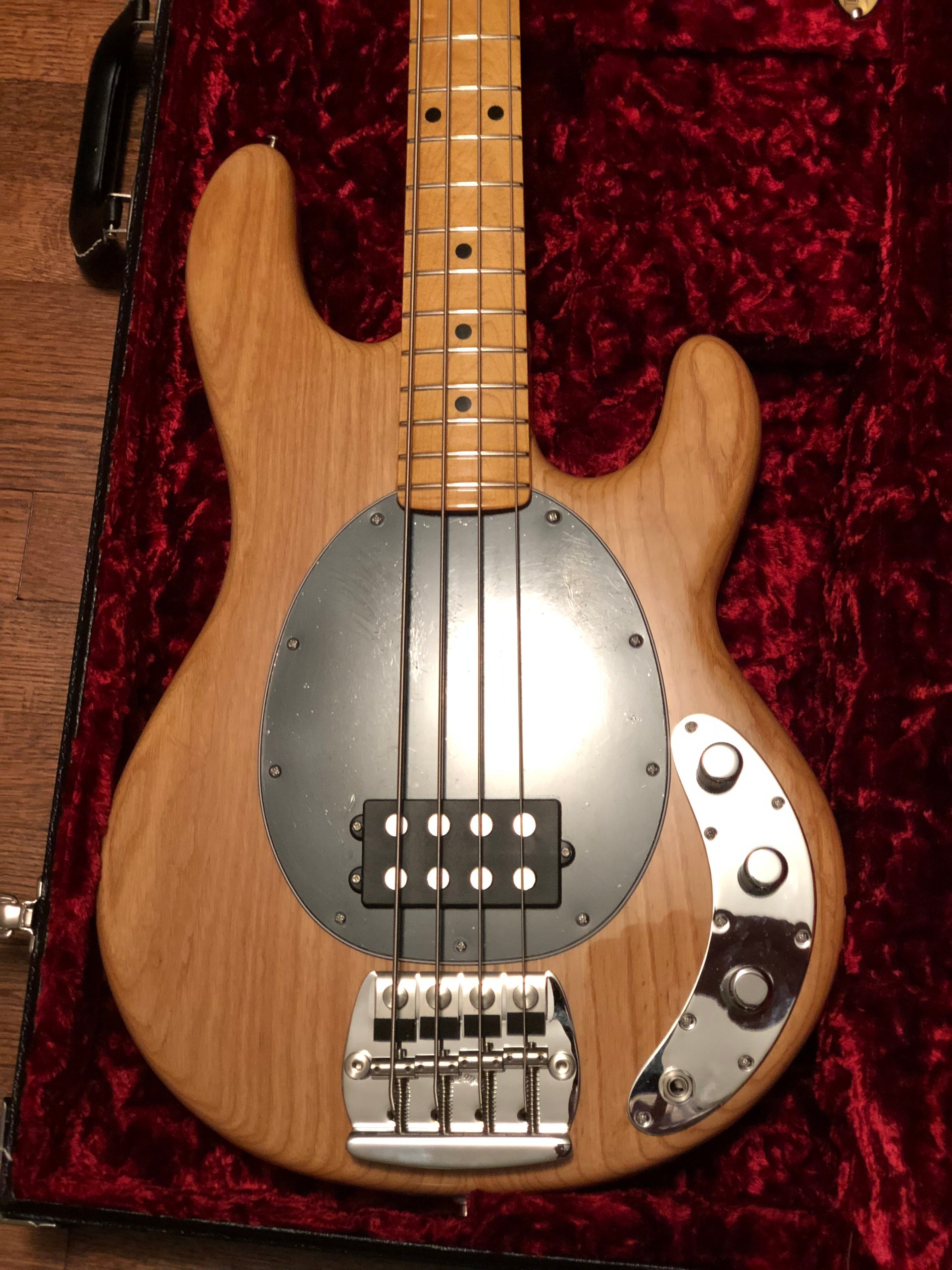
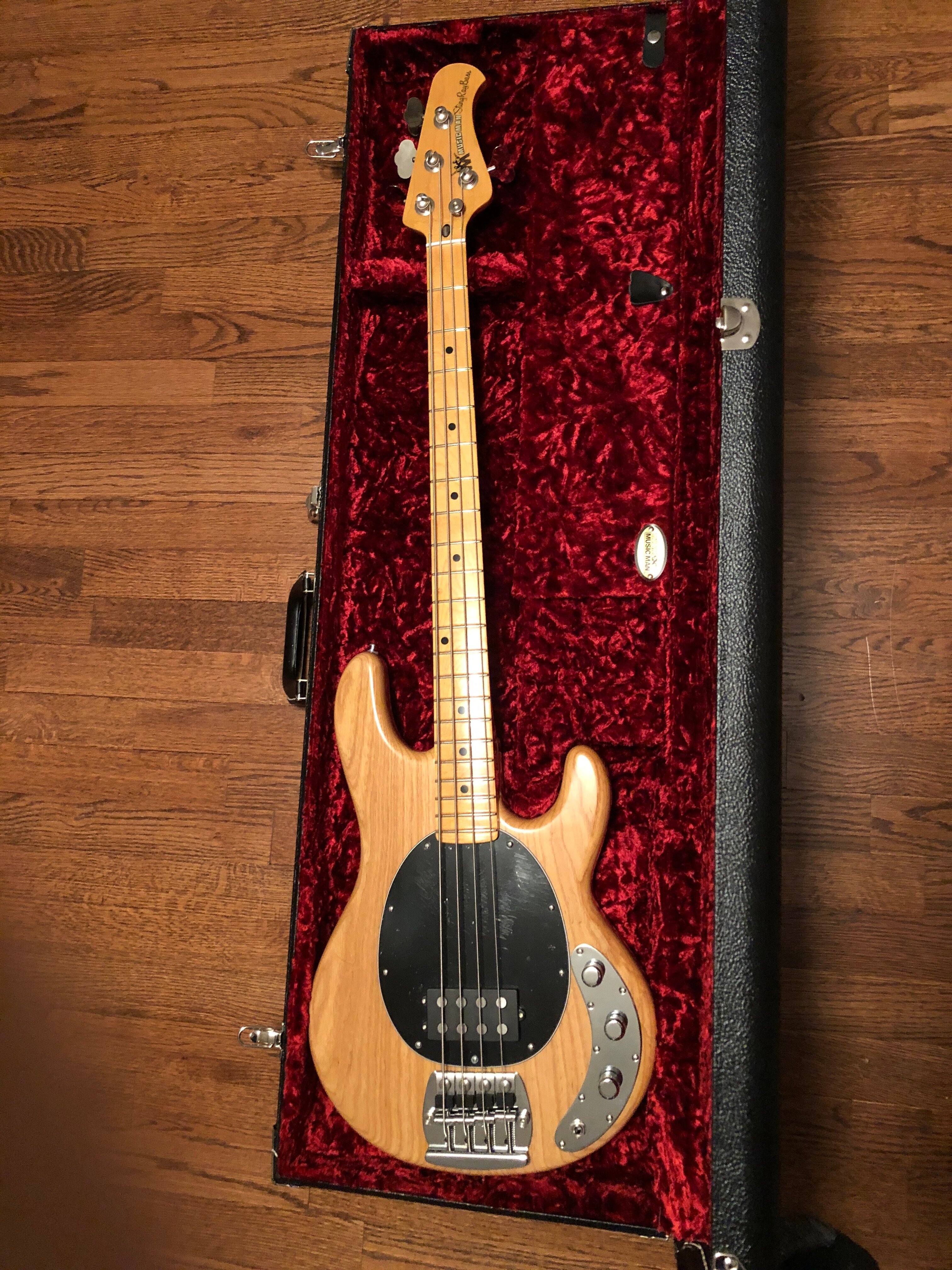
My Retro 70's G is strong. The person I got it from recorded it for me, playing every note on every fret. I knew it was going to be fantastic and I traded a BFR Fretless for it. I kinda miss that fretless with it's amazing Neo Humbucker. That BFR Neo pickup is next level. But the 2 Band Rertro Preamp & pickup is fantastic. The G is loud and proud.

Enjoy the benefits of a premium membership!
Upgrade Account
-
TalkBass has been independent since 1998. Add your voice.
Create a free account to reply to discussions, view embedded media, and browse with fewer display ads.
Join free Log in
Want zero display ads or expanded classifieds tools? Compare plans.
You are using an out of date browser. It may not display this or other websites correctly.
You should upgrade or use an alternative browser.
You should upgrade or use an alternative browser.
Stingray Weak G?
- Thread starter dustinymichaels
- Start date
-
- Tags
- stingray 4 stingray 4h
More options
Who Replied?
On my pre 2018 stingrays I always levelled the pole pieces by pushing the A and D ones down a bit. To me it provides a much more balanced response across all the strings.

My '94 drove me mad. It seemed to record ok but live the G was definitely lacking. I swapped in alnicos but no improvement. I finally replaced with a Lane Poor with bars and an OBP-3 and I never had an issue since. It absolutely sings.My ‘94 Stingray had a weak G. If you look at the path the strings take over the pole pieces, the G is not centered over the pole piece. I fixed it by VERY carefully pushing the A and D pole pieces so they are more level with the others, and then angling the pickup so the g is much closer to the strings than the E.
If you choose to adjust the height of the pole pieces, BE CAREFUL because you may also destroy the pickup. I had a backup, which is highly recommended.

Love that Retro Ray! I like that the strings pass directly over the pole piecesstraight from the saddles.My Retro 70's G is strong. The person I got it from recorded it for me, playing every note on every fret. I knew it was going to be fantastic and I traded a BFR Fretless for it. I kinda miss that fretless with it's amazing Neo Humbucker. That BFR Neo pickup is next level. But the 2 Band Rertro Preamp & pickup is fantastic. The G is loud and proud.View attachment 7028947View attachment 7028948
Note the 2 photos of my '87... The first pick shows the way it was assembled from the factory. See how the string alignment over the poles gets progressively worse from E to G. Second photo - I reassembled it swapping the saddle screws and strings. Much better pole alignment but A&D string spacing was off. I left it this way for several years before I reassembled it back to factory and adjusted the magnets....seems better.
....



This 100%.One of the basic premises of the Stingray design is that you can make up for the loss of low end that occurs from the pickup being moved closer to the bridge - with EQ in the preamp . When you set the knobs all at noon on a Stingray, the electrical response of the preamp is not even close to flat - it is scooped, with a bunch of gain at very low frequencies. So far, so good, but....there's a catch. The loss of low frequencies is a wavelength phenomenon, not strictly a frequency phenomenon. What that means is that the EQ that you need to correct for the pickup's position is different on every string - to compensate the G string you need as much boost on it at 98 Hz (it's lowest note) as you do on the E string at 41 Hz (the low E). But ...you only have one preamp - you can't fix every string perfectly; you have to compromise as to the EQ that you use, and be OK that it isn't going to be "correct" on every string.
The most obvious thing to do is make sure the instrument has a solid bottom end on the lowest strings - it's a bass guitar, it should have good fundamentals for the strings that don't duplicate the guitar range. That compromise, however means that the higher strings (the G in particular - it's the highest, so it's the one where the EQ is the least appropriate)) will not have the proper eq to compensate for the pickup position. So the instrument is solid on the E and A strings, OK...ish on the D, and weak on the G.
And this imbalance between E and G strings is part of the Stingray sound. The higher strings and higher notes are brighter / thinner sounding than on a P bass.
That said, the pickup on my Warmoth stingray is adjusted to put more distance between the pickup and E string than between the pickup and the G string. I carefully adjust all my basses for even string to string balance and this is what the 'ray needed.

One of the basic premises of the Stingray design is that you can make up for the loss of low end that occurs from the pickup being moved closer to the bridge - with EQ in the preamp . When you set the knobs all at noon on a Stingray, the electrical response of the preamp is not even close to flat - it is scooped, with a bunch of gain at very low frequencies. So far, so good, but....there's a catch. The loss of low frequencies is a wavelength phenomenon, not strictly a frequency phenomenon. What that means is that the EQ that you need to correct for the pickup's position is different on every string - to compensate the G string you need as much boost on it at 98 Hz (it's lowest note) as you do on the E string at 41 Hz (the low E). But ...you only have one preamp - you can't fix every string perfectly; you have to compromise as to the EQ that you use, and be OK that it isn't going to be "correct" on every string.
The most obvious thing to do is make sure the instrument has a solid bottom end on the lowest strings - it's a bass guitar, it should have good fundamentals for the strings that don't duplicate the guitar range. That compromise, however means that the higher strings (the G in particular - it's the highest, so it's the one where the EQ is the least appropriate)) will not have the proper eq to compensate for the pickup position. So the instrument is solid on the E and A strings, OK...ish on the D, and weak on the G.
I think you are essentially correct, but what you mean is that the loss of low frequencies is a problem derived from the relative lower volume of the lower harmonic components. Frequency and Wavelength are basically the same thing here.

OK, I'll go through this one thing at a time:AFAIK, the two main factors are string construction and the location of vibrational nodes relative to the pickup. The former: thinner strings are thinner, less rod-like and have different relationships between the harmonics. The second means that for an arbitrary note played on different strings, the pickups also "see" slightly different relationships between the harmonics that are present *. Unless you have EQ for each string that also changes with each note you play, EQ can't fix the sound entirely. Boosting EQ at 98 Hz won't help if I'm up at the 9th fret on the G and won't help the second harmonic of the open string.
A D string fretted at the 5th fret is a G but sounds different to an open G, or if you want to take the open string out of the equation, then the Ab.
I think about the best you might get a strings that are constructed, maybe different core and wrap ratios, to minimise the harmonic differences, but I expect it would be hard to do any maintain consistent tension and elasticity across a set of strings.
* I had one electric guitar that if I selected one pickup and picked a harmonic then at one of the standard locations - 5th or 7th fret - it was entirely silent. It's a very narrow set of harmonics when doing this and the single coil pick was at a node.
1) The harmonics on your G string and those on all your other strings are very much the same in terms of where they are relative to the fundamental - it isn't the string construction that makes the G sound weak on a 'Ray - if it was, it would infect every other electric bass type, and....we don't hear that. The difference in string construction also has nothing to do with getting more or less low end (what we're talking about here) - the bigger strings have more windings to try to keep the high frequency harmonics in line (and they do a good job at that - at least for round wounds - flats lose the harmonics so quickly that the fact that they are a bit off doesn't really matter much).
2) You are right that pickup location is important. If you want to fix the low frequency deficiency caused by pickup position (The 'Ray needs this as the pickup is much closer to the bridge), the EQ does need to change for each string to be "correct", but it doesn't need to change for each note you play on a string - the loss of low end is the same for every note on a string in a frequency response sense. As you go up the string, you don't need as much boost to the fundamental, because the fundamental is higher in frequency - a fixed low boost filter (which boosts the fundamentals of the lower notes more than those up the string) would correct the loss of low frequency energy for every note on that string.
Here's a response curve of what happens (on one of my basses) for all 5 strings - each string has it's own curve. There's a lot going on here, and this isn't a 'Ray, A 'Ray has more rolloff on every string due to where the pickup is) but it shows the concept:
What you see is that, at low frequencies, every string has a different rolloff. The G string has the most rolloff, so it needs the most help, but with one filter in the preamp (tuned to help out the lower strings), it doesn't get enough help - it sounds "weak".
3) I've been meaning to do a post explaining the Physics of how pickup locations affect basses (like my post on tone controls), and I have some of the work done, but it's a somewhat involved topic, and figuring out how to present it all in a manner where most folks can understand this is not a quick task - I will get it posted, but it may be a while.
The harmonics thing you mention - it's there on every string instrument. A 51 P bass has a very prominent one - the pickup is at 6.8 inches from the bridge, which is 20% of the string length, so yes, one of the harmonics - if you play it, you can hear it acoustically, but in the electrical output it is not there. This is part of the comb filter response, which is really obvious at a particular frequency - the notches in a comb filter act like that, but the low frequency rolloff of the comb filter is much broader - it affect a lot of notes, but not as much as a notch - it attenuates fundamentals, but they don't go completely away.
Frequency and wavelength are interrelated - not the same thing, but definitely intertwined. On a given string, knowing one means you can derive the other, but move over to the next string, and the equation has to talk into account the tuning difference - sound in air has one velocity, here there are as many velocities as there are strings - a higher string has a higher pitch (even though it's the same length) because it has a higher propagation velocity for waves traveling on it.I think you are essentially correct, but what you mean is that the loss of low frequencies is a problem derived from the relative lower volume of the lower harmonic components. Frequency and Wavelength are basically the same thing here.
Talking/thinking about wavelengths when you are trying to understand what pickup position does to the sound is helpful, because it's the locations of pickup(s) relative to where the harmonics have their nodes and antinodes that gives you the comb filter that is largely responsible for the sounds you're hearing - a given pickup location imparts the same 'wavelength filter" on every string - it may suppress the 5th harmonic of every note played on the 4th fret, for example. Move to a different fret, and a different wavelength filter applies - this is key to understanding why, as you play the same note in different locations, the timbre is different. Showing a frequency response curve is helpful when discussing many topics, but as every string has it's own frequency response, but they all share the same wavelength filter, discussing wavelengths is often more informative in this case.
Last edited:

2 additional follow up questions:
1) For those of use who are aware of and have played both, did the "Flea" bridge have any effect on this?
2) Which non-MM pickups (and/or preamps) have a better balance?
1) For those of use who are aware of and have played both, did the "Flea" bridge have any effect on this?
2) Which non-MM pickups (and/or preamps) have a better balance?

2 additional follow up questions:
1) For those of use who are aware of and have played both, did the "Flea" bridge have any effect on this?
2) Which non-MM pickups (and/or preamps) have a better balance?
1) no
2) none

Smooth_bass88
vaxx!
- Oct 31, 2006
- 12,122
- 16,793
- Disclosures
- have been on nationally released albums, charting on the Billboard 200
I’ve owned 4 EBMM basses. 3 of which had relatively weak G strings. A StingRay classic I played in a music store didn’t have this problem. These were all 90s and early 2000s basses, two with the classic bridge with string mutes. I ended up getting rid of all my StingRays in favor of Laklands and old Fenders.
Frequency and wavelength are interrelated - not the same thing, but definitely intertwined. On a given string, knowing one means you can derive the other, but move over to the next string, and the equation has to talk into account the tuning difference - sound in air has one velocity, here there are as many velocities as there are strings - a higher string has a higher pitch (even though it's the same length) because it has a higher propagation velocity for waves traveling on it.
Talking/thinking about wavelengths when you are trying to understand what pickup position does to the sound is helpful, because it's the locations of pickup(s) relative to where the harmonics have their nodes and antinodes that gives you the comb filter that is largely responsible for the sounds you're hearing - a given pickup location imparts the same 'wavelength filter" on every string - it may suppress the 5th harmonic of every note played on the 4th fret, for example. Move to a different fret, and a different wavelength filter applies - this is key to understanding why, as you play the same note in different locations, the timbre is different. Showing a frequency response curve is helpful when discussing many topics, but as every string has it's own frequency response, but they all share the same wavelength filter, discussing wavelengths is often more informative in this case.
I hadn't thought of the tension and mass of the string affecting the speed (and therefore the wavelength) of a wave in it. I'd love to read that detailed post about it, but it makes sense!
That is precisely how you tune a string - you adjust it's tension and linear mass density so that the velocity gives you the note you want. If you tune is so it takes 10 milliseconds (One hundreth of a second) for a wave to travel up the length of a string and back down, then the fundamental it's tuned to is 100 Hz. As the wave has to travel there and back, the wavelength of the fundametal of a vibrating string is actually twice its physical length. The harmonics are integer multiples of that - 200 Hz is the octave (which puts a full wavelength on the string), 300 Hz is an octave and a fifth up; that's a wavelength and a half, etc..I hadn't thought of the tension and mass of the string affecting the speed (and therefore the wavelength) of a wave in it. I'd love to read that detailed post about it, but it makes sense!

Maybe I just don’t understand what people mean when they say Stingrays have a weak G. I think that anyone who has ever held a bass knows that the g string has less “mass” sonically. But isn’t that just all bass guitars period. I have p’s and j’s too and don’t think my rays are weaker. It depends on the song, but I play on the g string as often as the other strings. You have to hit the g spot if you want a call back.
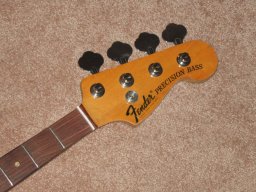
I would look at the tightness of the neck attachment screws and the mounting of the machine heads for any loose screws.
I don't know enough about the preamp to comment on it. The other area I would check is just a bad G string. Try another set of strings.
I don't know enough about the preamp to comment on it. The other area I would check is just a bad G string. Try another set of strings.


For me, I don't think the player is the determinant of the weak G phenomenon. Again, in relation to a sample size of....me, 3/4 of my Stingrays had weak Gs, 1 didn't. This hasn't been problem with my P or Js (2x '60s spacing, 1x 70s spacing w/Barts). Same band, same venue, same (more or less) setlist. Different basses, so the delta in this equation was the bass.I have 6. Had 8. Next year will be 30 years of primarily playing a Stingray. I have not had this issue. Currently I like Group III and IV EB flats. Historically I ran SM 77s 40-100. Not the heaviest strings. 99% of the time no pick. There have been some great responses to this so far! Both sides of the aisle. I like hearing about how people have responded to the weak G. Some moved on from the Stingray. Some suggestions to correct the problem. Some, like me, don't seem to have noticed a weak G. I'm hoping the people considering a Stingray are benefited by reading through our discussion.
Follow up question. How much do we think the appearance of the weak G is actually affected by the player?

I don't know how folks are eq'ing their amp, and someone mentioned above; it can help or hurt.
I gig every Wednesday as a house bassist, and I primarily use my SR5 as we could be playing anything, no weak G. In IEM, no weak G
When I bring out my SR4's, also no weak G.
I go way back to late 90's with StingRays....no weak G's baack then.
These aren't my primary basses. My main band I use Wals, and I don't eq my amp any differently. Still no weak G's.
I even had Wal build my last custom 4 string to be a single pickup bass in the Musicman position....and guess what? No weak G.
So to me it's how they're using their amps.
I gig every Wednesday as a house bassist, and I primarily use my SR5 as we could be playing anything, no weak G. In IEM, no weak G
When I bring out my SR4's, also no weak G.
I go way back to late 90's with StingRays....no weak G's baack then.
These aren't my primary basses. My main band I use Wals, and I don't eq my amp any differently. Still no weak G's.
I even had Wal build my last custom 4 string to be a single pickup bass in the Musicman position....and guess what? No weak G.
So to me it's how they're using their amps.

On my 2012 Stingray Classic it was definitely noticeable. My 2023 Stingray Special has no issues at all. Both basses wore/wear Ernie Ball Super Slinky roundwounds (45-100) and were set up by very experienced techs.


