
It’s wild that micguy correctly explained this phenomenon and people still go on for pages and pages about flatwounds and pickup changes.

TalkBass has been independent since 1998. Add your voice.
Create a free account to reply to discussions, view embedded media, and browse with fewer display ads.
Join free Log in
Want zero display ads or expanded classifieds tools? Compare plans.
It’s wild that micguy correctly explained this phenomenon and people still go on for pages and pages about flatwounds and pickup changes.
I think I agree with you?They can each provide an additional EQ curve before the pickup and before the preamp. For the strings, it's the relationship of the harmonics that is different, so not a simple EQ. It's EQ on EQ on EQ and complicated by the fact you also effectively change pitch and scale length, effectively, when fretting.
There's probably always going to be a string and fret that doesn't sound optimal, though. Or not optimal for every song - sometimes the middle sound of a G on the 15th fret of the E is what you want.
And if you want a round wound sound, then using flats won't help.
It's always going to be a series of compromises unless maybe you are using a piezo on each individual string then applying processing on each one. That's basically one of those old Line6 Varies basses, or something like a VB-99 if you could feed it with amplified piezo feeds. I have a piezo bridge with four outs to fit T some point but it's not a priority.
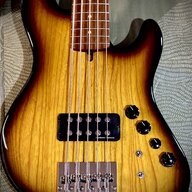
Funny, my ‘94 with the “Flea Bridge” had the same horrible assed pole-to-string alignment, and I never noticed a weak G.Love that Retro Ray! I like that the strings pass directly over the pole piecesstraight from the saddles.
Note the 2 photos of my '87... The first pick shows the way it was assembled from the factory. See how the string alignment over the poles gets progressively worse from E to G. Second photo - I reassembled it swapping the saddle screws and strings. Much better pole alignment but A&D string spacing was off. I left it this way for several years before I reassembled it back to factory and adjusted the magnets....seems better.
....
View attachment 7028973View attachment 7028974
And that also varies between string for the same note. Partly, that is because a G up on the 10th fret of the A is effectively a different scale length so the pickup is in a different location but also because the harmonic sequence of a long thin string is different to a short fat one for typical string construction. You can verify this by using a piezo pickup and comparing the harmonic sequences for strings of different thicknesses (which I've done). But then you can hear that effect isolated on a piezo-equipped bass as that 10th fret G on the A is thuddier. It also doesn't intonate as well as the sequence of harmonics drifts from the ideal. Again, audible as well as measurable.The character of the G string is inherent of the nature of the whole operation.
Moving it closer to the pickup will make a difference too, although the biggest effect there is relative volume. So it will get you more of your "cut" frequency of say 400Hz for the G string and increase strength in a mix. You are just going to add more twang at 800Hz in the process, so the compromise now is whether extra signal at 800Hz is an issue (all the frequencies change as pitch changes).Moving it closer to the pickup or whatever is not going to introduce all of those rich bass overtones (it’s a frequency/comb filtering thing, not a volume thing.)
I think you're right.And that also varies between string for the same note. Partly, that is because a G up on the 10th fret of the A is effectively a different scale length so the pickup is in a different location but also because the harmonic sequence of a long thin string is different to a short fat one for typical string construction. You can verify this by using a piezo pickup and comparing the harmonic sequences for strings of different thicknesses (which I've done). But then you can hear that effect isolated on a piezo-equipped bass as that 10th fret G on the A is thuddier. It also doesn't intonate as well as the sequence of harmonics drifts from the ideal. Again, audible as well as measurable.
Moving it closer to the pickup will make a difference too, although the biggest effect there is relative volume. So it will get you more of your "cut" frequency of say 400Hz for the G string and increase strength in a mix. You are just going to add more twang at 800Hz in the process, so the compromise now is whether extra signal at 800Hz is an issue (all the frequencies change as pitch changes).
Where raising the volume of the G might be an issue (aside from it meaning more volume from the D as well) is with compression. If it's a simple compressor then that increased signal at 800Hz will be part of what the compressor sees and so it'll be squashing the 400Hz you wanted. That might fight against what you wanted to achieve.
Again, the only way to fully solve it is take pickup positions out of the equation and process each string separately. As well as the (unimplemented) four output piezo I also have a Roland split pickup. As that goes very close to the bridge it gets close to taking string length out of the equation (probably why Roland expects you to put it there). But I don't have a break out box for each element as it's not high priority just academic interest to, say, run Jam Origin per string.
If you are going down that route you probably get a VB-99 or similar. I have it as two back burner projects. The piezo bridge is more about MIDI without the Roland pickup or spending $$$ on all the Shadow stuff. And for guitar as well as bass. Audio processing is just a potential extra. But it's lower priority than cleaning the gutters, etc.I think you're right.
On the other hand, nobody is going to run a bunch of complex software and all of that. Just play the bass and let the G string be what it is. I don't try to make a pen draw like a pencil.

I dont remember what this was.....but I do seem to remember someone mentioning that Ernie Ball's claim was that the voicing of the preamp was a contributing factor. To be clear the issue is a pronounced drop in output from the G string, not a fuller or warmer G string thats inherit to the design.It’s wild that micguy correctly explained this phenomenon and people still go on for pages and pages about flatwounds and pickup changes.
If you think of volume as the area under a curve, then EQ can affect that. The strength of harmonics reduces as you go up in frequency, so if you have a scoop cutting the loud second harmonic but a boost of the 5th the overall energy/volume may be lower.I dont remember what this was.....but I do seem to remember someone mentioning that Ernie Ball's claim was that the voicing of the preamp was a contributing factor. To be clear the issue is a pronounced drop in output from the G string, not a fuller or warmer G string thats inherit to the design.


