• TalkBass has been independent since 1998. Add your voice.
    Create a free account to reply to discussions, view embedded media, and browse with fewer display ads.
    Join freeLog in
    Want zero display ads or expanded classifieds tools? Compare plans.
Double Bass String height for Jazz pizzicato

Making deeper slots in the bridge is only to be able to better fill theming if they are filed too deep. When the right height is found, the crown needs to be filed down until the slots are a third to a half as deep as the string diameter (on the outer side, the inner side is a bit deeper).

For very low tension strings maybe a bit deeper so they don‘t jump out of the string groove when played a bit harder.
It helps to make the string groove a little bit wider than the string diameter to avoid clamping at the bridge groove.
 
  • Like
Reactions: redtomfunk
Sounds like you have some skills and no fear of
doing your own luthier work.

I had a Kay about 20 years ago that was made playable by a respected bass shop (Upton).
Based on their recommendations, an adjustable bridge was added to my instrument.

I’d suggest the same for your instrument.
 
Sounds like you have some skills and no fear of
doing your own luthier work.

I had a Kay about 20 years ago that was made playable by a respected bass shop (Upton).
Based on their recommendations, an adjustable bridge was added to my instrument.

I’d suggest the same for your instrument.
He knows it, but adding adjusters needs some tools (drill press with bridge fixation legs up), knowledge and adjusters that fit the woodworking process.
He tried finding a luthier doing that without the bass but they refused to do that. And as mentioned earlier, getting the bass from northern Norway to southern Norway to visit a luthier is no option for the OP.

My luthier used adjusters with metal inserts for upper bridge and legs, so a single hole needs to be drilled through the feet, the feet cut off, removing as much wood as the adjuster wheel is thick from the legs, and plug the lower hole end with a dowel so the inserts sit in place.

The deepness of the holes, the upper cutting place (to have the right deepness for the insert after cutting), the amount of wood cut out (less and you raise the bridge, more and you lower it) and the length of the dowel (so the lower insert sits in place) are important.
The deepness of the holes also determines the cutting point at the leg the length of the dowel.
It’s not rocket science, but one have to think about first where the cut should take place and calculate the length of the holes the amount of cut out, etc.
It is not as simple as it looks like on the first sight.

Bridges with pre-installed adjusters seem to be the simpler way, but unless you can fix the legs to the upper part well (maybe with shims and a lamp over both parts) fitting the feet to the top is a really hard task for a beginner and still hard with the feet fixed.
And you need to get the right size, carve the foot sides and remove the wood from the crown to the right height.

I don’t recommend a wooden thread for DIY as the diameter of the drilled threads on top part and feet needs to be different, the wooden threads need to be cut with the right tools and the metal inserts are more robust and can be changed more easily than a worn out wooden thread can get repaired.
More risk to damage the bridge up to getting unusable.

I recommend Aluminium adjusters (tested with a Full Circle). On my Instrument theey had a better influence on the sound than the luthier installed brass adjusters using the same brass inserts that were originally installed.

But first the higher strings need to get down a bit. If climate changes influence the top height, the adjusters can still be installed.

But this is only my opinion.
 
Last edited:
He knows it, but adding adjusters needs some tools (drill press with bridge fixation legs up), knowledge and adjusters that fit the woodworking process.
He tried finding a luthier doing that without the bass but they refused to do that. And as mentioned earlier, getting the bass from northern Norway to southern Norway to visit a luthier is no option for the OP.

My luthier used adjusters with metal inserts for upper bridge and legs, so a single hole needs to be drilled through the feet, the feet cut off, removing as much wood as the adjuster wheel is thick from the legs, and plug the lower hole end with a dowel so the inserts sit in place.

The deepness of the holes, the upper cutting place (to have the right deepness for the insert after cutting), the amount of wood cut out (less and you raise the bridge, more and you lower it) and the length of the dowel (so the lower insert sits in place) are important.
The deepness of the holes also determines the cutting point at the leg the length of the dowel.
It’s not rocket science, but one have to think about first where the cut should take place and calculate the length of the holes the amount of cut out, etc.
It is not as simple as it looks like on the first sight.

Bridges with pre-installed adjusters seem to be the simpler way, but unless you can fix the legs to the upper part well (maybe with shims and a lamp over both parts) fitting the feet to the top is a really hard task for a beginner and still hard with the feet fixed.
And you need to get the right size, carve the foot sides and remove the wood from the crown to the right height.

I don’t recommend a wooden thread for DIY as the diameter of the drilled threads on top part and feet needs to be different, the wooden threads need to be cut with the right tools and the metal inserts are more robust and can be changed more easily than a worn out wooden thread can get repaired.
More risk to damage the bridge up to getting unusable.

I recommend Aluminium adjusters (tested with a Full Circle). On my Instrument theey had a better influence on the sound than the luthier installed brass adjusters using the same brass inserts that were originally installed.

But first the higher strings need to get down a bit. If climate changes influence the top height, the adjusters can still be installed.

But this is only my opinion.
One of the mechanical engineers that I used to work with said “If you can’t make it accurate, make it adjustable.”
 
Can you make one like the last one but with the end of the fingerboard visible too? And one with end of the fingerboard visible above the bridge crown (shoot from over the tailpiece)?
Otherwise it looks good.

image.jpg
image.jpg
 
Looks good. Copy the bridge curvature on a piece of paper or cardboard and cut along the curve if you haven’t already done that.
Then if you want you can file the bridge crown down to the current slot deepness.

I‘m sure you can get further down to something like 7/8/9/10 without problems.
Use the shape of the original crown and let it rotate below the E-string to find the height position for D and A depending how low you want the G.

Don‘t forget to always file from the middle of the bridge outside because of the grain.

You‘ll make it. Good luck.
 
Thanks for your help!
I am quite happy with this string height when I play in half/first position. I start to struggle in thumb position. It needs to be said that I have never learned to play in thumb position but I feel that having an instrument with lower string height could help a lot up there
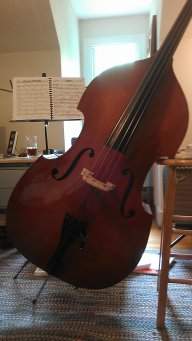
 
Which strings do you use?
Looks a bit like Spirocore (or cheap Asian strings looking like them), but even with Spirocore it would be interesting to know the size (3/4 or 4/4, I assume 3/4 since Thomann is in Germany) and weight (pegbox silks red: medium, purple: light, yellow: solo).

3/4 medium are a bit hard for me. I had the 4/4 on the 110 cm scale which is about the same tension. Also at an action that was too high. Got an adjustable bridge that was still a bit high, but not playing thump position. But tuned down about a halftone for baroque recorders they played like butter. Decades later when my top sunk a bit (because of the top shrinking orthogonal to the grain) I put my strings of the adjustable bridge a bit lower towards the higher strings and that helped a lot, specially for thumb position. Another thing that helped is using synthetic core strings (I like Innovation Braided for bowed and plucked stuff) as the core is a bit stretchier than steel and strings are easier to press down then. But they she quicker than Spiros.

So you might decide to stay with what you have in case your top might shrink a bit too (more with coarser grain than with fine one) or you might need to get a new bridge or adjusters installed in a few years. (Temporarily you can place shims under the bridge legs until the luthier visit can be done. Or stay with what you currently have and pray that the top won’t shrink too much.)

Much later I got the 4/4 light which are a bit weak on the E, but the 3/4 light on my 3/4 scale EUB is very balanced and should work well for you.

BTW, if you are interested in string tension data unified for the same string length and other string information, have a look at the string stickies, you can find the link to my Dropbox there.
 
Thanks for your help!
I am quite happy with this string height when I play in half/first position. I start to struggle in thumb position. It needs to be said that I have never learned to play in thumb position but I feel that having an instrument with lower string height could help a lot up there
EVERYBODY struggles in thumb position to start out. Adjusting string height to make thumb position easier may well result in too low a height for half position. This is where fingerboard scoop plays a role.
 
7 mm should be OK for thumb position, but if it is only the G or D and G you might want to change them for synthetic core strings like Innovation Braided or Evah Pirazzi Weich. They are easier to press down because the core is stretchier.
Keep the Spiros, so in a few years when the top has settled or when you got an adjustable bridge you might get down up to 6 mm on the G.

Solo strings in orchestra tuning are similar in tension as light strings tuned a halftone lower, so you can experiment a bit with detuned strings if less tension helps you in thumb position. You can use my Formulas.html from the Dropbox to find the tension of detuned strings.
Maybe 4/4 Light Spiros are better than the 3/4 Solos because they have more tension on the lower strings.
4/4 Spiro Solos are similar to tuning you current strings down by a wholetone. These are the lowest tension Spiros.

I won’t recommend gut because of the humidity changes (and strongly discourage you for using wound gut), but plain gut might be an option for G and maybe also for D.

But I think you would be happier with the synthetic core metal wounds. Dominants can break, so I don’t recommend them as even Thomastik does.

Check my Excel file for other strings that might work better for you tensionwise.
 
Hi all,
I bought a double bass 20 years after having sold mine.
A Thomann semi solid which I happy with in terms of sound and quality at least for the time being.
I kept playing electric bass meanwhile.
To keep it short I am a beginner and I play jazz.
Unfortunately there is no luthier where I live and I cannot travel to one as the journey with the double bass will exceed the costs of the double bass itself.
Now I want my double bass to be set up for jazz pizzicato.
I replaced the strings to a set of brand new Thomastik Spirocore weichs.
I filed the nut to have as small space as possible between the strings and the fretboard (at the nut)
I have filed a bit the bridge notches and could play it with some exercise.
I had to stay away from it for some weeks and when I got back to it I felt it was pretty hard to play.
I started with the idea to play the instrument with a bit of a higher action just for exercise but then realised it would be hard to play in thumb position.
The current action is 9mm on the G string and 10mm on the E string.
Action is measured from the bottom of the string to the top of the fretboard end.
I have a rat tail file.
How low would you go if you were me?
Please consider my bridge is not adjustable.
Which sandpaper do I use to sand the bridge once I am done with the bridge string notches?

Thanks in advance for your advice :)

You put the strings where you feel they enable you to play without issue. That will be different for everyone, their bass, their strings, their touch, etc. For me it just means getting the strings high enough that digging in does not cause rattling against the fingerboard. Also you should get an adjustable bridge ASAP, unless you like cutting wood every 3-6 months.
 
7 mm should be OK for thumb position, but if it is only the G or D and G you might want to change them for synthetic core strings like Innovation Braided or Evah Pirazzi Weich
I will wait until I got a lower action but do you mean these?
And
 
I will wait until I got a lower action but do you mean these?
And
Yes for both.
 
Try to downtuned your 3/4 Weich G to F# and try the feel of it. If the transition from D to (downtuned) G (at F#) is OK for you, get the 3/4 Solo A. Or the 4/4 Weich G. Or an Evah Weich G.

Won’t GHS send the Innovation set to Norway or just a distributor in the USA won’t do it?
Too bad that the UK guys sold Innovation, but they had a hard time before they did.
Maybe you find a distributor in the UK who ships to Norway. But I guess they only ship complete sets, not single strings.
OTOH I never ordered innovation strings since they are made by GHS, only from the UK. I have no idea if I would be able to get them to Germany nowadays.
 
Try to downtuned your 3/4 Weich G to F# and try the feel of it.
I tried yesterday. It helps a bit but being a beginner I don`t have callous on the thumb nor technique so it is that is the problem. Maybe a Thomastik spirocore solo 4/4 would be even better.
Or maybe a different type of string. Black nylon, etc?
But you are saying the chore of the evah pirazzi being synthetic is easier to work with, so probably I should get a Evah Pirazzi?
What would you do in my shoes?
 

Latest posts