I've been told that you shouldn't use flats strung thru the body because of the sharp bend as it turns over the bridge, which can cause premature failure of the strings. If so, are some flats better adapted for thru body stringing than others? Any remarks & experiences by members appreciated on this subject.

Enjoy the benefits of a premium membership!
Upgrade Account
-
TalkBass has been independent since 1998. Add your voice.
Create a free account to reply to discussions, view embedded media, and browse with fewer display ads.
Join free Log in
Want zero display ads or expanded classifieds tools? Compare plans.
You are using an out of date browser. It may not display this or other websites correctly.
You should upgrade or use an alternative browser.
You should upgrade or use an alternative browser.
String thru body flatwounds?
- Thread starter autoglide
- Start date
More options
Who Replied?

DR Flats through body - no problems at all. I actually sent them an email once asking the same question, and they said it's fine to string thier flats through body.
I think Labellas might actually tell you not too on the packaging.
So check the string makers suggestions.
I think Labellas might actually tell you not too on the packaging.
So check the string makers suggestions.



Lakland's Joe Osborn set comes (or at lest used to, it's been years since I bought a set) a warning not to string them through the body. However, I've got a set on my Sting bass and there's not been any problem. It seems that the reason for the warnings is that it MIGHT cause the string winding to break, and the warning serves to clear the string company from obligation under any warranty.
So, if you choose to string any specific set of flats through the body, and they warn against it just know it's at your own risk. BTW, if youi have a choice between top-load and STB, go with top-load for flats. My experience is that all the advantages and indeed, differences, of STB are in the head. I strung my Laklands with the E and D through the top and the A and G through the bridge. I couldn't hear nor feel any difference in a true side-by-side comparison. When I restrung that bass, I alternated so the E and D were STB and the A and G top-load. No difference at all. So, for flats, just to be safe, I'd go top-load if it's an option.
John
So, if you choose to string any specific set of flats through the body, and they warn against it just know it's at your own risk. BTW, if youi have a choice between top-load and STB, go with top-load for flats. My experience is that all the advantages and indeed, differences, of STB are in the head. I strung my Laklands with the E and D through the top and the A and G through the bridge. I couldn't hear nor feel any difference in a true side-by-side comparison. When I restrung that bass, I alternated so the E and D were STB and the A and G top-load. No difference at all. So, for flats, just to be safe, I'd go top-load if it's an option.
John

I've been told that you shouldn't use flats strung thru the body because of the sharp bend as it turns over the bridge, which can cause premature failure of the strings. If so, are some flats better adapted for thru body stringing than others? Any remarks & experiences by members appreciated on this subject.
You want to use flats with a tapered E and B. Sadowsky's work and they're great flats!

I've had Fender, Chromes, RotoSounds and Thomastik-Infeld flats all strung through the body with no issues. As said above by others, LaBella is the only make I've seen with a definitive recommendation not to do it.
Only issue I ever had personally is with the standard scale (i.e. long) Chromes not fitting properly through the body. The silk threads end up extending past the nut (I'm certainly not the first this has happened to). So I think you need super-long scale when stringing through the body with Chromes. No issues in that regard with any other long-scale brands I tried.
I always string through the body ... but to be honest, when I tried it just through the bridge, I couldn't discern any tonal difference. I just like to think it sounds better
Only issue I ever had personally is with the standard scale (i.e. long) Chromes not fitting properly through the body. The silk threads end up extending past the nut (I'm certainly not the first this has happened to). So I think you need super-long scale when stringing through the body with Chromes. No issues in that regard with any other long-scale brands I tried.
I always string through the body ... but to be honest, when I tried it just through the bridge, I couldn't discern any tonal difference. I just like to think it sounds better

scottbass
Bass lines like a big, funky giant
I have had the same set of Thomastik-Infeld flats strung through-body on my P bass for about 18 months now. Between practice, rehearsals and gigs I play about 15 hours per week. No issues. I plan to leave the same set on that bass for about 15 more years!
I was also wary, considering a couple of other string manufacturers warn against it. But I made a point of being very gentle in registering the strings to the saddles - I just used slight finger pressure to create gentle bending - and I can't see any issues at all with how the windings look at the bend points.
All that being said, it is also the opinion of many people here at TB that through-bass stringing on a solid-body bass doesn't really get you any increased sustain or improvement in whatever other tonal properties you might think it would. I have to admit that I can't tell a difference in sound properties or sustain between two P basses strung through-body and through-bridge.
I was also wary, considering a couple of other string manufacturers warn against it. But I made a point of being very gentle in registering the strings to the saddles - I just used slight finger pressure to create gentle bending - and I can't see any issues at all with how the windings look at the bend points.
All that being said, it is also the opinion of many people here at TB that through-bass stringing on a solid-body bass doesn't really get you any increased sustain or improvement in whatever other tonal properties you might think it would. I have to admit that I can't tell a difference in sound properties or sustain between two P basses strung through-body and through-bridge.

I just pulled my 6 month old chromes off of my 08 P that were strung through body. For the last couple of months, I've noticed a weird overtone coming from the D string all up and down the neck. I restrung through the bridge with this next set, and even though I had the same gauge strings, I had some major intonation and action issues. While I would expect some with a string set change, I've never had to make this much adjustment with the same brand and gauge of strings (only length was different). After looking at it for a bit, I realized, when stringing through the body, the string is making more contact along the circumferance of the saddle, and the center point of the contact is further back and down on the saddle. After looking at the old strings, I realized the windings were very separated at the point where they "wrap" around the saddle. As I sit and think about it, a round wound would only make contact at the apex of each winding.... where the flat winds make complete contact. Mechanically speaking, I think you're better off through bridge with flatwounds, that way you limit contact with the saddle, and keep the windings from separating.

LaBella actually makes a set of flats specifically FOR stringing through the body. They tapered the 1/2 in front of the ball end and gave it a silk wrap. I use them on my Fender 51 P reissue, and they sound great - classic LaBella flats.
From their website:
Thru-Body Flat Wound String
(Available in all of the above sets)
La Bella Strings introduces the first successful flat wound bass string meant specifically for electric basses where the strings pass through the body.
These flat wound bass strings are specially designed for instruments with string openings through the body. This design adds a unique resonance as the strings pass through the solid wooden body and over the bridge from underneath. With this configuration, the resulting sharp angle located at the bridge can cause the flat wound outer wrap to crack, fray or break with standard strings. To avoid any damage to the string. La Bella Strings has engineered a durable yet flexible section near the ball-end. Both the string and great sound remain intact.
From their website:
Thru-Body Flat Wound String
(Available in all of the above sets)
La Bella Strings introduces the first successful flat wound bass string meant specifically for electric basses where the strings pass through the body.
These flat wound bass strings are specially designed for instruments with string openings through the body. This design adds a unique resonance as the strings pass through the solid wooden body and over the bridge from underneath. With this configuration, the resulting sharp angle located at the bridge can cause the flat wound outer wrap to crack, fray or break with standard strings. To avoid any damage to the string. La Bella Strings has engineered a durable yet flexible section near the ball-end. Both the string and great sound remain intact.

It's not about the wrap wire, it's about the core wire. When bent, a flatwound exerts a lot of tension on the core wire, which may or may not break. Same issue at the other end, if you end up with wrapped string going around the tuning peg.
It's not about the wrap wire, it's about the core wire. When bent, a flatwound exerts a lot of tension on the core wire, which may or may not break. Same issue at the other end, if you end up with wrapped string going around the tuning peg.
Agreed. And really "wrapped" and "going around" are great words to describe how the string interacts with the saddle when stringing through body. It's wrapping around the saddle, where through bridge, you're sitting on the saddle.
That separation is creating a lot of tension on the core, no doubt.
I hated pulling those chromes, because the had broken in nicely..... I just couldn't deal with the overtones coming from the D string anymore.
Thanks for the heads up on the Labellas Ed! I'll have to check those out.

I noticed that my recently acquired Lakland JO4 has a set of TI through the body, I think it makes it sing a bit more..prolly just in my head though

Just last week I broke my D string on a set of DR Hi-Beams (roundwounds) and it broke at the bridge right where the string makes the sharp turn around the saddle to go down into the body. I haven't broken a string in over 20 years and have a very light touch but I've only just recently started stringing through the body as opposed to out the back.
I'm just going to say screw it and forget about going through the body from now on.
I'm just going to say screw it and forget about going through the body from now on.

DR Flats through body - no problems at all. I actually sent them an email once asking the same question, and they said it's fine to string thier flats through body.
I think Labellas might actually tell you not too on the packaging.
So check the string makers suggestions.
+1

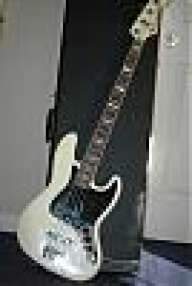
It seems too me that depending on the bass and bridge your using would make a difference
on weather you string thru the body or not, "how much angle is on the strings".
I have a set of JO's strung thru my J-bass body, and of course shows a small bit
of seperatation on the wraps at the saddle, but have had no problems with tone
variation or breakage.
on weather you string thru the body or not, "how much angle is on the strings".
I have a set of JO's strung thru my J-bass body, and of course shows a small bit
of seperatation on the wraps at the saddle, but have had no problems with tone
variation or breakage.

TI Flats through the body of my Lakland 5s with no problem. However, whenI use Lakland JO Flats, I heed their advice to go through the bridge. Hear no difference in sustain either way.


