

Enjoy the benefits of a premium membership!
Upgrade Account
-
TalkBass has been independent since 1998. Add your voice.
Create a free account to reply to discussions, view embedded media, and browse with fewer display ads.
Join free Log in
Want zero display ads or expanded classifieds tools? Compare plans.
You are using an out of date browser. It may not display this or other websites correctly.
You should upgrade or use an alternative browser.
You should upgrade or use an alternative browser.
Strings going to "wrong" tuning pegs.
- Thread starter cbyrd2200
- Start date
More options
Who Replied?
Wow, did I really just see that?
Yes.
Work in a guitar repair shop for a few months. You'll see worse.

Only slightly ahead of the ones that don't cut the string ends off and let them flop around just waiting to take an eyeball out.

If any of those strings are touching each other (even though they've got felt on them).....the fact that if they are touching could create some unpleasant ghost effects or "shorting" phantom effects when a string is played.
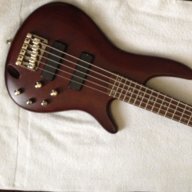
If any of those strings are touching each other (even though they've got felt on them).....the fact that if they are touching could create some unpleasant ghost effects or "shorting" phantom effects when a string is played.
Bull ****!
Hold a screwdriver against the strings past the nut and tell me what happens. Im doing it right now and I'll tell you: nothing.
If you need more proof, put your D in the G slot of your nut and put your G in the D slot of your nut. Then fret somewhere above where the strings cross each other. This simulates strings crossing behind the nut. Not a damn difference!
Remember, once your string is drawn across the nut, nothing past the nut affects the sound. Have you ever broken the string on a Floyd Rose equipped guitar behind the nut and the guitar still held the broken string in tune because of the locking nut? This is common.
By your logic, the string would be muted every time I fretted it with my one of my fingers.

Regardless of how this affects tuning or sound, there is no good that can come from placing a side load on the nut slot. If a bass is strung properly, with the string coming off the top of the bushing, there is absolutely no reason to reroute strings or to add additional string trees. And, it's not any more difficult to string a bass properly, than to do it improperly. I don't understand why guys will wrap one or two turns around the post, and go to such great lengths to compensate for it. Makes no sense to me.
Regardless of how this affects tuning or sound, there is no good that can come from placing a side load on the nut slot. If a bass is strung properly, with the string coming off the top of the bushing, there is absolutely no reason to reroute strings or to add additional string trees.
I've seen nuts fail just from having the E string wrapped the wrong way around the tuner. I can't imagine what's going to happen to that one.
There's no reason to add a string tree to a well designed bass. Some basses aren't very well designed.
Regardless of how this affects tuning or sound, there is no good that can come from placing a side load on the nut slot. .
How about, Warwick, Spector, Rick, Gibson and many others that have side loads on the nut ? These manufacturers actually build them that way. Not as extreme as the O.P. but still stupid side loads.

Checkout some Jackson or Charvell point-headed basses.


- Oct 30, 2007
- 802
- 11
- 39
- Disclosures
- Endorsing Artist: Fender Musical Instruments, SIT strings
Remember, once your string is drawn across the nut, nothing past the nut affects the sound. Have you ever broken the string on a Floyd Rose equipped guitar behind the nut and the guitar still held the broken string in tune because of the locking nut? This is common.
do i buy this? if you have a guitar plugged into an amp, and strum the strings above the nut, are you saying that you can't hear that through the amp? theres clearly a vibration in the strings that resonates on both sides of the nut.
Non-tapered 2x2's generally have a thicker nut, and the angle is usually not all that sharp. It's strictly for looks. There's no actual benefit to it. Design-wise, headstocks like Ibanez make a lot more sense. But, would a Les Paul or a Ric look as cool with a tapered headstock? Not a chance.
do i buy this? if you have a guitar plugged into an amp, and strum the strings above the nut, are you saying that you can't hear that through the amp? theres clearly a vibration in the strings that resonates on both sides of the nut.
You can hear that through the amp. There is vibration on both sides of the nut. I agree with you. But this has nothing to do with altering your strings past the nut and its influence on said strings' sound. You can touch anything you want to the strings after the nut: IT WILL NOT, NEVER HAS AND NEVER WILL change your sound on the part of the guitar you actually play.
You will notice Conor, that if you put your fingers down on the strings past the nut after you strum them, they will stop ringing. However if you strum your open strings over the neck and then mute the strings behind the nut with your finger, the strings are still resonating over the neck. Now take your finger back off. Do you here the ringing of the strings past the nut over the resonating of the strings over the neck? You'd be lying if you said yes.


[Invalid or Expired Link Removed]
I really do hate to call it wrong (because its different! not wrong) but I just needed to get the idea across.
Why do players do this? Quite frankly, I didn't notice any difference in the playability of an instrument strung in such a fashion. Maybe someone can explain something I missed?
WHAT IS THAT?? WHAT THE F#%$ IS THAT ???
Attachments

[Invalid or Expired Link Removed]
I really do hate to call it wrong (because its different! not wrong) but I just needed to get the idea across.
Why do players do this? Quite frankly, I didn't notice any difference in the playability of an instrument strung in such a fashion. Maybe someone can explain something I missed?
Hmmmmm..... no sir, I don't like it.

Just cut the A string long and wind it all the way to the bottom of the peg and this won't be necessary (assuming that's why it was done).

Just cut the A string long and wind it all the way to the bottom of the peg and this won't be necessary (assuming that's why it was done).
Agree to the first part, that's how I do it and I have never experienced A string rattle. As to why ... I wouldn't be surprised the guy did it because he thought it looked cool.

"I'd call it wrong because it greatly increases the odds of busting a nut, so to speak."
My exact, initial reaction.
And (as already mentioned) remembering what key tunes what string would be problematic.
My exact, initial reaction.
And (as already mentioned) remembering what key tunes what string would be problematic.


