• TalkBass has been independent since 1998. Add your voice.
    Create a free account to reply to discussions, view embedded media, and browse with fewer display ads.
    Join freeLog in
    Want zero display ads or expanded classifieds tools? Compare plans.

Double Bass Stripped Revolution 2

I did something terrible today:D
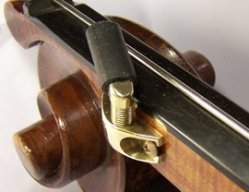
Got kind of tired of my Revolution Solo 2, because it never completely satisfied my taste. And then I thought it would be fun to check out the construction. The wood was sanded down to almost nothing anyway, because of the serious small gap under the wings of my bridge.
Beneath the wooden shell there is some rubber padding, and the piezo element was kind of covered with small sheets of duck-tape. I guess Upton has a good plan with the construction. But I am gonna try rebuild the pickup with some maple shims and make it a plain construction without the "duck-tape" and the rubber buffer. I guess it will become something between the RS and an Underwood.

 
I'd like to know too. What you found inside the RS2 was the mass-loading materials that are used to tailor its response.
 
those peices of duct tape may actually improve the sound. i have a few wing mounted pickups that sounded very harsh and brittle when shimmed with maple shims, but when i shimmed them in with folded up pieces of paper the sound mellowed nicely and lost some of the harsh edge.
 
those peices of duct tape may actually improve the sound. i have a few wing mounted pickups that sounded very harsh and brittle when shimmed with maple shims, but when i shimmed them in with folded up pieces of paper the sound mellowed nicely and lost some of the harsh edge.

Those pieces of tape are there for a reason. ;)
 
A few weeks since I did the reassembly. I understand the parts inside were there for a reason. But after the reassembly I must say that the sound result was an improvement. As I presumed the sound would be something between the RS and the Underwood. In fact it came out to be one of the better pickups I´ve tried. Unfortunately the reassembly and hotglue work was to rough for the shield mesh in the cable, so it broke lose from the pickup element. When I then took it apart, the piezo element edges broke loose. Im not sure if it works anymore.
But the prosess did convince me that converting from spruce to maple embedding the pickup is a better choice.
It would be nice if Upton made a maple option.
 
It would be nice if Upton made a maple option.

How 'bout willow, cedar, or ebony? Perhaps they could offer it in ten versions:

Spruce, ebony, willow, cedar, ebony all with or without the mass-loading materials. :D

Seriously, if the pickup sounds better to you on your bass without the internal materials that they took all the time to research and tweak, then enjoy! I doubt your experience and preference would persuade them to undo their design-work. At least I hope it wouldn't-- I'm really happy with mine. :)

With pickups, YMMV holds as much as ever.
 
When the first pickups were made, it was The Revolution Pickup System. It consisted of a bridge pickup in maple, a foot pickup in maple, and both going to a maple housing blender box that fit on the after length strings. You could then "dial in" your sound depending on what you liked. The units were time consuming and expensive...but we were shut down for patent infringement because of the location of the bridge foot pickup. That location is patented. So...we went back to the drawing board...and after about a year of tinkering with lots of different woods and dampeners...we liked how the bridge wing pickup sounded in spruce the best. It was the perfect balance, and allowed one element to reproduce a very transparent signal that did not color it.

This is why it is the Revolution SOLO. One pickup...not two...not a blender...not a system. The nice benefit we did not initially plan on was the pickups became easier to make, less parts and ultimately more affordable to the end user as well as relatively easy to install.

We then took the lesson we learned and patented everything we could about it.
 
I think that the RS is both a pretty nice pickup, and a very difficult pickup to use. It is nice, because it somehow sounds neutral and pretty much like an double bass directly into the board: in studio. But in live use you kind of need a little ekstra to the sound to cut through in the band. This is where the RS lacks that last vitamin injection to the sound. That is why I think it would be nice to have other wood options wheb you buy an RS.
If it´s not a patent problem, then having a maple, rosewood or perhaps a walnut option would be nice. Some guys have discovered walnut to be an excellent tonewood for endpin, endpin rod and tailpiece. The RS would of course be a little more expensive.
 
I think you have to keep in mind sample-size. As I mentioned before, with pickups, YMMV holds as much as ever. Any particular pickup, including the RS, can sound great on one bass and like dog**** on another even when judged by the same person. Think of all the variables. The specifics of the placement, different bridges, different instruments, different pre-amps, heads, speakers, and room interactions. I have no doubt that to Bassalova, on his bass and to his ear, maple sounds better. Designers of pickups, again including the RS, typically test their products across a broad range of instruments, setups, amps, etc. In one small set of circumstances, the RS may sound better in maple and may lack "vitamin injection" to cut through. That's usually a matter of compensating for the acoustics of a venue by proper tone-shaping. FWIW, I do that all the time. I listen to the response of a room and then tweak the parametric tone-shaping section of my EA iamp. It's easier than changing the material encasing the piezo. :)
 
Of course you dial in with the parametric. Easy to do with my Eden WT400. Then the source is the most important. I have tried RS on both my former bass and now my Grunert. I also have a female colleage that never got any decent sound from the RS. Maybe we have a strange taste for double bass sound in Norway...;)
 
I think that the RS is both a pretty nice pickup, and a very difficult pickup to use. It is nice, because it somehow sounds neutral and pretty much like an double bass directly into the board: in studio. But in live use you kind of need a little ekstra to the sound to cut through in the band. This is where the RS lacks that last vitamin injection to the sound.
FWIW, another case of YMMV.

I go without an amp or mic only as often as the situation allows. And sadly, that's not often enough.

But when I need to cut thru or have a little ekstra in a live setting, the Rev Solo works really well on my bass. I blend it w/ a mic thru my amp. That's the sound that appeals to me. I have experimented a fair amount w/ amps, speakers. pickups, mics, strings, etc.

Into a board though say for a live recording, it sounds ... brittle, edgy.

In a studio settiing ... I take it off the bass and leave it at home. Mic only.

I basically have always thought the RS was a "well tuned" piezo inside a wood casing, that worked really well on some but not all basses. I had no idea about the dampening material, whatever it is. And I've always thought the wood casing around the piezo just made sense for a "woodier" sound.

Interesting post for sure. Thanks for sharing Bassalova. I would love to visit Norway. :)
 
...but we were shut down for patent infringement because of the location of the bridge foot pickup. That location is patented. ...
Wow, you can patent a pickup location? Seems kind of unfair. I noticed that there are several other firms doing a Realist-style pickup but they're all in Europe. I suppose they aren't allowed to sell in USA? It's surprising then that Underwood wasn't able to protect the wing slot location.