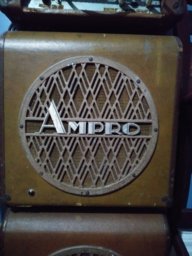
The bias procedure is simple and you do not need to open up the amp, so you will not be exposed to high voltage. If the tubes can be biased, it may return the amp's headroom to normal.
Here is the chart that shows the codes for the LEDs.
View attachment 4503451
The amp has six output tubes. They are organized into two circuits of three tubes. Each circuit has a bias control and a set of Green and Red indicator LEDs.
From the manual:
View attachment 4503464
Here is how the amp normally operates:
If the bias controls are turned all the way CCW, all of the bias indicator LEDs should go out. As you turn one of the bias controls CW, the associated Green LED should come on first. This happens when each of the three tubes in the circuit pulls approximately 15mA. This is an "AND" function: tube 1 AND tube 2 AND tube 3 must satisfy the minimum current target for the Green LED to come on.
As you continue to turn the bias control CW, eventually the associated Red LED should come on. This happens when one of the tubes in the circuit pulls approximately 30mA. This is an "OR" function: when tube 1 OR tube 2 OR tube 3 exceeds the max current range, the Red LED comes on.
At this point, both Red and Green should be lit. Back the bias off just a touch until the Red LED goes out and the bias is set for the first circuit.
Repeat for the second circuit.
If it's not possible to adjust for Green/Green with no Red, consult the chart above.
To answer your question, yes the operating characteristics of tubes change as they age. Over the life of a tube, the ability for the cathode to emit electrons eventually begins to decrease. This may result in the current decreasing. But in my experience, frequently tubes tend to start running hotter as they age. This can occur as the control grid becomes less effective at holding the electrons back, or if the tube has leak that contaminates the vacuum with impurities.
When one tube gets colder and another tube gets hotter it really degrade how well matched they are. So you might wind up with Red before Green...or worse Red and no Green (see the chart above).
You don't typically need to do a complete tube job. The normal lifetime of the small signal tubes is considerably longer than the output tubes. A full matched set of 6550 runs about $270.
Also, if only one of the output tubes goes bad, it may be possible for a tech to install another tube with characteristics similar to the remaining good tubes. It may even be possible to sort the output tubes into a different order that provides a better current match. It's helpful if the tech has a tube tester.
If the amp continues to distort when the bias is adjusted to Green/Green, there are a few things you can check. The problem could be in the preamp or the power amp. The amp has Preamp Out and Power Amp In jacks on the back. The jacks are basically at the junction between the preamp and power amp. The first thing to try is to plug a short 1/4" to 1/4" jumper between these jacks. The Power Amp in jack is switching and sometime the contacts can get dirty or corroded. Inserting a jumper bypasses the switching.
If you have another amp with an Effects loop, the second thing you can do is try running the Preamp from the SVT into the other amp's effects return, and running the other amp's preamp out or effects send into the SVT's Power Amp In.
You can do this, but the signal level of your bass is unlikely to be hot enough to drive the power amp to full power. I believe 0.25V RMS is required for full power.
If you can figure out where the problem is, you can try rolling a new tube into the amp. The preamp uses two 12AX7s. The power amp uses one 12AX7 and two 12AU7s. You can replace any of the 12AX7s with a new 12AX7. I suggest rolling a good tube through each tube slot. In other words, you only need one spare 12AX7.
I suggest a bit more caution if you want to replace the 12AU7s, because they control the bias for the output tubes. Before pulling the 12AU7s, turn the bias controls CCW so the bias indicator LEDs go out. Then, after you install new 12AU7s, follow the bias procedure in the manual.
Why? A new 12AU7 may be stronger and pull more current than the old tubes. If this occurs, it will pull down the bias voltage, which increases the current passing through the output tubes. To prevent this, you set the bias really cold before messing with the 12AU7s.