Playing '4 in the bar' jazz style would you emphasize the 2 & 4 for give more of a swing feel to the tune? (1234)

Enjoy the benefits of a premium membership!
Upgrade Account
-
TalkBass has been independent since 1998. Add your voice.
Create a free account to reply to discussions, view embedded media, and browse with fewer display ads.
Join free Log in
Want zero display ads or expanded classifieds tools? Compare plans.
You are using an out of date browser. It may not display this or other websites correctly.
You should upgrade or use an alternative browser.
You should upgrade or use an alternative browser.
Double Bass 'Swing Feel'
- Thread starter gypsydjango
- Start date
More options
Who Replied?
Absolutely not. It's not the bassist's job.

Agreed, no. Futhermore, I have recently been encouraged by a new wise friend of mine to not even think in four (tap foot, etc), but always translate to two feel (one & three). This little subtle cognitive shift has had a HUGE impact on my time-feel (much more free, less rigid - less draaaaaagy, easier to catch the rhythmic map), and my drummer friend I play with ever week noticed the change immediately with delight and enthusiasm. My bass sensai once encouraged me to sometimes put a little downward right elbow movement on two and four, though, to encourage a subtle bounce without losing time... I've been thinking about this a lot recently-- might be worth exploring...
Last edited:

Yes when that's what the music calls for.
No when it's not.
No when it's not.


Sometimes yes. ...and sometimes you only play the backbeats.
Understand that there is a wide variety of swing feels; so you don't always play the same. Triplets can be relaxed, tight or loose. Also, the pocket between you and the drummer can vary: I.E. do you play with the drummer, slightly behind the drummer, or slightly ahead of the drummer. Navigating the pocket can be a challenge because you and the drummer have to agree on the amount of rhythmic tension or the tempo will vary.
If you really know your stuff, even the note choices and phrasing can vary depending on the style of swing you are playing.
Understand that there is a wide variety of swing feels; so you don't always play the same. Triplets can be relaxed, tight or loose. Also, the pocket between you and the drummer can vary: I.E. do you play with the drummer, slightly behind the drummer, or slightly ahead of the drummer. Navigating the pocket can be a challenge because you and the drummer have to agree on the amount of rhythmic tension or the tempo will vary.
If you really know your stuff, even the note choices and phrasing can vary depending on the style of swing you are playing.
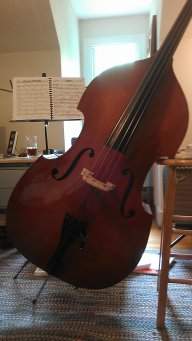
Playing '4 in the bar' jazz style would you emphasize the 2 & 4 for give more of a swing feel to the tune? (1234)
I generally treat each beat the same and do not in any way accent the 2 and 4. Sometimes i give a little more weight to the 1 when it suits the moment.
There are varieties of "swing." In its earliest and purest forms, the upbeat (AKA weak beats, backbeats, and 2 & 4) were not emphasized by the bass. It was only with the transition from tuba to the double bass did walking-bass lines become common, and it was unusual for the tuba to play at all on upbeats. When bassists began to play four notes to a measure, other instruments (drums, piano, guitar) owned any emphasized upbeats; if you listen to The Hot Club of Paris, or Count Basie, or Louis Jordan, you'll hear the guitarist and/or drummer NOT playing the upbeats any more emphatically than the downbeats.
Although it was common in big bands for the drummer to go to the snare on upbeats when "taking the song out," it was really the advent of rhythm and blues (and then rock and roll) which popularized the 2-and-4 snare through entire songs. We became so used to that sound that we began to think of SWING as being that way.
Of course there are exceptions to any rule, but the general rule in playing walking lines is to keep it even. Doing so provides smooth forward motion. Leave upbeat emphasis to other rhythm-section members.
-- Just my (informed) opinion.
Although it was common in big bands for the drummer to go to the snare on upbeats when "taking the song out," it was really the advent of rhythm and blues (and then rock and roll) which popularized the 2-and-4 snare through entire songs. We became so used to that sound that we began to think of SWING as being that way.
Of course there are exceptions to any rule, but the general rule in playing walking lines is to keep it even. Doing so provides smooth forward motion. Leave upbeat emphasis to other rhythm-section members.
-- Just my (informed) opinion.
Professor Curry knows the score. When you say "jazz style", the question is: before (roughly) 1950, or after 1950? For "modern" jazz, usually it's nice even quarter note walking. For "early" jazz, usually it's "boom-chick", root-five on the 1 and 3, possibly slap on the 2 and 4.

I've heard great bass players do it and I've heard other great bass players insist that one should never do it. I guess the correct answer is 'it depends' 


Yow! I learned a lot right here. Need to go to the basement and do some noodling. Thanks guys and I'll keep checking back for other tips
Agreed, no. Futhermore, I have recently been encouraged by a new wise friend of mine to not even think in four (tap foot, etc), but always translate to two feel (one & three)...
Instead of counting "one-two-three-four", are you using "one, one-two-three"? Did I get it right?
Perhaps @zootsaxes is suggesting "one-and-three-and" (ands on beats 2 and 4). I'd have trouble with saying "three" instead of "two." Personally, all I care about is the self-assurance to know where ONE is.
Professor Curry knows the score. When you say "jazz style", the question is: before (roughly) 1950, or after 1950? For "modern" jazz, usually it's nice even quarter note walking. For "early" jazz, usually it's "boom-chick", root-five on the 1 and 3, possibly slap on the 2 and 4.
I would put the year on or around 1937.
I agree, the modern style first appears in the late '30s, but it was not until the big bands collapsed and bebop turned into mainstream modern jazz that the old style faded into historical preservation. You could argue that both styles are subjects of historical preservation today, but that's another topic!I would put the year on or around 1937.
Instead of counting "one-two-three-four", are you using "one, one-two-three"? Did I get it right?
No I still talk in terms of "one two three four," and still play those beats —- but I'm not pounding all four beats with my foot. Just one and three now and it's made a huge difference, especially locking in with drummers who like to be rhythmically restricted as little as possible. I never really think "one two three four", (or 1 2 or 1 3) like an aebersold count in or anything, though, in all fairness it's more like "Uh uh uh uh" in my head. It's just easier to hear and be more open if I'm meeting the drummer on the "big beats"… this is something I am just now digesting myself, so I am certainly no authority - caveat reader…
Last edited:
Personally, all I care about is the self-assurance to know where ONE is.
yeah yeah - this is what I am trying to communicate.
The thing with that "swing" is that it describes a corelation of multiple parameters coming together. The feeling of highlighted 2&4 is one of them, always there, even if no instrument (with some drum exceptions, maybe) plays it, but is felt, drives everbody (much like the unconscious drives everybody; at least if you believe in psychoanalitics).


