• TalkBass has been independent since 1998. Add your voice.
    Create a free account to reply to discussions, view embedded media, and browse with fewer display ads.
    Join freeLog in
    Want zero display ads or expanded classifieds tools? Compare plans.

SX Ursa 6-string Jazz bass

JMimbs said:
If you could see how much better the finish looks in person, the GAS would only be exponentially worse. :hyper:

You got that right. I just picked up a red one too and my expectations were exceeded. The finish is amazing, I gots some mad figuring in the neck and the setup was pretty close to what I like.

Only things it needs are new strings and a real setup. How can these things cost only $160? Oops, I guess I need to stay quiet about that!!
 
Just got my CAR SX six string in the mail as an early birthday present, opened it up to inspect and test and it's a beauty and indeed the neck has a bit of flare on it and the finish is pretty well done, tuned up the strings and got nice action up and down the strings and across the board - no dead frets, no scratchy pots, tuners not too bad either and from what I could tell with stock strings and pickups the bass doesn't sound bad at all. I have long slinky slender hands and the neck width feels like it was made just my size, might have to pursue the six string bass world a bit more!!!

Alas, birthday not until NEXT Tuesday so after going over it I packed it back up and put it in the closet :(, but now on to upgrades, looking at changing out the pickboard for one of either of these material:

[Invalid or Expired Link Removed]

[Invalid or Expired Link Removed]

and add to that some DR Red Devils, some chrome with red dot knobs and top it of with a red strap, gonna call her big red :bassist:!!!
 
For you guys that will be setting the strings up on the on the six string. I learned a little trick that I would like to pass on to you guys to save you some trouble. On the B string and the E string, It is best to drop the saddle down low on the bridge, before you try to set the intonation, because the screw is not strong enough for the thick strings and it will bend. If the string is high it will cause one side to jump up. If you drop the string down, then the string goes back, without bending so much. When it is high it really flexes alot and causes one side to raise. I hope I explained that where you guys can understand me.:D It took me a while to figure it out. My guitar came with the B string jacked up on one side. Both screws on the saddle had to be dropped before I could get it to go back, so I could set the intonation. Hope this helps some one else.
 
as someone who was going to buy a 5 but then jumped the gun to the CAR 6 based on the few pics in this thread, I DEMAND more pics of the CAR 6er from current owners to hold me over. :bassist:

Here's a couple taken from my cell phone; its the best I've got. I tried to clean them up as best I could. They really don't do it justice though. The finish looks absolutely amazing.

Link Removed

Link Removed
 
For you guys that will be setting the strings up on the on the six string. I learned a little trick that I would like to pass on to you guys to save you some trouble. On the B string and the E string, It is best to drop the saddle down low on the bridge, before you try to set the intonation, because the screw is not strong enough for the thick strings and it will bend. If the string is high it will cause one side to jump up. If you drop the string down, then the string goes back, without bending so much. When it is high it really flexes alot and causes one side to raise. I hope I explained that where you guys can understand me.:D It took me a while to figure it out. My guitar came with the B string jacked up on one side. Both screws on the saddle had to be dropped before I could get it to go back, so I could set the intonation. Hope this helps some one else.

Thanks for the tip on that one. It took me half an hour (I know, I'm a slow) to figure that one out. However, do you have a problem with all of your saddles tilting to the side? After 3 hrs of trying to set the damn thing up, I can't seem to figure out why the saddles won't stay straight. The only time they can remain straight is when they are NOT aligned with the grooves on the bridge plate. I want to make sure I'm not doing something wrong before contacting Kurt. I assume setting up a 6'er should be like any old 4 string, but with 2 extra saddles and such.

This problem is making me rethink my purchase... :hmm:
 
This may not be the way others may do but it worked great for me. I read and tried to do it the cheapeast way I know how, but the correct way for my playing.

I play Jazz, rock, country, pretty much everything and I need a fast low fretboard. I get to solo from time to time, so I want it right.

What I did was take and get the neck straight as I could, without the strings on it of course. After getting it straight as I could, I put a square piece of aluminum that was straight on top of the frets to see which ones were high or low. After I was sure it was straight, I put transfer tape all the way over the top of the whole top of the neck. Transfer tape is what sign painters use to put vinyl letters on with. After covering the fretboard, I pushed the tape down close in between the frets and use a razor knift to cut a straight slit on top of each fret. I only had one low fret.

I took the 320 sandpaper and wraped it around the aluminum tubing 1 in. X 1 in. and about a foot long. I took it and used it like a file, flat all the way up and down the fretboard. It took it down until all the frets were the same hieght. I used the low one to go by. I then put 600 grit on the tube and and made it slick. After doing this, I put the 320 grit back on it and went to the five frets at the top and filed them down lower with the 320. I started at the top and filed the top one the most and graduated down to the fifth fret and filed it lesser the the first. I then put the 600 grit back on it and and made sure those five were slick and graduated perfectly to 6th and 7th fret.

I have a buddy who has a body shop and he gave me a straight piece of wood that they use to sand cars down with. I put 2000 grit paper on what I would call a paddle or mixing stick and went over all the frets. Taking any kind of burr that was on it off and pretty much crowned and polished the fret with the 2000 grit. I went along the sides of the frets also as they were covered as to protect the finish of my booteek neck. I took the tape off and used a polish on my frets and neck to clean it put, my strings back on it and then you would not believe how low the saddles would go without buzzing. The neck flies and I can play it just like a 4 string. It is there, I gigged with it to night and everything was perfect. That is just my way, others have other ways of doing this. Sandpaper is all it cost me. I saved $150.00 or so by doing it myself. It took less than an hour to do this. I did not take that much off. Just enough to even the frets up and take some off at the top 5 frets to allow me to go lower. It plays now as good as my Status Graphite bass but, a whole lot less money. I hope this helps others to figure out how to make your bass perfect for you playing.
 
This may not be the way others may do but it worked great for me. I read and tried to do it the cheapeast way I know how, but the correct way for my playing.

I play Jazz, rock, country, pretty much everything and I need a fast low fretboard. I get to solo from time to time, so I want it right.

What I did was take and get the neck straight as I could, without the strings on it of course. After getting it straight as I could, I put a square piece of aluminum that was straight on top of the frets to see which ones were high or low. After I was sure it was straight, I put transfer tape all the way over the top of the whole top of the neck. Transfer tape is what sign painters use to put vinyl letters on with. After covering the fretboard, I pushed the tape down close in between the frets and use a razor knift to cut a straight slit on top of each fret. I only had one low fret.

I took the 320 sandpaper and wraped it around the aluminum tubing 1 in. X 1 in. and about a foot long. I took it and used it like a file, flat all the way up and down the fretboard. It took it down until all the frets were the same hieght. ...

Thanks for sharing.

The method I use to determine which frets are high/low (I didn't invent it, just passing it on) is to mark the tops of the frets with a marker. Then I just do a couple of strokes with my sanding bar (I got one from an airplane hobby site, they use them to shape wings). The low frets will still have all of the marker showing. I continue to sand until I am touching all of the frets, then crown (I use a crowning tool from Stewmac).
 
PBnJBassist, I am no Luthier but I found that if you lower the saddle down, the screws tends to be straighter. Heavy strings probably put 500 lbs of pressure on the neck. The screws on the saddles are a little weak. They bend but it does not effect the sound or playing of the bass. I guess you could invest in some stronger screws or even yet more saddles but I am happy with mine. I thought about it and for $170.00 shipping included, this bass is a steal. Put a new bridge on if you are not happy. What are they, $20-30 bucks.

The thing I like is, the body, neck, finish, keys are pretty much perfect. You can change anything you want at anytime and still have nothing in this bass while gigging with it. Have you checked the price on a new six string of this quality?

When I did the fret job on mine, it lowered my strings and the screws became straighter. When your saddles are high, the pressure of the strings bend the screws. This causes them to go side ways. When you screw the saddles back to set the intonation, the screws have to bend as they go back, if they are high. But, when lowered they go straight back. Check my post and other post about leveling the frets, and setting the neck up.

I took a business card and cut it into thirds and folded it in half (2 paper thickness) and put it in my neck pocket to help level my neck and then I leveled the frets, lowered the saddles, and my guitar plays perfect. No money spent at all. I hope this helps you.

I found that all guitars have to be set up before playing them. I upgraded my Fender Jazz because I did not like the bridge on it. I put a badass2 bridge on it and bassline pickups on it. Now I have invested a lot of money in it. It still had to be set up. I have less than an third of the money I spent in my SX 6 string (not 4 string) and have a much better guality Guitar. The finish and neck is much better quality. I can change everthing else, as my pocket allows:cool: This is just my opinion.
 
PBnJBassist, I am no Luthier but I found that if you lower the saddle down, the screws tends to be straighter. Heavy strings probably put 500 lbs of pressure on the neck. The screws on the saddles are a little weak. They bend but it does not effect the sound or playing of the bass. I guess you could invest in some stronger screws or even yet more saddles but I am happy with mine. I thought about it and for $170.00 shipping included, this bass is a steal. Put a new bridge on if you are not happy. What are they, $20-30 bucks.

The thing I like is, the body, neck, finish, keys are pretty much perfect. You can change anything you want at anytime and still have nothing in this bass while gigging with it. Have you checked the price on a new six string of this quality?

When I did the fret job on mine, it lowered my strings and the screws became straighter. When your saddles are high, the pressure of the strings bend the screws. This causes them to go side ways. When you screw the saddles back to set the intonation, the screws have to bend as they go back, if they are high. But, when lowered they go straight back. Check my post and other post about leveling the frets, and setting the neck up.

I took a business card and cut it into thirds and folded it in half (2 paper thickness) and put it in my neck pocket to help level my neck and then I leveled the frets, lowered the saddles, and my guitar plays perfect. No money spent at all. I hope this helps you.

I found that all guitars have to be set up before playing them. I upgraded my Fender Jazz because I did not like the bridge on it. I put a badass2 bridge on it and bassline pickups on it. Now I have invested a lot of money in it. It still had to be set up. I have less than an third of the money I spent in my SX 6 string (not 4 string) and have a much better guality Guitar. The finish and neck is much better quality. I can change everthing else, as my pocket allows:cool: This is just my opinion.

That makes sense about saddle height and such. I setup my own basses since only I know how I like my setup, and I play with very high action. I lowered the saddles and they straightened out fine. It actually feels terribly awkward playing with low action; I haven't done so since I first started (approximately 3 years ago)! :D Everything else about the bass represents a "best bang for your buck" since, as you pointed out (though in question format), a competent 6-string is hard to come by @ $180, which is why I bought this one.

When I first got it, I took the thing apart to look at the insides. I'll admit, you do get what what you pay for. But for this bass, I'd say it's only weak spot is the electronics. The necks is fine and the body is all right with me. The finish on mine though is decent, but I didn't buy it for the color. :p
 
Just unboxed mine like an hour ago after a long day. While I was tuning it up I heard like a pop and creak sound so I loosened the strings and put it back in ths box. Never heard that sound on my 4 strings when new. Is this normal for a new 6 string cuz of the added string tension? or could it just be the string tree or like the bridge? Otherwise I think I'll exchange it in case it got shipping damage

 
eoplocust said:
Just unboxed mine like an hour ago after a long day. While I was tuning it up I heard like a pop and creak sound so I loosened the strings and put it back in ths box. Never heard that sound on my 4 strings when new. Is this normal for a new 6 string cuz of the added string tension? or could it just be the string tree or like the bridge? Otherwise I think I'll exchange it in case it got shipping damage

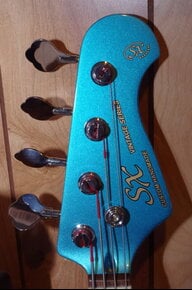
Could be the neck settling into the pocket, or one of the truss rods settling into the channel. AFAIK they don't tune those up to pitch at any point prior to shipping. Go ahead and finish tuning it up and give it a thorough testing. Kurt at Rondo is very cool about returns, if something is indeed wrong he'll take care of it.
 
I just looked at it again today. There's a small gap where the neck and body would meet. I don't know if it's due to shipping damage but i don't wana keep it, try and fix it, and see some kind of truss rod issue later so I will return it. Very nice bass tho. I also noticed 2 hairline cracks in the paint right behind the neck joint. Could just be the paint but the two together might mean it was slammed down hard in transit
 

Latest posts