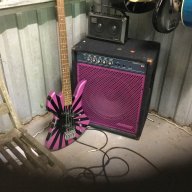
Recently we had some bad storms in Ireland, and I had half of a very old sycamore tree fall down the back. I’m slowly working my way through it near where it fell with an axe, but I’ve had the idea of using the wood for a bass. I’ve made one before that didn’t work out very well but taught me a lot. I was wondering If anyone had experience with drying and preparing it, and any tips specifically on sycamore? Thanks

Enjoy the benefits of a premium membership!
Upgrade Account
-
TalkBass has been independent since 1998. Add your voice.
Create a free account to reply to discussions, view embedded media, and browse with fewer display ads.
Join free Log in
Want zero display ads or expanded classifieds tools? Compare plans.
You are using an out of date browser. It may not display this or other websites correctly.
You should upgrade or use an alternative browser.
You should upgrade or use an alternative browser.
Sycamore.
- Thread starter FergusMc
- Start date
More options
Who Replied?


I think it's related to maple, should be good. Looked up on Wikipedia - could be a bunch of different species, some maple, some not. From the leaves, guessing it's the kind that's not maple. No clue sorry.
I don’t have a clue myself. The leaves there won’t show anything because they’re just from ivy growing on the tree. I’m thinking of getting a plank out of it and speed drying it to put in a few cracks. I like the idea of having the natural cracks in it, and I’m also not patient enough to wait for it to dry. I’m thinking of trying to dry it over an open fire, but it’ll all be an experiment, because I can’t find anything about drying it fast.

Not hard to have it crack while drying - not doing that is the hard part.
If the sun shines, putting it in a clear plastic tent (or for one board, I suppose an automobile) in the sun is the least-expensive at-home method, typically. With a stack of lumber fans are typically employed as well, but that's also from us folks who are trying not to crack too much...
Drying it over a fire has potential for a number of potentially undesirable results, but if you want to, it's your firewood...
If the sun shines, putting it in a clear plastic tent (or for one board, I suppose an automobile) in the sun is the least-expensive at-home method, typically. With a stack of lumber fans are typically employed as well, but that's also from us folks who are trying not to crack too much...
Drying it over a fire has potential for a number of potentially undesirable results, but if you want to, it's your firewood...

It's got a Janka hardness almost twice that of Basswood, So would think it could work for a body
It's overall characteristics are similar, but slightly below that of Honduarn Mahogany, so for use in a neck id study a bit more
It's overall characteristics are similar, but slightly below that of Honduarn Mahogany, so for use in a neck id study a bit more
The last neck I made turned out so bad I’d say I’ll buy an old neck for this one... body was my plan.It's got a Janka hardness almost twice that of Basswood, So would think it could work for a body
It's overall characteristics are similar, but slightly below that of Honduarn Mahogany, so for use in a neck id study a bit more

Not hard to have it crack while drying - not doing that is the hard part.
If the sun shines, putting it in a clear plastic tent (or for one board, I suppose an automobile) in the sun is the least-expensive at-home method, typically. With a stack of lumber fans are typically employed as well, but that's also from us folks who are trying not to crack too much...
Drying it over a fire has potential for a number of potentially undesirable results, but if you want to, it's your firewood...
I’m not sure if you fully read the original post. I live in Ireland... we get two days a year that would be hot enough to dry wood at most... I’ve got a full tree. Worth experimenting.
Well, I never know how much of that is smokescreen to keep down the tourists and how much is reality. I've seen pictures of sunshine in Seattle on here, so I take terrible weather reputations with a grain of salt.I’m not sure if you fully read the original post. I live in Ireland... we get two days a year that would be hot enough to dry wood at most... I’ve got a full tree. Worth experimenting.
Honestly, if you actually want to use that Sycamore in an instrument, you really need to properly dry it. I would suggest cutting it into one and a half inch thick boards or two inch boards, ensure the ends are painted or sealed and stack them with stickers for at least a year per inch of thickness. If you're not familiar, stickers refers to small strips of wood between the boards so that air can reach all sides of the board. Almost anything you do to "speed up" the drying will result in cupping, cracking, splitting, and twisting in the wood.
This process will allow you to have good usable Lumber in the end. If you're set on building something sooner than that, I'd recommend just buying a body blank or using some local lumber that is already dry and ready to go. I did something similar to what you're planning many years ago, and regretted it as the entire body cupped as it dried.
This process will allow you to have good usable Lumber in the end. If you're set on building something sooner than that, I'd recommend just buying a body blank or using some local lumber that is already dry and ready to go. I did something similar to what you're planning many years ago, and regretted it as the entire body cupped as it dried.

Manton Customs
UK Luthier
Sycamore is reasonably common in luthiery, especially violins (the common fiddleback wood). You may confuse the people on here, as Sycamore is a completely different tree in the USA! The species you're talking about will be Acer Pseudoplatanus, which I believe basically means fake plane as it looks a lot like a plane tree (which the American Sycamore is). Being a Acer it is a true Maple though and often called English or European Maple, which I've learnt to call it to save confusion! I've built (laminate) necks and bodies from it, it's not as hard or stiff as Hard Maple, but still useable. It can be extremely beautiful with flame figure etc.
I can't help much on the drying of it, but I believe it can stain easily from stickers.
I can't help much on the drying of it, but I believe it can stain easily from stickers.

It's got a Janka hardness almost twice that of Basswood, So would think it could work for a body
It's overall characteristics are similar, but slightly below that of Honduarn Mahogany, so for use in a neck id study a bit more
I was thinking about hardness, too. My house, built in 1900, still has its original sycamore frame. You cannot pound a nail into it.
Cut and stacked right, kept in a barn with good ventilation, it should be perfectly seasoned in about six years. (Even in Éire!)
Three years if yer lucky!
Three years if yer lucky!
The problem there is to have it cut and stacked right. I’m trying to cut through this trunk with an axe I bought for about €20 when the tree fell. I definitely don’t have the equipment to cut it “right” I can always buy a body blank or some nice seasoned wood if I’m planning to make something that definitely works, but I like the idea of experimenting with this. I have a few things I’m planning to try on various bits of it to attempt to dry it fast. If it doesn’t work then it doesn’t work. But it’ll be fun to try.Cut and stacked right, kept in a barn with good ventilation, it should be perfectly seasoned in about six years. (Even in Éire!)
Three years if yer lucky!
Ah, but if you sneak it in the malt kiln over the peat fire - roasted, toasted, sycamore... and poteen!
For dismembering a tree trunk without the right tools, there getting the right tools, and there's doing it the very old fashioned way, with wedges and gluts (more tools, but you can make the gluts from wood - a wedge being a steel wedge, and a glut being a wooden wedge.) That would also be referred to as "riven" or "rived" lumber. If you want to get fancy and know a blacksmith, turn an old leaf spring into a froe.
You start a split with the wedge, then open it up further with the gluts util it falls apart. You basically need to split more-or-less in half each time, or the split will run out (leave the grain lines and peel off) to the smaller side.
Let me see if I can find a good diagram. Sorry, not going to happen today and I'll be busy over the weekend.
For dismembering a tree trunk without the right tools, there getting the right tools, and there's doing it the very old fashioned way, with wedges and gluts (more tools, but you can make the gluts from wood - a wedge being a steel wedge, and a glut being a wooden wedge.) That would also be referred to as "riven" or "rived" lumber. If you want to get fancy and know a blacksmith, turn an old leaf spring into a froe.
You start a split with the wedge, then open it up further with the gluts util it falls apart. You basically need to split more-or-less in half each time, or the split will run out (leave the grain lines and peel off) to the smaller side.
Let me see if I can find a good diagram. Sorry, not going to happen today and I'll be busy over the weekend.
Last edited:

I don't think you're going to want to try to get boards out of that tree with your axe. You probably want to cut out a nice section or two and take it to someone who has a wood planer, and let them rip it for you.
For drying, I'd see if I could find a local potter and ask if you can throw a piece in their kiln someday when they're not using it. Just one piece as an experiment. If that seems to work, you can do a bunch at once. And look up the right temperatures and times for it, there's probably info online. Heck there are probably lutherie forums where they could answer all these questions much better than we're going to be able to.
For drying, I'd see if I could find a local potter and ask if you can throw a piece in their kiln someday when they're not using it. Just one piece as an experiment. If that seems to work, you can do a bunch at once. And look up the right temperatures and times for it, there's probably info online. Heck there are probably lutherie forums where they could answer all these questions much better than we're going to be able to.

madbass6
Inactive
- Jan 13, 2009
- 2,428
- 1,295
- Disclosures
- I do not give consent to use any of my photos ! please respect that. thank you.
Hey if you can pull it off why not,Recently we had some bad storms in Ireland, and I had half of a very old sycamore tree fall down the back. I’m slowly working my way through it near where it fell with an axe, but I’ve had the idea of using the wood for a bass. I’ve made one before that didn’t work out very well but taught me a lot. I was wondering If anyone had experience with drying and preparing it, and any tips specifically on sycamore? Thanks
Go for it! Please keep us posted!
There were really two questions.
First, would the wood be acceptable for using in a build. From my experience I'd say yes for a body. In a neck I'd not be afraid to use it as one of the woods in a laminated neck.
Second, how to dry it quickly. That's much harder. You'll have cut it into flat stock regardless. I'd try for 8/4 thickness (2 inches). When you rip it, be sure to eliminate all the pith and seal all the end grain. Properly stacked out of the weather it should be usable in about three years.
Getting access to a drying kiln to accelerate drying is the safest option. One alternating some folks I know have tried (I have not) with some success is freezing. Put your blank in a freezer for 24 hours. Take it out and let it thaw while keeping all the moisture wiped away. Repeat this cycle four or five time and check it with a moisture meter. Keep it up until the moisture is down to an acceptable level.
Like I said, I've not tried freezing, but I know some guys who have been successful on smaller blanks.
Good luck
First, would the wood be acceptable for using in a build. From my experience I'd say yes for a body. In a neck I'd not be afraid to use it as one of the woods in a laminated neck.
Second, how to dry it quickly. That's much harder. You'll have cut it into flat stock regardless. I'd try for 8/4 thickness (2 inches). When you rip it, be sure to eliminate all the pith and seal all the end grain. Properly stacked out of the weather it should be usable in about three years.
Getting access to a drying kiln to accelerate drying is the safest option. One alternating some folks I know have tried (I have not) with some success is freezing. Put your blank in a freezer for 24 hours. Take it out and let it thaw while keeping all the moisture wiped away. Repeat this cycle four or five time and check it with a moisture meter. Keep it up until the moisture is down to an acceptable level.
Like I said, I've not tried freezing, but I know some guys who have been successful on smaller blanks.
Good luck
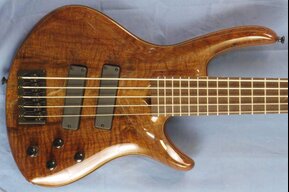
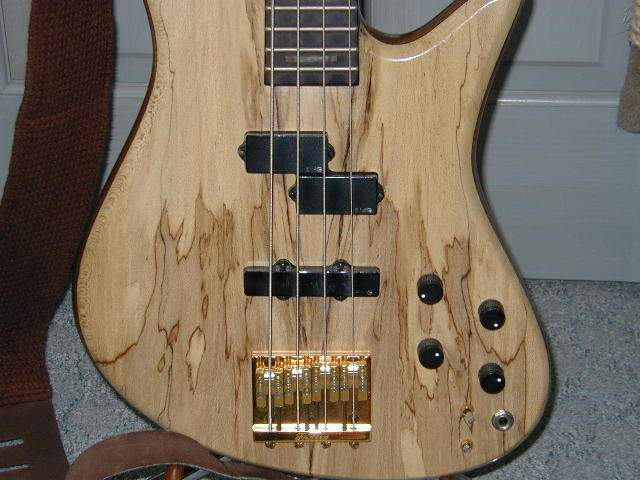
It's beautiful wood. Not sure what it compares to sound wise but it is gorgeous. Whiter and I believe softer than maple. My Fodera has spalted sycamore top. Picture below.

This. You’re not going to be able to use it anytime soon. Even as firewood you’d have to dry it for at least a year. Mill, sticker and stack. To be on the safe side I’d count on sitting on it for 2 or even 3 years. Wood has to be absolutely stable before using it for luthiery.Honestly, if you actually want to use that Sycamore in an instrument, you really need to properly dry it. I would suggest cutting it into one and a half inch thick boards or two inch boards, ensure the ends are painted or sealed and stack them with stickers for at least a year per inch of thickness. If you're not familiar, stickers refers to small strips of wood between the boards so that air can reach all sides of the board. Almost anything you do to "speed up" the drying will result in cupping, cracking, splitting, and twisting in the wood.
This process will allow you to have good usable Lumber in the end. If you're set on building something sooner than that, I'd recommend just buying a body blank or using some local lumber that is already dry and ready to go. I did something similar to what you're planning many years ago, and regretted it as the entire body cupped as it dried.
Many European violin family luthiers won’t use wood that hasn’t been seasoned for at least 50 years.


