• TalkBass has been independent since 1998. Add your voice.
    Create a free account to reply to discussions, view embedded media, and browse with fewer display ads.
    Join freeLog in
    Want zero display ads or expanded classifieds tools? Compare plans.

taper core strings

Taper core strings have one or two less layers of wrap at the 'ball end' of the string that goes over the bridge saddles.

You primarily see this design on B strings, since those strings are so 'fat'. The logic is that a taper core string will help with intonating a large diameter string. Most set-up guys that I've talked to believe that is a bit of a myth, and that 'standard' thick strings will actually intonate a bit better. I don't think that design really makes a bit of difference one way or the other.

The most extreme version of this design is 'exposed core' that just has the thin wire core touching the bridge saddles.

I would not make a string choice based on how much wire sits on the bridge saddle myself.
 
When I briefly used LaBella supersteps back in the '90's, I found that there were too many intonation compromises. On my modulus 5, the intonation can be brought to very close tolerances with D'Addario 170's, but the exposed cores of the LaBellas made it very difficult to intonate. I tried first using the octave as reference for each string, but the octaves and 5ths across the strings would only be good in certain registers. I'm guessing that happened because the mass is not consistent from end to end.

The sound was nice, punchy and articulate- especially on the low B.
 
Taper core strings have one or two less layers of wrap at the 'ball end' of the string that goes over the bridge saddles.

You primarily see this design on B strings, since those strings are so 'fat'. The logic is that a taper core string will help with intonating a large diameter string. Most set-up guys that I've talked to believe that is a bit of a myth, and that 'standard' thick strings will actually intonate a bit better. I don't think that design really makes a bit of difference one way or the other.

The most extreme version of this design is 'exposed core' that just has the thin wire core touching the bridge saddles.

I would not make a string choice based on how much wire sits on the bridge saddle myself.

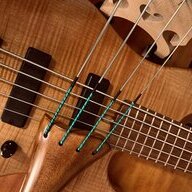
I have GHS Progressives with the 'exposed core' on the B and E-strings (see pic below). Personally, I find them to sound rather hollow the higher I go on the fingerboard, and I also find them a bit more difficult to intonate. I don't care for them. I think the Skjolds I bought last night will work much better for me.

Link Removed