• TalkBass has been independent since 1998. Add your voice.
    Create a free account to reply to discussions, view embedded media, and browse with fewer display ads.
    Join freeLog in
    Want zero display ads or expanded classifieds tools? Compare plans.

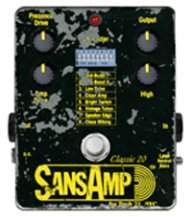
Tech 21 VT Bass DI + Compression

Character at slightly past noon is not dead clean as that starts to boost the signal.

The clean tones on the VT Bass are with the Character below noon.

On the VT Bass pedal with the speaker sim engaged (character at noon and drive around minimum) flat response will be:

Low 1:30
Mid 1:30
High 9:30-10

Is this setting how to get the cleanest and flattest response?

ie
Drive: min
Character: 12:00
Low 1:30
Mid 1:30
High 9:30-10
 
The DI pedal is slightly different. Flat would be with the speaker sim and Bite turned off. The EQ and Character controls at noon. You're best bet would just be to experiment. I would probably just turn off the Bite and keep the speaker sim engaged. When you start adding Drive, flat becomes a moot point as distortion creates upper harmonic content. You can go through the SansAmp circuitry and get a clean tone. The Drive doesn't have to be set to minimum for a clean tone. Drive also acts as an overall input level when the SansAmp circuit is engaged.
 
  • Like
Reactions: AlexanderB
I am? What am I getting tripped up on, exactly? I knew that. I also sort of figured by the info in the manual and the discussions on here that the Character does hint at distorting slightly past noon. Still sounds clean to me, though.


Could have sworn I just said the same thing to you using different words ;)


Except if I make a slight change on my amp it changes pretty drastically in the PA, especially where the volume knob's concerned. Anyway, the tone settings are unimportant. I already told you the REDDI sounds to me like a B-15 or SVT set for clean near-flat response. Those settings are different on each amp, and just like I can change the sounds on my Ampeg tube amps with the tone knobs, I can plug the REDDI into a board or EQ and do the same thing.

So you've thoroughly confused me now. I have no idea what point you're trying to make here. All I said is that I hear compression in the VT running clean that I don't hear in the tube amps and DI I use that are running clean. Are you saying that the little bit of compression I hear is a result of my setting the Character slightly past noon and that I wouldn't hear it if it wasn't? OK, fair enough. I'd be willing to test that theory out tonight or tomorrow when I get some time.
Resurrecting this one. Dust the dirt off....hah. Just recently acquired a VT DI and without a doubt i hear compression happening. So much so that i don't feel the need to use my TC Electronic Spectracomp pedal any longer. It's there...i feel it in my fingers and in my ears. I was only running the Spectracomp at between 9 or 10 o'clock. So not very high. So reading what the representative from Tech21 has said is baffling to all my sensibilities.
 
  • Like
Reactions: Jeff O'Connor
Resurrecting this one. Dust the dirt off....hah. Just recently acquired a VT DI and without a doubt i hear compression happening. So much so that i don't feel the need to use my TC Electronic Spectracomp pedal any longer. It's there...i feel it in my fingers and in my ears. I was only running the Spectracomp at between 9 or 10 o'clock. So not very high. So reading what the representative from Tech21 has said is baffling to all my sensibilities.
And to add to that i do not run the VT DI overly hot. All of these in o'clocks volume11, Blend 1-2. Mid 10-12. Character 10-1. Drive 10-11. Bass 12-1 Treble 11ish. Speaker Sim engaged. Bite Off. I am not using this as a direct pedal but directly into my amp. I also am noticing a slight character change when i engage or disengage the -20db XLR switch. Probably shouldn't have anything to do with anything since i am not even using it, but it does. It's subtle but i feel it for certain.
 
And to add to that i do not run the VT DI overly hot. All of these in o'clocks volume11, Blend 1-2. Mid 10-12. Character 10-1. Drive 10-11. Bass 12-1 Treble 11ish. Speaker Sim engaged. Bite Off. I am not using this as a direct pedal but directly into my amp. I also am noticing a slight character change when i engage or disengage the -20db XLR switch. Probably shouldn't have anything to do with anything since i am not even using it, but it does. It's subtle but i feel it for certain.
And one last thing i forgot to mention is.....i absolutely frickin love this thing! :)
 
Resurrecting this one. Dust the dirt off....hah. Just recently acquired a VT DI and without a doubt i hear compression happening. So much so that i don't feel the need to use my TC Electronic Spectracomp pedal any longer. It's there...i feel it in my fingers and in my ears. I was only running the Spectracomp at between 9 or 10 o'clock. So not very high. So reading what the representative from Tech21 has said is baffling to all my sensibilities.

How so?

I also am noticing a slight character change when i engage or disengage the -20db XLR switch.

A perceived change most likely due to the Fletcher Munson effect. We measure these on a scope and I can attest that the waveform is the same with the PAD engaged or disengaged.

And one last thing i forgot to mention is.....i absolutely frickin love this thing! :)

We're glad you like the pedal.
 
There is no compression circuit in the unit. Compression is a byproduct of the tube emulation depending upon the setting. It's the same with a tube amp. How is the pedal set when you hear compression?
 
  • Like
Reactions: Zbysek and Kro
The amp emulation behaves like a tube circuit. If you don't want as much tube emulation turn the Blend down or reduce the Drive. With the Blend off it's just a DI with EQ. An SVT would behave in a similar manner. The difference is that in a powerful tube amp, the amount of Drive and saturation is dependent upon volume and that forces you to play a bit differently when you're moving that much air.
 
  • Like
Reactions: AlexanderB and Kro
The amp emulation behaves like a tube circuit.

Just so that there's no mistaking it, when I talk about the compression that my VTDI imparts, I'm in no way saying it's a bad thing - quite the opposite. Being able to dial up/down such a convincing and natural sounding compression feel is an awesome feat as far as I'm concerned, and is actually one of the selling points of these little SansAmp wonders.

They key is finding just the right amount that works for you and your mixes, something I'm personally still actively fine-tuning.
 
The amp emulation behaves like a tube circuit. If you don't want as much tube emulation turn the Blend down or reduce the Drive. With the Blend off it's just a DI with EQ. An SVT would behave in a similar manner. The difference is that in a powerful tube amp, the amount of Drive and saturation is dependent upon volume and that forces you to play a bit differently when you're moving that much air.
Is there a graphical or otherwise explaination as to what the blend knob does., other than the very general description that it "adds more modeling"?
 
Is there a graphical or otherwise explaination as to what the blend knob does., other than the very general description that it "adds more modeling"?

Keep in mind that blend is pre-EQ (low, mid, high), but aside from that it blends the unaffected signal with that of the affected SansAmp signal (character, drive, sim, bite, all that other fun stuff). So yeah, any compression or other modeling aspect that is added by the SansAmp circuit could be toned down as the blend is reduced towards the unaffected signal.

It also can interact with those other filters and give some really weird frequency valleys... so use your ears and caution when blending. See the next post after that one I linked above for a visual example of what a blend sweep does to a frequency sweep. It doesn't tell you anything about how any of the other emulation aspects are blended in, but it might prove to be an interesting reference.
 
  • Like
Reactions: woodyng2
Keep in mind that blend is pre-EQ (low, mid, high), but aside from that it blends the unaffected signal with that of the affected SansAmp signal (character, drive, sim, bite, all that other fun stuff). So yeah, any compression or other modeling aspect that is added by the SansAmp circuit could be toned down as the blend is reduced towards the unaffected signal.

It also can interact with those other filters and give some really weird frequency valleys... so use your ears and caution when blending. See the next post after that one I linked above for a visual example of what a blend sweep does to a frequency sweep. It doesn't tell you anything about how any of the other emulation aspects are blended in, but it might prove to be an interesting reference.
Thanks!
 
I recently bought a Vt Di after owning one of the original series vt pedal for years.
I’m really enjoying the extra versatility of the DI,as i have it running 2 separate Markbass amps.
Looking through the user manual,i decided to try my initial settings at the one labelled,
......wait for it....”warm compression”. :cool: I really love that setting for my GL Precision style bass with flatwounds. I otherwise NEVER use compression in my signal chain. I’ve owned a bunch of Tech21 products over the years,including the remarkable Landmark 300 and Vt 500 heads.

 
There is no "modeling" in the VT Bass or any of our SansAmp products. We use actual analog circuits. On our DI's with Blend, your signal pans from the unaltered sound of your Bass to the SansAmp emulation. The "Blend" function on our DI's is based on a commonly used studio technique for recording bass guitar with an amp. They mic the amp and also DI the bass directly and mix or "blend" the signals for a composite sound. The amp gives you the character while the DI signal adds definition.
 
There is no "modeling" in the VT Bass or any of our SansAmp products.

Analog modeling is still modeling isn't it? Many of the Tech 21 products emulate elements of full, mic'd up rigs.

I know that there is a distinction to be made between simulation and emulation, and Tech 21 seems to fall on the emulation side, but unless I'm misunderstanding it does all seem like modeling to me.
 
There is no "modeling" in the VT Bass or any of our SansAmp products. We use actual analog circuits. On our DI's with Blend, your signal pans from the unaltered sound of your Bass to the SansAmp emulation. The "Blend" function on our DI's is based on a commonly used studio technique for recording bass guitar with an amp. They mic the amp and also DI the bass directly and mix or "blend" the signals for a composite sound. The amp gives you the character while the DI signal adds definition.
And thank God you make the blending optional. Never saw a blend knob on a tube amp :D
 
Analog modeling is still modeling isn't it? Many of the Tech 21 products emulate elements of full, mic'd up rigs.

I know that there is a distinction to be made between simulation and emulation, and Tech 21 seems to fall on the emulation side, but unless I'm misunderstanding it does all seem like modeling to me.
"Modeling" is reserved for digital. One could make the argument that it's all modeling, but the industry has decided to use "modeling" for digital and "emulation" for analog.
 
  • Like
Reactions: woodyng2 and Zbysek