
Enjoy the benefits of a premium membership!
Upgrade Account
-
TalkBass has been independent since 1998. Add your voice.
Create a free account to reply to discussions, view embedded media, and browse with fewer display ads.
Join free Log in
Want zero display ads or expanded classifieds tools? Compare plans.
You are using an out of date browser. It may not display this or other websites correctly.
You should upgrade or use an alternative browser.
You should upgrade or use an alternative browser.
Testing Compressors: Cali, Smoothie, Empress, Diamond, Keeley, FEA, Darkglass, Doc Lloyd, Lusithand & more
- Thread starter scubaduba
- Start date
More options
Who Replied?

Scubaduba sir, The work you've contributed here is much appreciated. Not sure if its on your list but I'd really like to find out more on the new Smoothie Tough+Suave version. Your reviews of the Suave version had me going back and forth between the Suave and Tough but now with the Tough+Suave version I'm almost sold. Being able to combine the 2 via the DIP switches seems flexible enough to cover most of the ground I'd need in a compressor
Thanks a lot. Glad to hear the reviews have been helpful.

@scubaduba, Do you currently have a favorite when it comes to active basses?
Thanks,
Funkhead
I'm trying to stay away from asserting personal bias and keeping the thread and reviews transparent.
Truth is there are a lot of great compressors these days. For active basses it is helpful to have lots of headroom and compressors with input gain controls or those that operate at higher voltage can be helpful.
A few that come to mind are:
• Cali76CB
• Keeley Bassist
• Smoothie
• FEA compressors
• G-Lab
• The Taurus Tux (review forthcoming)
• Doc Lloyd Photon
• Empress
All of those played just fine with my G&L L2500 (known for hot output).
Last edited:
Thanks, I am using the Doc Lloyd Photon an I like it so far with my active bass. I was really loving it with my passive Rics.I'm trying to stay away from asserting personal bias and keeping the thread and reviews transparent.
Truth is there are a lot of great compressors these days. For active basses it is helpful to have lots of headroom and compressors with input gain controls or those that operate at higher voltage can be helpful.
A few that come to mind are:
• Cali76CB
• Keeley Bassist
• Smoothie
• FEA compressors
• G-Lab
• The Taurus Tux (review forthcoming)
• Doc Lloyd Photon
• Empress
All of those played just fine with my G&L L2500 (known for hot output).
G&L L-2500’s are sweet machines.

@scubaduba, Do you currently have a favorite when it comes to active basses?
Thanks,
Funkhead
Not the Diamond. But you probably knew that already.
Thanks, as long as Photon death Ray made the list, I am happy. I am still getting used to 18 volts too but the Doc Lloyd is making me smile.Not the Diamond. But you probably knew that already.
Wow! That’s a smart looking pedal (a bit of alright as the Britts would say). I suppose the only bummer is that it will probably be over $300.
$229
Darkglass Hyper Luminal Bass Compressor Pedal

I believe DOD beat you to that with “The Milk Box”.....pause for laughterI believe that many of the “we have a famous rack in a stomp-box” compressors are due to the very similar attack and release dynamics. The MXR goes from fast to really, really fast attack times, like the 1176. I believe that is where the similarities end tho, because the 1176 uses a single FET in the very beginning of the audio path for gain control. I believe the MXR uses a VCA. The 1176 is designed to minimize the FET distortions, but there is sill a little distortion that is always in the signal. VCA's are designed to have nearly no distortions or the THD is so low (near zero) that you, as a human, would never hear them.
Even Bongo (golden eared Cyrus) did a side-by-side of the Cali76 (with TX) and an 1176. He said they were similar, but there were audible differences. When they released the Cali CB comps, Cyrus did another side-by-side between the big box Cali and the CB. I asked him if the CB got closer to the sound of the 1176 or further from it. He said that the CB got further from the 1176 sound, but said it was still an exceptional sounding comp. I believe the Cali comps are very similar circuit designs to the original 1176. Even with the very similar audio and sidechain circuits they have enough differences (I’m guessing internal operating voltages and attack times/dynamics) that Cyrus was able to hear them.
Even the WarmAudio 76 has been both reported to sound exactly like an 1176 and slightly different than an 1176. I believe that the WA76 is a perfect clone of the UA1176… So, I believe there will always be some eye-to-ear bias that will influence people’s perceptions.
BTW… I am in the process of stuffing a $20K rack comp into a stompbox! Please stand by….
-Frank

As my input to the thread, I have used the MXR M87, Keeley Compressor Pro, and just got my G-Lab BC-1 in today. I have sold the MXR as the Keeley was slightly better. Not a lot different, I just liked the "auto" attack and release. But the G-Lab comp is amazing. It's silent for one...not one bit of noticeable hiss coming from the pedal. It has two channels. No more knob twisting when going from finger style (where I don't play as hard) and pick (where I dig in). The G-Lab just lets me click the selector switch and move to the second channel. There is a third "C" channel that is full comp and full boost...and the only place I see that being useful is if you use lots of overdrive and want to drive it hard. That's another key feature of the BC-1...it's a booster...a very silent one.
I really miss having a threshold light and a meter like the Keeley. The BC-1 looks very spartan compared to the Keeley. Just some LED lights. But it is more advanced than you think with full MIDI control and even a MIDI pass through so it doesn't have to be the last one on your MIDI chain. Very cool compressor. And the best of all...no attack and release times to futz with. Also retains the low end. I'd say this is a well hidden gem...especially for the $150 I picked it up for.
Best of all, you can't tell it's there until you turn it off.
I really miss having a threshold light and a meter like the Keeley. The BC-1 looks very spartan compared to the Keeley. Just some LED lights. But it is more advanced than you think with full MIDI control and even a MIDI pass through so it doesn't have to be the last one on your MIDI chain. Very cool compressor. And the best of all...no attack and release times to futz with. Also retains the low end. I'd say this is a well hidden gem...especially for the $150 I picked it up for.
Best of all, you can't tell it's there until you turn it off.
Just got one of the OvniFX Smoothie's in to test out! Thought it would be appropriate to add the video to this sticky.

Just got one of the OvniFX Smoothie's in to test out! Thought it would be appropriate to add the video to this sticky.
Mine actually just came in today, and it is an amazing compressor! Not an expert by any means, but I love it way more than my previous Keeley. It's gonna stick around for a while!

Hmmm
Darkglass arrived Thursday
Long weekend ahead
If it does what they say, it will be a bargain and a potential game changer
Let the games begin...
Darkglass arrived Thursday
Long weekend ahead
If it does what they say, it will be a bargain and a potential game changer
Let the games begin...
I've been playing through it for an hour or so this morning already.
Thoughts on the Taurus Tux:
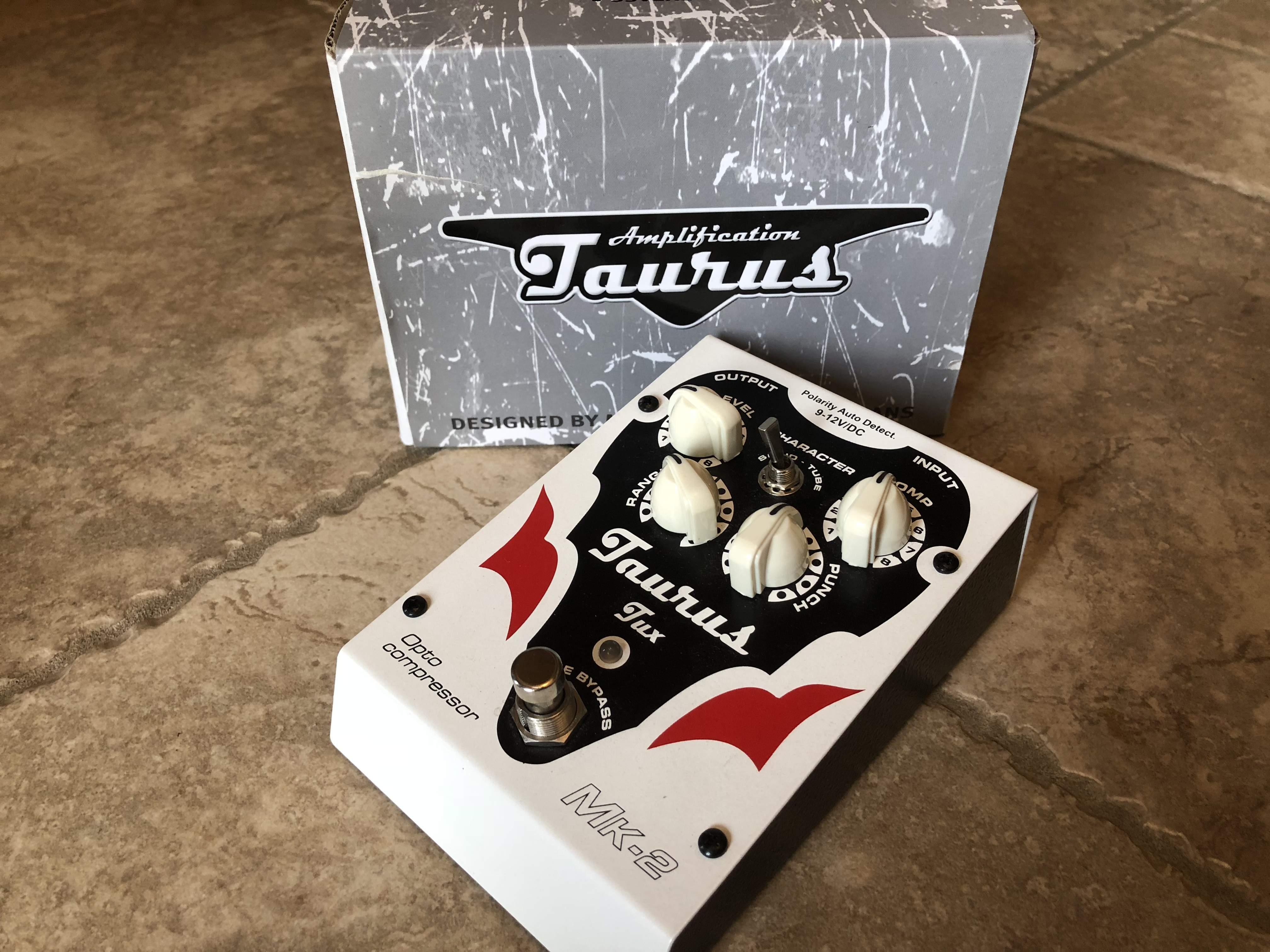
This is a review of the MK-2, which is the newer and smaller optical pedal design from this boutique Polish pedal maker. There was a more budget Black Line model that appears to have been discontinued and the larger Silver Line still in production. The MK-2 has the same Level, Comp, Range, and Punch knobs as the Black Line and Silver Line. However, the MK-2 has a switch to change the character of the compression between solid state and Tube like. More on this later.
The build quality seems very good with solid metal housing. The knobs turn with authority and the switch has a solid feel and is true bypass. The LED lights green when powered and flashes various shades of red as gain is reduced (signal over threshold). The LED functions almost exactly like the LED on the Diamond.
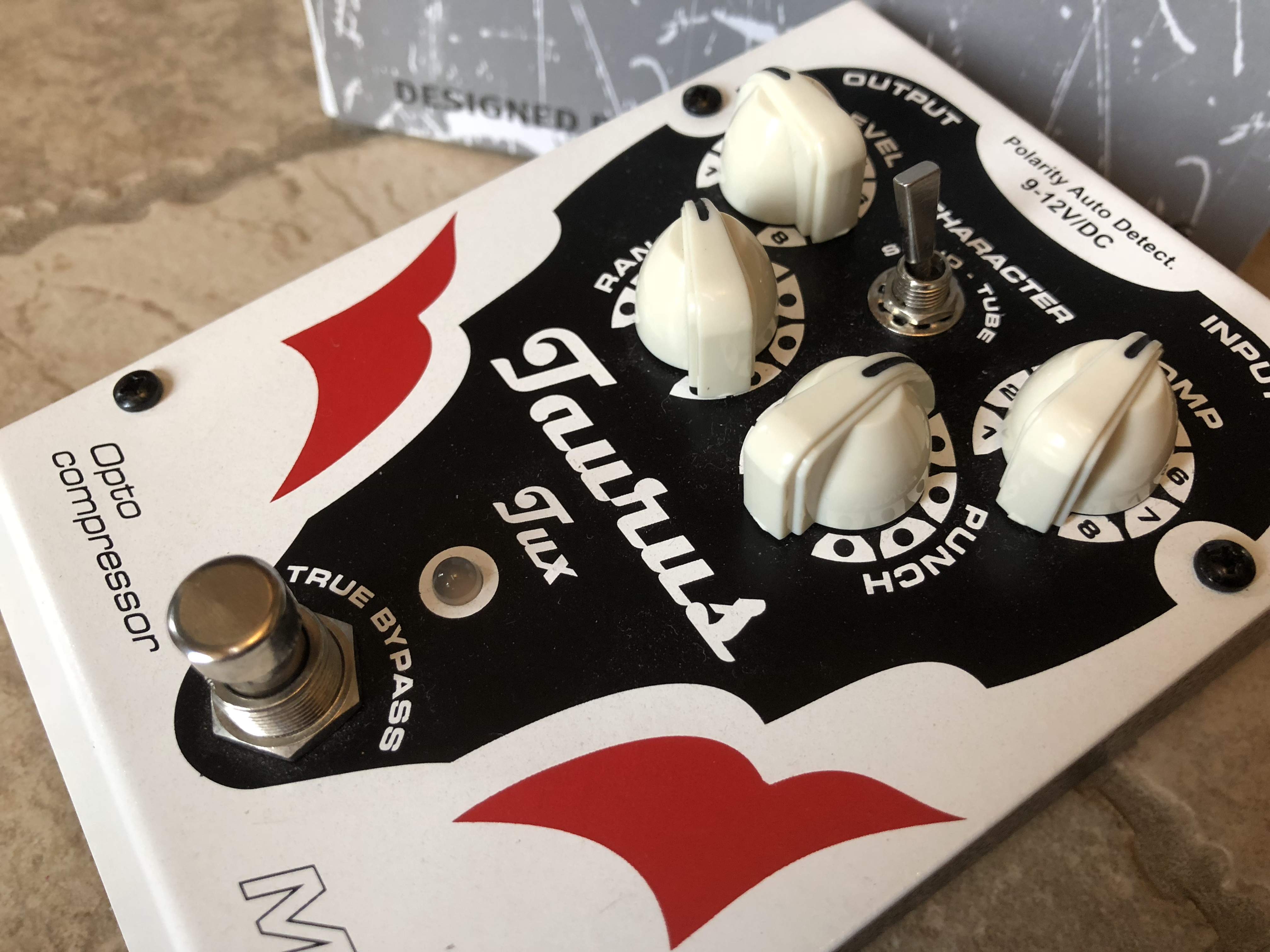
The Level controls the output of the compressor pedal. All the way counter clockwise is original signal level.
The Compress knob controls the compression ratio level. The manual does not define the ratio range but it is pretty wide. Capable of pretty good squish on the high end and very nice and subtle on the lower end.
Punch essentially controls the attack level. All the way counter clockwise is called "sharp" which is the slowest attack allowing more initial transient in. All the way clockwise is called "soft" which is the fastest attack clamping on the initial transient harder. I found the range quite useful all the way across knob twist.
The Range knob is interesting. Per the manual it controls the band threshold. In other words, it adjusts the frequency range at which your signal triggers the compressor. To my ear it functions a lot like the filter control on the XTS Fermata. Higher (more clockwise) settings trigger the compressor at a wider range, more clockwise opens up the compressor and squishes the highs and mid range less. The more rotation counter clockwise the more articulate the tone becomes. It works very well.
The Punch and Range knobs are highly interactive so you can dial in a pretty vast variety of compression sounds and feel. The MK-2 really juices up the sound considerably. It covers a wide variety of compression types from subtle to more rubbery vintage type limiting. You can dial in super punchy, fast, articulation or pretty even and even squashy. It is quite versatile and pretty quiet unless you dial in more dramatic effect.
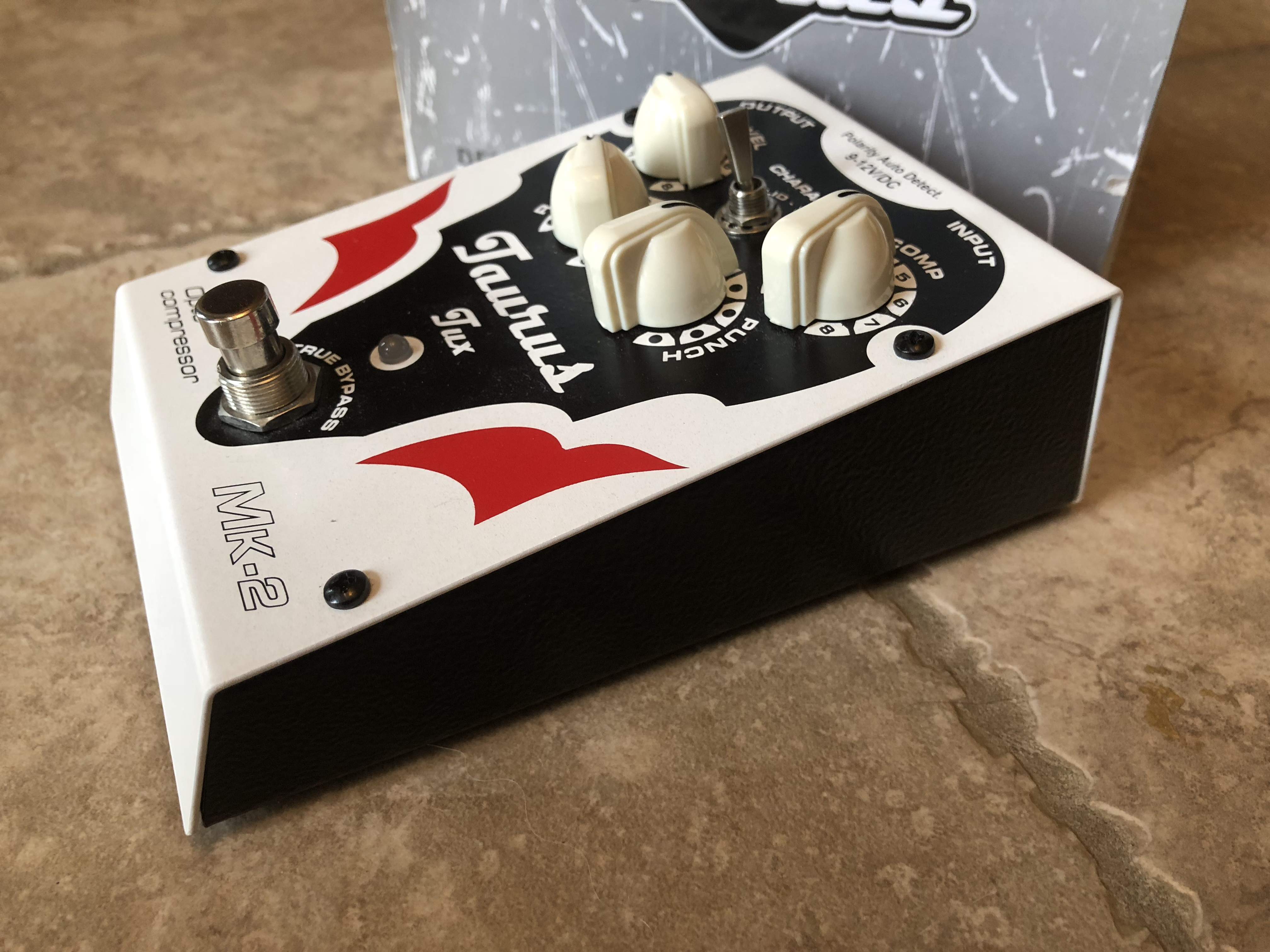
To my ear the MK-2 is pretty neutral or transparent. Highs and lows are consistent. I wouldn't say it brings a huge level of "fatness" but that Range knob really allows you to dial in a real punchy, lively, and "wider" sound. Really, really nice actually.
I really like the Character switch. Solid is a little more open sounding with a more modern punch. When you flip to Tube you can hear the pedal allow a little more harmonic content through. A little more wooly and vintage sounding. This makes an already versatile compressor even more so. The difference between the two settings might seem subtle at first, but you quickly realize the compressor knob interacts differently in Tube mode and so does the Punch dial. Previous Tux models had a compressor/limiter switch. I think I would much prefer this Character switch. You can still dial in the MK-2 as more of a limiter with the Punch and Comp knob.
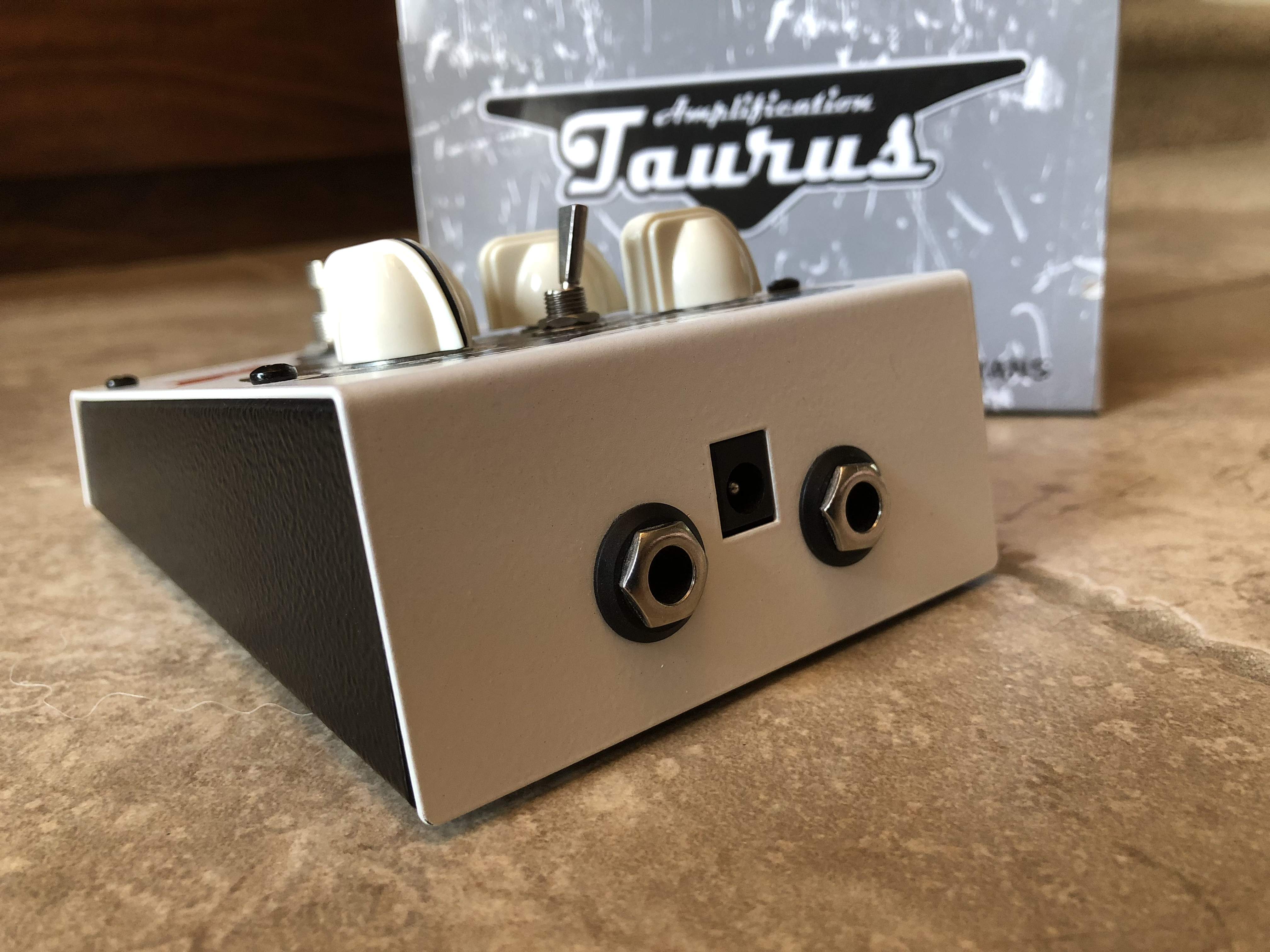
The Tux MK-2 runs on 9 - 12 volt and has an internal voltage converter that adjusts the voltage from 9 volt to 18 volt or 12 volt to 24 volt for plenty of headroom. I had absolutely no issue with any of my basses. The Tux also automatically switches to "bypass mode" in case of disconnection or low voltage. Nice feature for protecting from loss of signal. Top mounted power and input/output jacks.
While the Tux is larger than some other compressors, it still is pedal board capable though a bit tall. It's about the same height as the Cali76 CB.
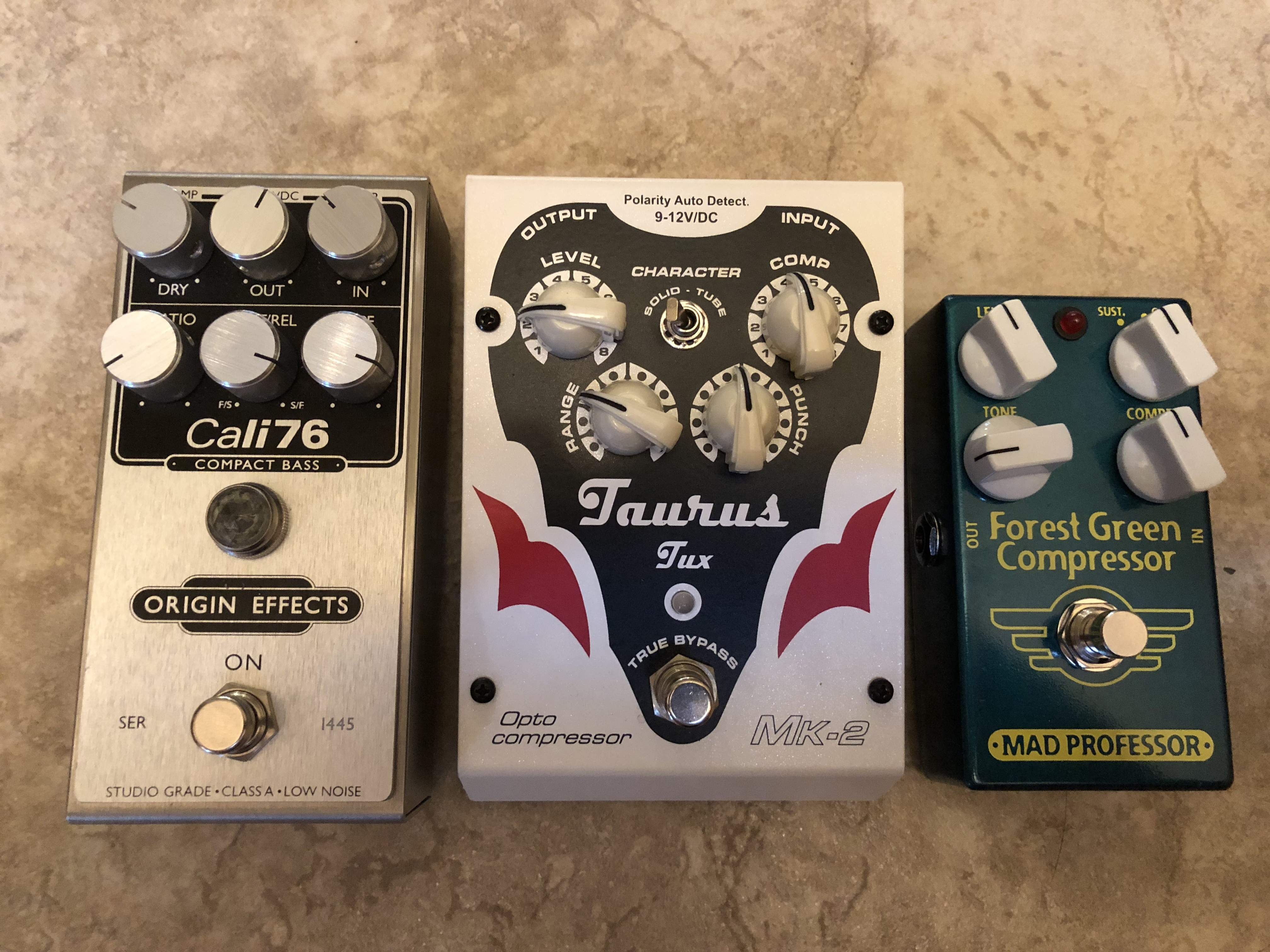
This one really surprised me. It is inherently transparent but can be super punchy and does add that special something in a more dramatic way than say the Empress or Keeley which are considered to be transparent compressors. If you are looking for something a little off the beaten path that is still pretty transparent with some unique features this is a nice package all the way around.
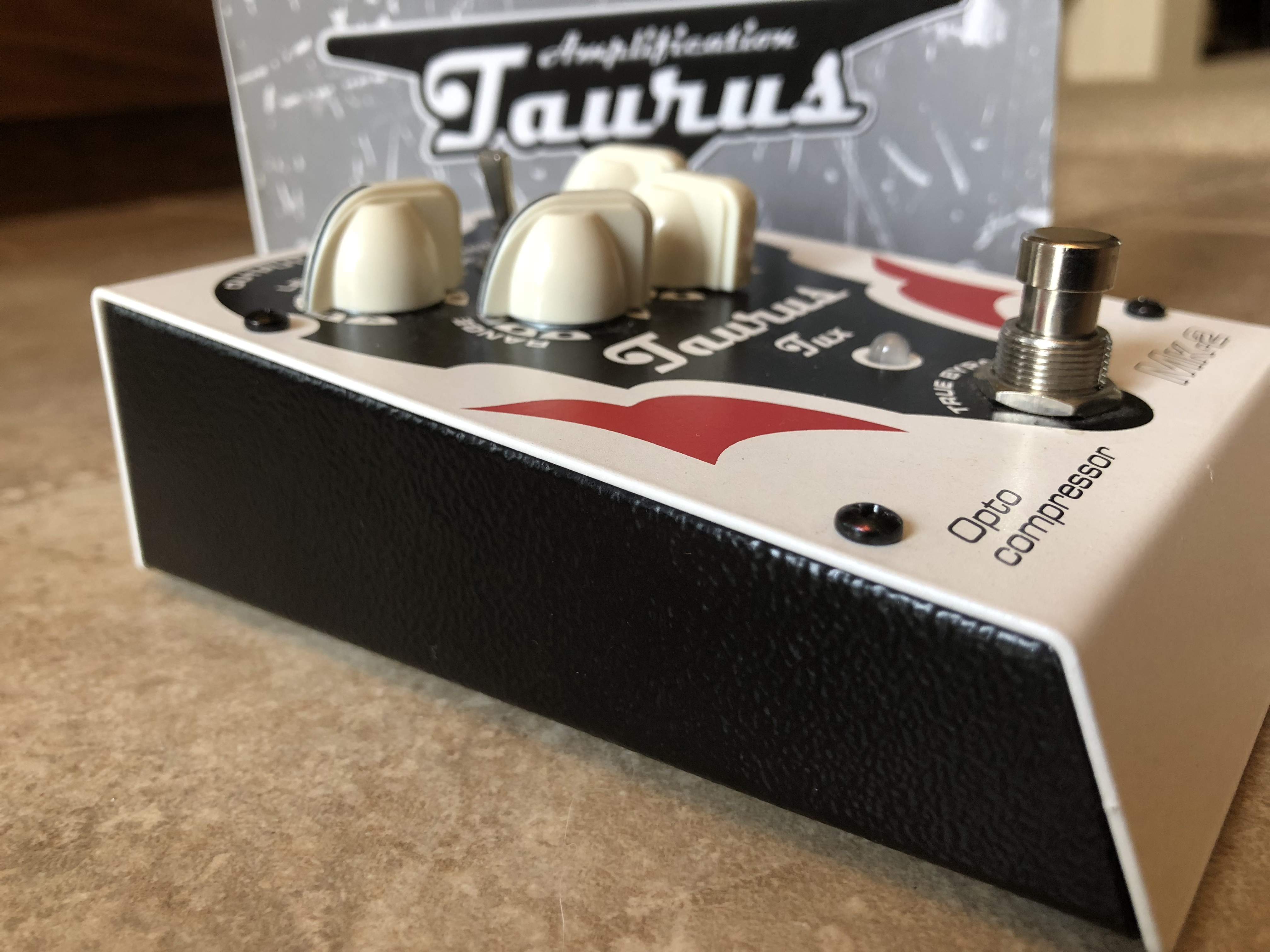
This is a review of the MK-2, which is the newer and smaller optical pedal design from this boutique Polish pedal maker. There was a more budget Black Line model that appears to have been discontinued and the larger Silver Line still in production. The MK-2 has the same Level, Comp, Range, and Punch knobs as the Black Line and Silver Line. However, the MK-2 has a switch to change the character of the compression between solid state and Tube like. More on this later.
The build quality seems very good with solid metal housing. The knobs turn with authority and the switch has a solid feel and is true bypass. The LED lights green when powered and flashes various shades of red as gain is reduced (signal over threshold). The LED functions almost exactly like the LED on the Diamond.
The Level controls the output of the compressor pedal. All the way counter clockwise is original signal level.
The Compress knob controls the compression ratio level. The manual does not define the ratio range but it is pretty wide. Capable of pretty good squish on the high end and very nice and subtle on the lower end.
Punch essentially controls the attack level. All the way counter clockwise is called "sharp" which is the slowest attack allowing more initial transient in. All the way clockwise is called "soft" which is the fastest attack clamping on the initial transient harder. I found the range quite useful all the way across knob twist.
The Range knob is interesting. Per the manual it controls the band threshold. In other words, it adjusts the frequency range at which your signal triggers the compressor. To my ear it functions a lot like the filter control on the XTS Fermata. Higher (more clockwise) settings trigger the compressor at a wider range, more clockwise opens up the compressor and squishes the highs and mid range less. The more rotation counter clockwise the more articulate the tone becomes. It works very well.
The Punch and Range knobs are highly interactive so you can dial in a pretty vast variety of compression sounds and feel. The MK-2 really juices up the sound considerably. It covers a wide variety of compression types from subtle to more rubbery vintage type limiting. You can dial in super punchy, fast, articulation or pretty even and even squashy. It is quite versatile and pretty quiet unless you dial in more dramatic effect.
To my ear the MK-2 is pretty neutral or transparent. Highs and lows are consistent. I wouldn't say it brings a huge level of "fatness" but that Range knob really allows you to dial in a real punchy, lively, and "wider" sound. Really, really nice actually.
I really like the Character switch. Solid is a little more open sounding with a more modern punch. When you flip to Tube you can hear the pedal allow a little more harmonic content through. A little more wooly and vintage sounding. This makes an already versatile compressor even more so. The difference between the two settings might seem subtle at first, but you quickly realize the compressor knob interacts differently in Tube mode and so does the Punch dial. Previous Tux models had a compressor/limiter switch. I think I would much prefer this Character switch. You can still dial in the MK-2 as more of a limiter with the Punch and Comp knob.
The Tux MK-2 runs on 9 - 12 volt and has an internal voltage converter that adjusts the voltage from 9 volt to 18 volt or 12 volt to 24 volt for plenty of headroom. I had absolutely no issue with any of my basses. The Tux also automatically switches to "bypass mode" in case of disconnection or low voltage. Nice feature for protecting from loss of signal. Top mounted power and input/output jacks.
While the Tux is larger than some other compressors, it still is pedal board capable though a bit tall. It's about the same height as the Cali76 CB.
This one really surprised me. It is inherently transparent but can be super punchy and does add that special something in a more dramatic way than say the Empress or Keeley which are considered to be transparent compressors. If you are looking for something a little off the beaten path that is still pretty transparent with some unique features this is a nice package all the way around.
Last edited:
Updated summary of the reviews:
BBE Optostomp: Testing compressors: Cali76 CB, Smoothie, Keeley Bassist, FEA Optifet, Seymour Duncan Studio Bass
Bogner Lyndhurst: Testing Compressors: Cali, Smoothie, Empress, Diamond, Keeley, FEA, Darkglass, Doc Lloyd, JHS & more
Broughton Apex: Testing compressors: Cali76 CB, Smoothie, Keeley Bassist, FEA Optifet, Seymour Duncan Studio Bass
Cali CB vs. Smoothie Suave Optical:Testing compressors: Cali76 CB, Smoothie, Keeley Bassist, FEA Optifet, Seymour Duncan Studio Bass
Cali76 CB and fretless: Testing compressors: Cali76 CB, Smoothie, Keeley Bassist, FEA Optifet, Seymour Duncan Studio Bass
Few more thoughts on Cali, Smoothie, and Keeley: Testing compressors: Cali76 CB, Smoothie, Keeley Bassist, FEA Optifet, Seymour Duncan Studio Bass
Darkglass Hyper Luminal: Testing Compressors: Cali, Smoothie, Empress, Diamond, Keeley, FEA, Darkglass, Doc Lloyd, JHS & more
Darkglass Supersymmetry: Testing compressors: Cali76 CB, Smoothie, Keeley Bassist, FEA Optifet, Seymour Duncan Studio Bass
Diamond Bass Compressor JR: Testing compressors: Cali76 CB, Smoothie, Keeley Bassist, FEA Optifet, Seymour Duncan Studio Bass
Doc Lloyd Photon Death Ray: Testing compressors: Cali76 CB, Smoothie, Keeley Bassist, FEA Optifet, Seymour Duncan Studio Bass
EBS Multicomp: Testing compressors: Cali76 CB, Smoothie, Keeley Bassist, FEA Optifet, Seymour Duncan Studio Bass
Effectrode PC-2A: Testing compressors: Cali76 CB, Smoothie, Keeley Bassist, FEA Optifet, Seymour Duncan Studio Bass
Empress: Testing compressors: Cali76 CB, Smoothie, Keeley Bassist, FEA Optifet, Seymour Duncan Studio Bass
FEA DB-CL (Dual Band Compressor/Limiter): Testing Compressors: Cali, Smoothie, Empress, Diamond, Keeley, FEA, Darkglass, Doc Lloyd, JHS & more
FEA OPTI-FET: Testing compressors: Cali76 CB, Smoothie, Keeley Bassist, FEA Optifet, Seymour Duncan Studio Bass
Fermata (Xact Tone Solutions): Testing compressors: Cali76 CB, Smoothie, Keeley Bassist, FEA Optifet, Seymour Duncan Studio Bass
Forest Green (Mad Professor: Testing Compressors: Cali, Smoothie, Empress, Diamond, Keeley, FEA, Darkglass, Doc Lloyd, JHS & more
G-Lab BC-1 Boosting Compressor: Testing Compressors: Cali, Smoothie, Empress, Diamond, Keeley, FEA, Darkglass, Doc Lloyd, JHS & more
Pulp 'N' Peel (JHS): Testing Compressors: Cali, Smoothie, Empress, Diamond, Keeley, FEA, Darkglass, Doc Lloyd, JHS & more
PWNZOR (3Leaf): Testing compressors: Cali76 CB, Smoothie, Keeley Bassist, FEA Optifet, Seymour Duncan Studio Bass and Testing compressors: Cali76 CB, Smoothie, Keeley Bassist, FEA Optifet, Seymour Duncan Studio Bass
Refinery (Foxpedal): Testing Compressors: Cali, Smoothie, Empress, Diamond, Keeley, FEA, Darkglass, Doc Lloyd, JHS & more
Seymour Duncan Studio Bass: Testing compressors: Cali76 CB, Smoothie, Keeley Bassist, FEA Optifet, Seymour Duncan Studio Bass
Smoothie OTA vs. Smoothie Optical: Testing compressors: Cali76 CB, Smoothie, Keeley Bassist, FEA Optifet, Seymour Duncan Studio Bass
Taurus Tux MK-2: Testing Compressors: Cali, Smoothie, Empress, Diamond, Keeley, FEA, Darkglass, Doc Lloyd, JHS & more
Wampler Ego Mini after time in store: Testing compressors: Cali76 CB, Smoothie, Keeley Bassist, FEA Optifet, Seymour Duncan Studio Bass
The Warden (EarthQuaker Devices): Testing Compressors: Cali, Smoothie, Empress, Diamond, Keeley, FEA, Darkglass, Doc Lloyd, JHS & more
Best overall everyday compressor (my opinion)... so far: Testing compressors: Cali76 CB, Smoothie, Keeley Bassist, FEA Optifet, Seymour Duncan Studio Bass
BBE Optostomp: Testing compressors: Cali76 CB, Smoothie, Keeley Bassist, FEA Optifet, Seymour Duncan Studio Bass
Bogner Lyndhurst: Testing Compressors: Cali, Smoothie, Empress, Diamond, Keeley, FEA, Darkglass, Doc Lloyd, JHS & more
Broughton Apex: Testing compressors: Cali76 CB, Smoothie, Keeley Bassist, FEA Optifet, Seymour Duncan Studio Bass
Cali CB vs. Smoothie Suave Optical:Testing compressors: Cali76 CB, Smoothie, Keeley Bassist, FEA Optifet, Seymour Duncan Studio Bass
Cali76 CB and fretless: Testing compressors: Cali76 CB, Smoothie, Keeley Bassist, FEA Optifet, Seymour Duncan Studio Bass
Few more thoughts on Cali, Smoothie, and Keeley: Testing compressors: Cali76 CB, Smoothie, Keeley Bassist, FEA Optifet, Seymour Duncan Studio Bass
Darkglass Hyper Luminal: Testing Compressors: Cali, Smoothie, Empress, Diamond, Keeley, FEA, Darkglass, Doc Lloyd, JHS & more
Darkglass Supersymmetry: Testing compressors: Cali76 CB, Smoothie, Keeley Bassist, FEA Optifet, Seymour Duncan Studio Bass
Diamond Bass Compressor JR: Testing compressors: Cali76 CB, Smoothie, Keeley Bassist, FEA Optifet, Seymour Duncan Studio Bass
Doc Lloyd Photon Death Ray: Testing compressors: Cali76 CB, Smoothie, Keeley Bassist, FEA Optifet, Seymour Duncan Studio Bass
EBS Multicomp: Testing compressors: Cali76 CB, Smoothie, Keeley Bassist, FEA Optifet, Seymour Duncan Studio Bass
Effectrode PC-2A: Testing compressors: Cali76 CB, Smoothie, Keeley Bassist, FEA Optifet, Seymour Duncan Studio Bass
Empress: Testing compressors: Cali76 CB, Smoothie, Keeley Bassist, FEA Optifet, Seymour Duncan Studio Bass
FEA DB-CL (Dual Band Compressor/Limiter): Testing Compressors: Cali, Smoothie, Empress, Diamond, Keeley, FEA, Darkglass, Doc Lloyd, JHS & more
FEA OPTI-FET: Testing compressors: Cali76 CB, Smoothie, Keeley Bassist, FEA Optifet, Seymour Duncan Studio Bass
Fermata (Xact Tone Solutions): Testing compressors: Cali76 CB, Smoothie, Keeley Bassist, FEA Optifet, Seymour Duncan Studio Bass
Forest Green (Mad Professor: Testing Compressors: Cali, Smoothie, Empress, Diamond, Keeley, FEA, Darkglass, Doc Lloyd, JHS & more
G-Lab BC-1 Boosting Compressor: Testing Compressors: Cali, Smoothie, Empress, Diamond, Keeley, FEA, Darkglass, Doc Lloyd, JHS & more
Pulp 'N' Peel (JHS): Testing Compressors: Cali, Smoothie, Empress, Diamond, Keeley, FEA, Darkglass, Doc Lloyd, JHS & more
PWNZOR (3Leaf): Testing compressors: Cali76 CB, Smoothie, Keeley Bassist, FEA Optifet, Seymour Duncan Studio Bass and Testing compressors: Cali76 CB, Smoothie, Keeley Bassist, FEA Optifet, Seymour Duncan Studio Bass
Refinery (Foxpedal): Testing Compressors: Cali, Smoothie, Empress, Diamond, Keeley, FEA, Darkglass, Doc Lloyd, JHS & more
Seymour Duncan Studio Bass: Testing compressors: Cali76 CB, Smoothie, Keeley Bassist, FEA Optifet, Seymour Duncan Studio Bass
Smoothie OTA vs. Smoothie Optical: Testing compressors: Cali76 CB, Smoothie, Keeley Bassist, FEA Optifet, Seymour Duncan Studio Bass
Taurus Tux MK-2: Testing Compressors: Cali, Smoothie, Empress, Diamond, Keeley, FEA, Darkglass, Doc Lloyd, JHS & more
Wampler Ego Mini after time in store: Testing compressors: Cali76 CB, Smoothie, Keeley Bassist, FEA Optifet, Seymour Duncan Studio Bass
The Warden (EarthQuaker Devices): Testing Compressors: Cali, Smoothie, Empress, Diamond, Keeley, FEA, Darkglass, Doc Lloyd, JHS & more
Best overall everyday compressor (my opinion)... so far: Testing compressors: Cali76 CB, Smoothie, Keeley Bassist, FEA Optifet, Seymour Duncan Studio Bass
Last edited:

Just got one of the OvniFX Smoothie's in to test out! Thought it would be appropriate to add the video to this sticky.
After reading all the reviews here I thought that the Smoothie could be the best candidate to replace my Keeley Bassist, at least for my personal needs. This video make me want to order one, it's a great review. I've been following this guy for a while and he constantly posts spcectacular stuff.
Thoughts on the Darkglass Hyper Luminal:
There is much excitement and anticipation for the new Darkglass hybrid compressor so I wanted to get some thoughts out there as soon as possible. I spent the better part of a day playing through the pedal with four different basses (G&L L2500, Pedulla fretless, Sire P7, and Tobias), a Genzler amp head through Genzler cabinets, through the Genzler amp with earphones, and through my Shift-Line Olympic MKIII with earphones. My cans of choice were Beyerdynamic DT770 which are high quality and sonically quite flat in terms of frequency response.
There is a lot of variables to test in this compressor so what I am publishing here are my initial thoughts. No doubt I will be spending a lot more time with this pedal in the days ahead. I know many of you just can't wait to read more about it so here it goes.
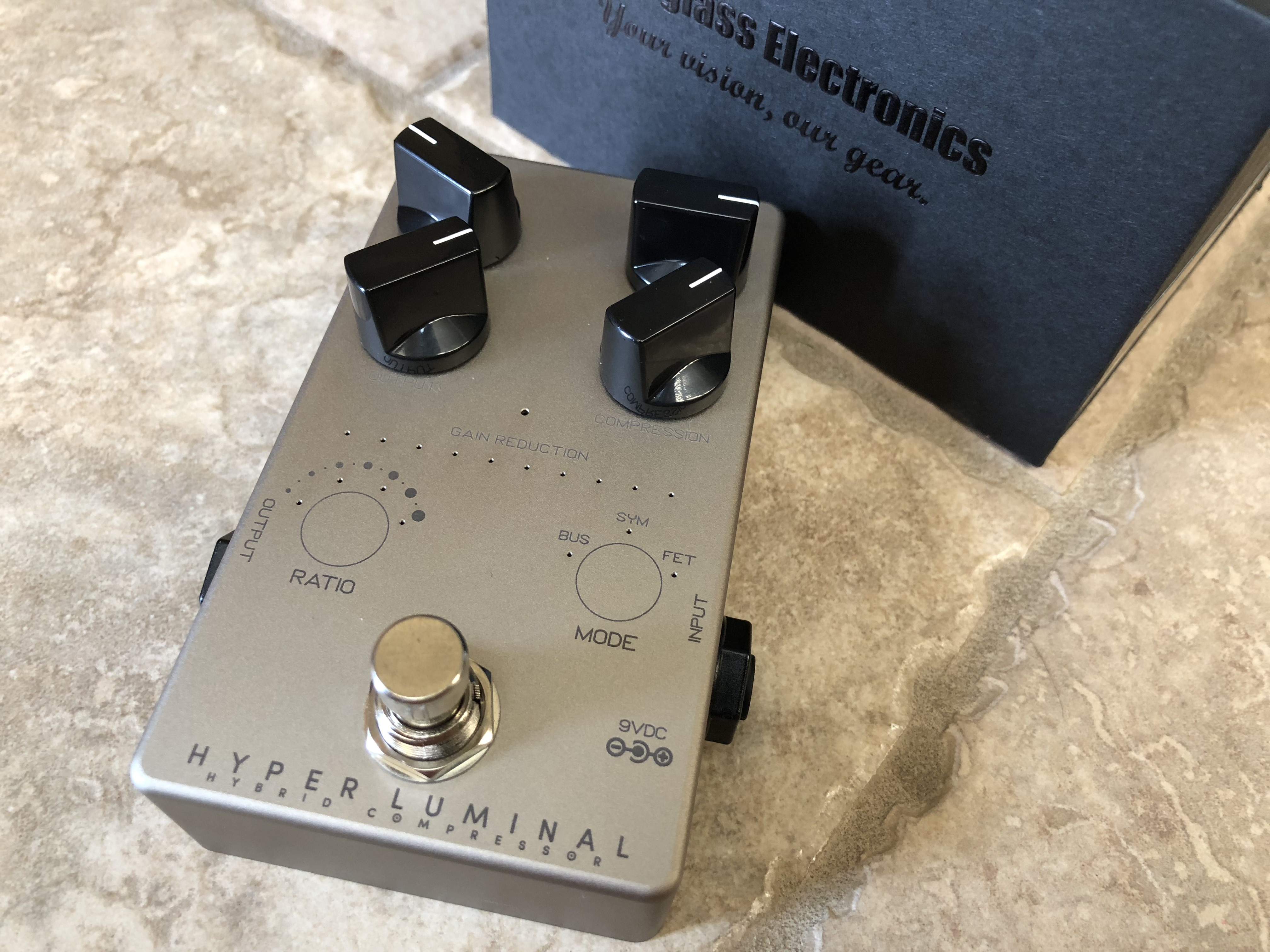
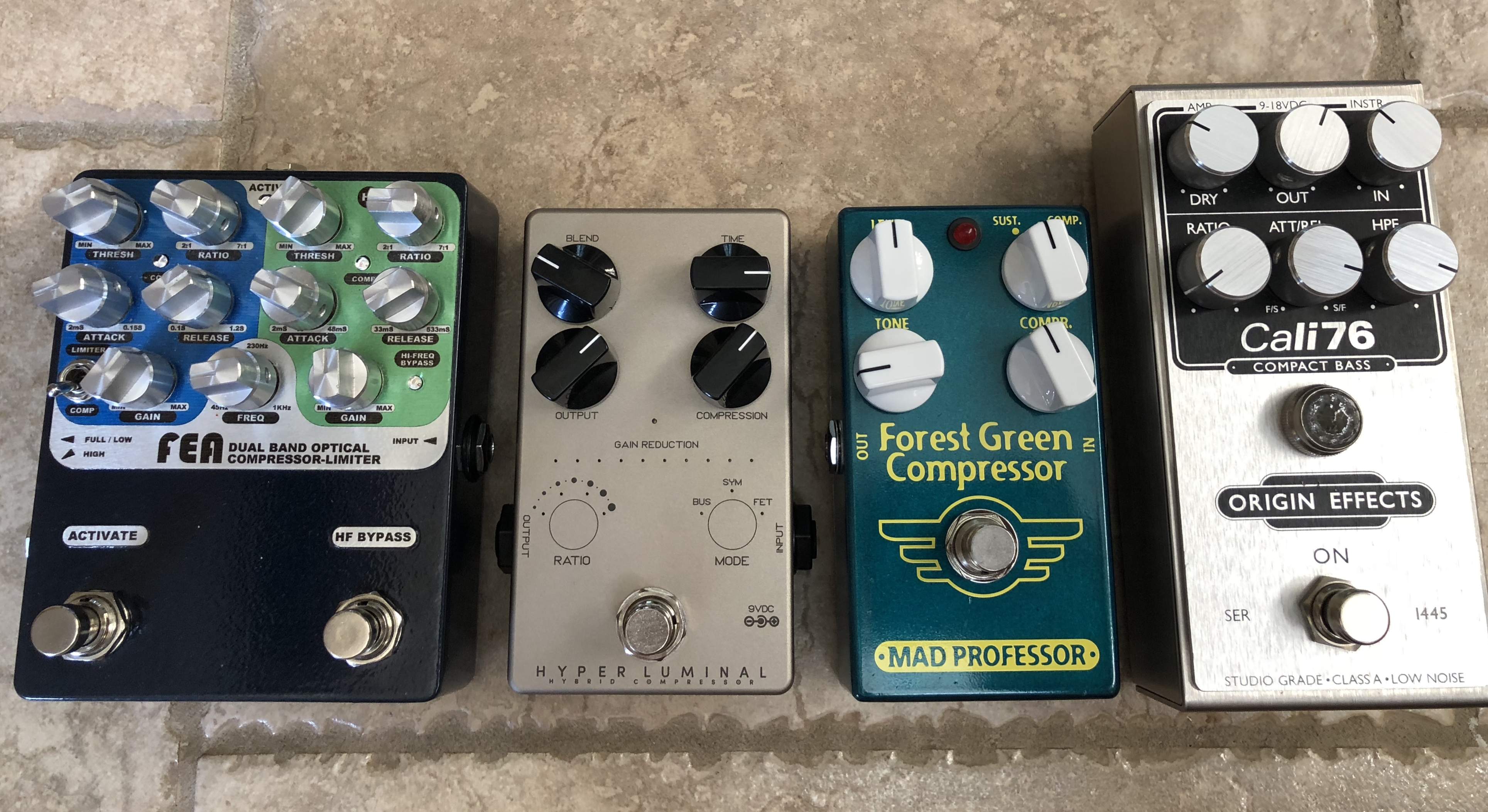
The pedal itself is very sexy. Dare I say the best looking compressor I've laid hands on. Reminds me of some sort of device you'd see on an episode of Battlestar Galactica or something. </NerdComment> It is quite small and light weight but solid in build construction just like all Darkglass products. If you have experienced the former Super Symmetry (or any other Darkglass product) you know how the casing looks and feels. Definitely quality. Input and output jacks are on the side, as is the power jack. On the left side is a USB port which is used to connect the Hyper Luminal to a PC or Mac to use with the Darglass software Suite. More on that later.
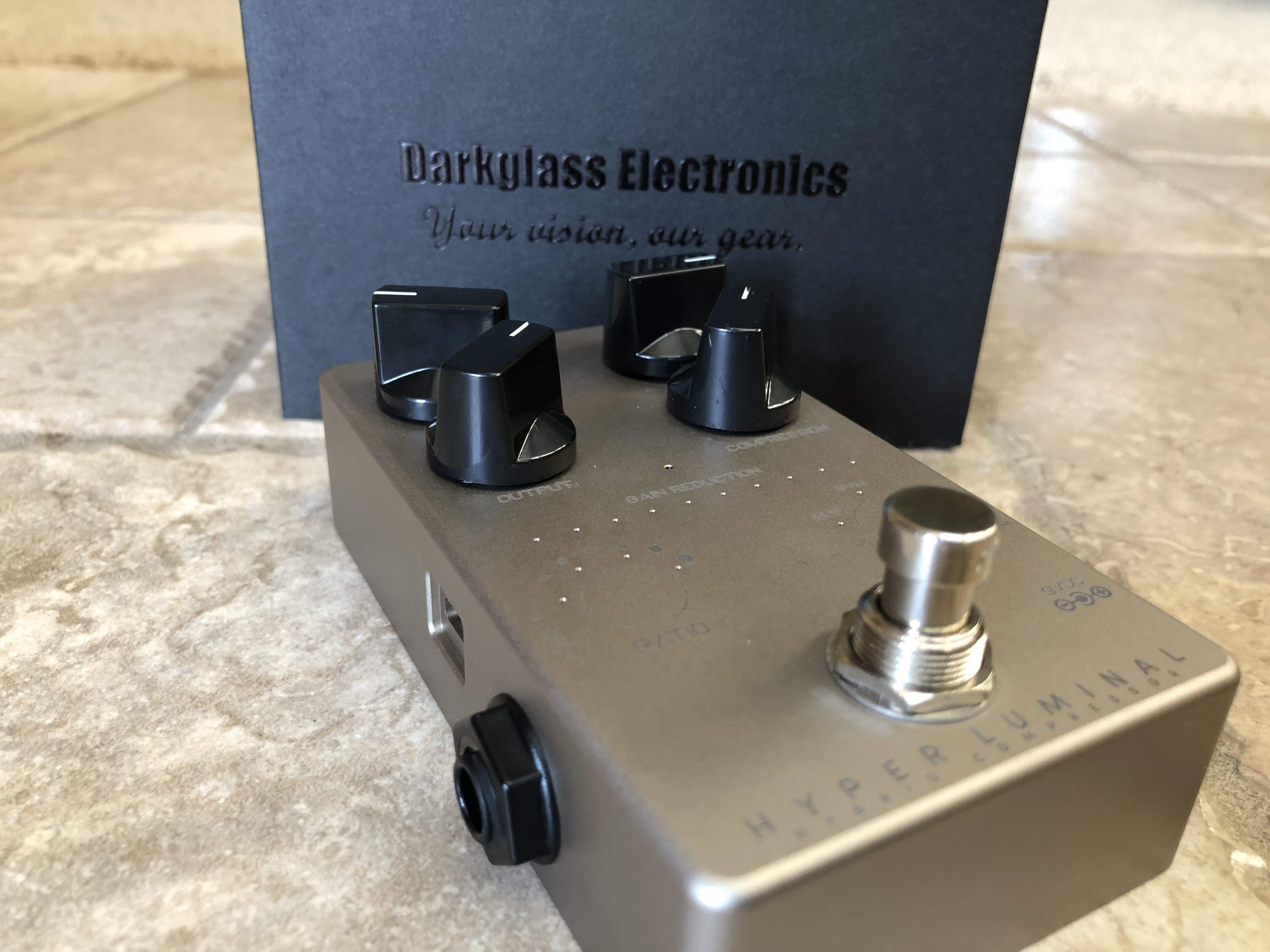
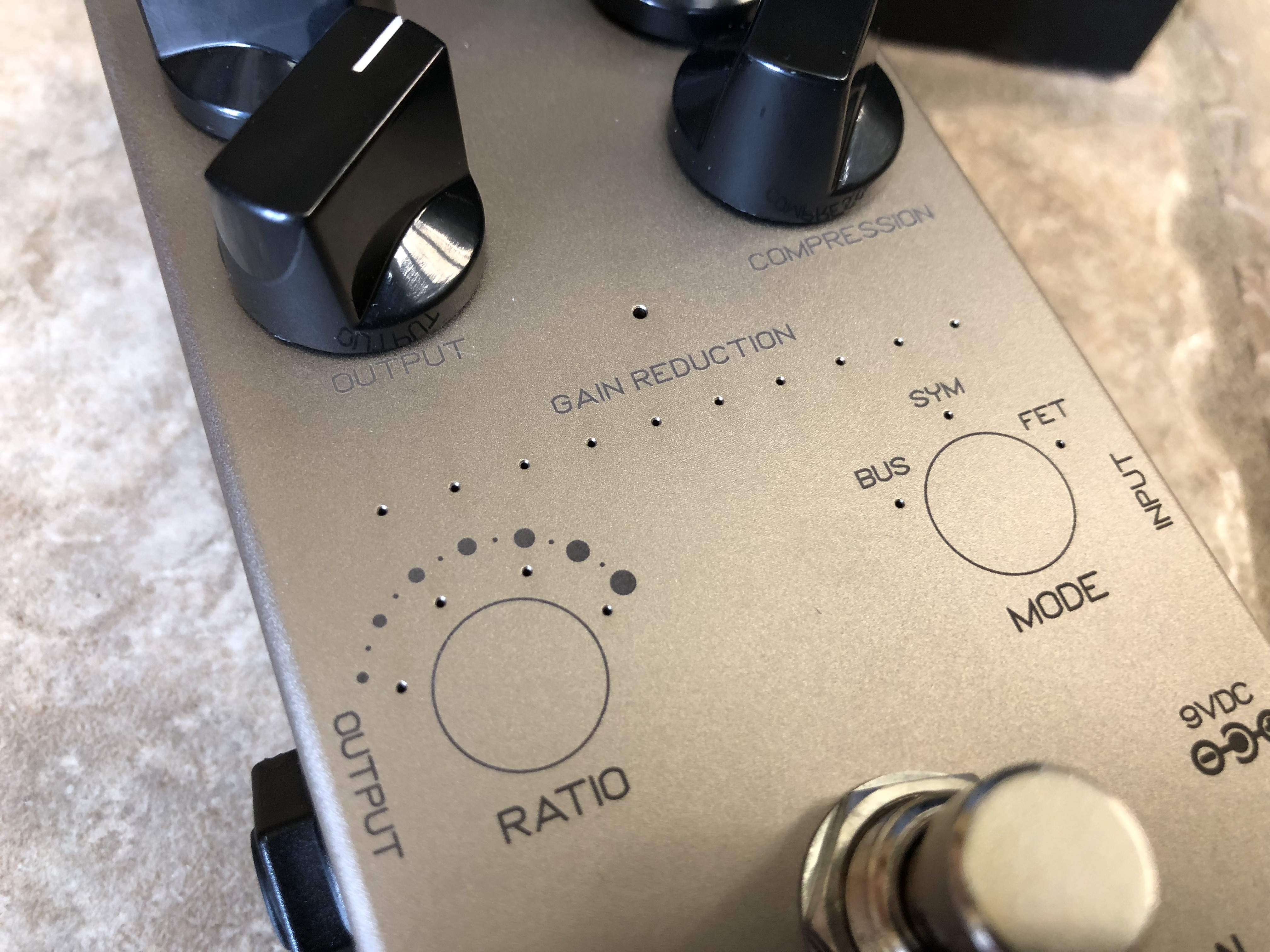
The LED's are just plain awesome. There is really nothing like it in the compressor market. The gain reduction meters are familiar for anyone who used the Super Symmetry. But Darkglass has upped the game with more blue LED's to indicate ratio setting and compressor mode. The On/Off LED is blue as well.
I suspect some wonder how the width of the pedal compares to the now discontinued Super Symmetry. With right angle EBS cables the pedal measures 3 11/16 wide which is very close to the width of the Super Symmetry (which has top mounted jacks).
A major departure from traditional pedal design, the Hyper Luminal uses touch sensors for ratio and compressor models. In my experience they work very well. You won't inadvertently change a setting by accidentally touching one. The sensors require some force applied before the buttons respond. There is no tactile response, you just need to push the defined area with some force.
There are four knobs: Blend, Time, Output, Compression.
Blend mixes your clean and compressed signal. All the way clockwise is complete effect and adding more dry as you rotate counterclockwise.
Compression knob sets the overall amount of compression and effects the internal makeup gain. The perceived volume becomes quite a bit louder as you rotate clockwise (especially past noon).
Output sets the output volume of the unit. There is plenty of gain on tap but it does add noise to the noise floor as you rotate clockwise especially past noon.
The Time knob sets both the attack and release together. By default the knob is configured in an inverse relationship meaning all the way counterclockwise is minimum attack and max release (compressor clamps more quickly on initial transient but waits longer to release) and all the way clockwise is max attack and minimum release (compressor waits longer to compress initial transient but releases more quickly). You can use the Darkglass Suite to fine tune these settings. For example, you can set the Time knob to a fixed release meaning the knob will only controls the attack. Or you can set the Time knob to a proportional setting where Attack and Release are controlled proportionally. This means all the way clockwise is slowest attack and slowest release, vice-versa when turned all the way counterclockwise. With all compressor types you also have the option of setting the Time knob to fixed Attack meaning the Time knob will only control release timing. Pretty nifty indeed.
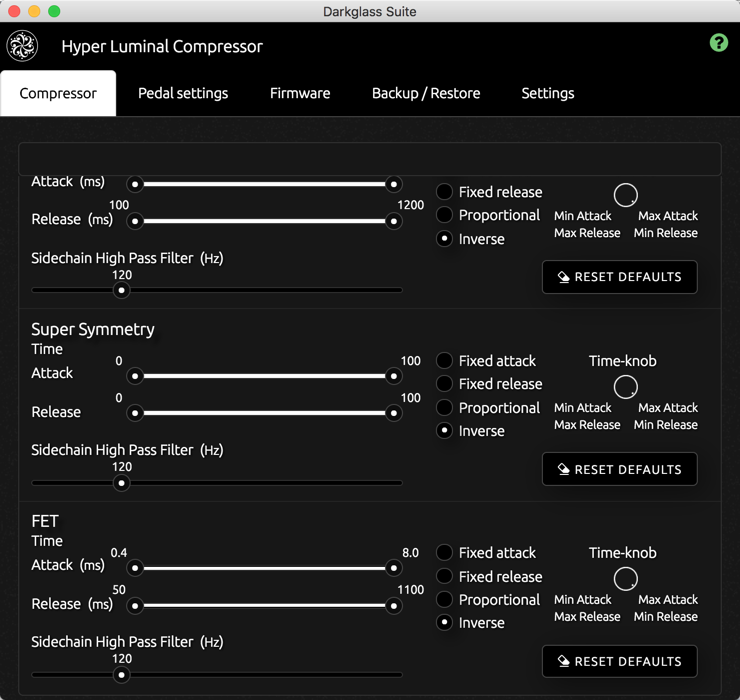
The Darkglass Suite also allows you to fine tune the attack timing and release timing. See screen shot. I think some of the real magic comes with being able to adjust the digitally controlled high pass filter (HPF) to prevent lower frequencies from triggering the compressor. Want more bottom end, less compressed? Just set your HPF frequency point. I found a real nice sweet spot at between 120hz and 140hz.
Other nice features of the software Suite include the ability to save your compressor pedal setup as a backup to easily load later if you need to. You can also restore the pedal to original manufacturer settings with the click of a button. Unlike the TC Electronics Spectracomp software I have had absolutely no issues with the Darkglass Suite. It loads fast and just plain works.
So how does it sound? Well, there's a lot of variety baked in.
Super Symmetry mode will be familiar to anybody who has used a Super Symmetry before. It has that same darker tone with perceived highs rolled off. Does it sound exactly the same? Can't say for certain but probably very, very close. Ratio settings are the same original range of the Super Symmetry.
FET mode is modeled after the legendary 1176® which is renowned for its transient impact and heralded for use on bass and drums. FET mode has some grit and energy to it that I quite like. This mode reminded me most of the Taurus Tux MK-2 I recently reviewed which has grit and a super punchy vibe. Maybe a bit like the punch of the Mad Professor Forest Green, the brightness and “pop” of the Cali76 CB, or maybe even a bit of the vibe of the Diamond BCP-1. There are 4 ratio settings: 4, 8, 12, 20 and Darkglass even accounted for the famous "all buttons in" mode of the 1176® which results in a real big tone and added harmonic content. Don't think all out distortion or OD but more "big". I don't have an 1176® to compare to but I quite liked how things sound in FET mode. This mode does have the most inherent noise floor though, especially as you increase ratio and then turn the Compression knob Clockwise and even more so as you add in more dry signal. The "all buttons in" mode is enabled when all four ratio LEDs are lit and really is unique. It does become more explosive. With my already aggressive G&L L2500 FET mode extended it’s inherent rudeness to a whole new level in a pleasing way. I definitely plan to spend more time in this mode. FET mode is the most capable as a limiter.
Bus mode is modeled after the Solid State® Logic Bus Compressor. Again, I don't have one to directly compare with but the Hyper Luminal in this mode just sounds really, really good. Not sure how to describe it. More punchy for sure but in a smooth way. Not really aggressive but wider and more articulate. There are 4 ratio settings: 1.5, 2, 4 and 10. I found myself gravitating to ratio 2:1 and 4:1 most for real nice subtle smoothing out with added sustain and punch. It takes higher rotations of the Compressor knob and lowered rotations of the Time knob to trigger the gain reduction compared to the FET mode. With the same G&L L2500 in bus mode the bass tone sweetened out without losing punch or excitement. Nice.
I suspect most customers will buy the Hyper Luminal for the BUS and FET settings and I prefer both to the Super Symmetry setting. But that Super Symmetry setting is there for the time when you need a bit more wooly and vintage sound and feel. The Super Symmetry mode has the lowest noise floor.
Having all three modes and so much control with the Suite makes this compressor highly versatile.
With the array of flashing lights does come the need for a little more juice to power the pedal. It runs on standard 9 volt DC adapter with center-negative plug but Darkglass says the pedal has a current draw of 250ma. That might make create a bit of a challenge for some pedal board power supplies. I ran the pedal off two 100ma ports on my CIOKS DC5 using a parallel cable combing the sum of the current of the two ports creating 200ma. I never encountered a problem but the manual states the pedal has a 250ma requirement. The Hyper Luminal does double the voltage internally meaning 9 volt is doubled to 18 volt creating more headroom. I had no issues with any of my basses.
It is not the most quiet compressor ever but far from the noisiest either. I A/B tested against the Diamond, FEA DB-CL, Taurus Tux, Cali76 CB, and Mad Professor Forest Green and the Hyper Luminal had similar noise floor to the Cali76 CB at comparable gain settings. But understand it is probably not an issue for all but the most picky and sensitive users.
There's a lot to like for sure and the Hyper Luminal definitely forges a new path. You get a very well made tool with a whole lot of versatility and it really sounds great. A whole lot of compressor here and an interesting approach with digital control of an analogue circuit. The touch sensitive buttons are unique and the LED's are flat out cool. There is nothing like it on the market and I think a major progression in compressor pedal architecture. The Darkglass Suite customizations bring things to a whole new level.
No doubt Darkglass has a hit here. You can dial in smooth and controlled, more aggressive and punchy, and really anything in between. Those looking for more of a limiter will find ways to dial the Hyper Luminal to satisfaction too. The gain reduction LED's help you understand what is going on with the compression as you train your ear. Really nice piece of gear here. Nice price too at $249 retail.
I'll share more in the days ahead.
There is much excitement and anticipation for the new Darkglass hybrid compressor so I wanted to get some thoughts out there as soon as possible. I spent the better part of a day playing through the pedal with four different basses (G&L L2500, Pedulla fretless, Sire P7, and Tobias), a Genzler amp head through Genzler cabinets, through the Genzler amp with earphones, and through my Shift-Line Olympic MKIII with earphones. My cans of choice were Beyerdynamic DT770 which are high quality and sonically quite flat in terms of frequency response.
There is a lot of variables to test in this compressor so what I am publishing here are my initial thoughts. No doubt I will be spending a lot more time with this pedal in the days ahead. I know many of you just can't wait to read more about it so here it goes.
The pedal itself is very sexy. Dare I say the best looking compressor I've laid hands on. Reminds me of some sort of device you'd see on an episode of Battlestar Galactica or something. </NerdComment> It is quite small and light weight but solid in build construction just like all Darkglass products. If you have experienced the former Super Symmetry (or any other Darkglass product) you know how the casing looks and feels. Definitely quality. Input and output jacks are on the side, as is the power jack. On the left side is a USB port which is used to connect the Hyper Luminal to a PC or Mac to use with the Darglass software Suite. More on that later.
The LED's are just plain awesome. There is really nothing like it in the compressor market. The gain reduction meters are familiar for anyone who used the Super Symmetry. But Darkglass has upped the game with more blue LED's to indicate ratio setting and compressor mode. The On/Off LED is blue as well.
I suspect some wonder how the width of the pedal compares to the now discontinued Super Symmetry. With right angle EBS cables the pedal measures 3 11/16 wide which is very close to the width of the Super Symmetry (which has top mounted jacks).
A major departure from traditional pedal design, the Hyper Luminal uses touch sensors for ratio and compressor models. In my experience they work very well. You won't inadvertently change a setting by accidentally touching one. The sensors require some force applied before the buttons respond. There is no tactile response, you just need to push the defined area with some force.
There are four knobs: Blend, Time, Output, Compression.
Blend mixes your clean and compressed signal. All the way clockwise is complete effect and adding more dry as you rotate counterclockwise.
Compression knob sets the overall amount of compression and effects the internal makeup gain. The perceived volume becomes quite a bit louder as you rotate clockwise (especially past noon).
Output sets the output volume of the unit. There is plenty of gain on tap but it does add noise to the noise floor as you rotate clockwise especially past noon.
The Time knob sets both the attack and release together. By default the knob is configured in an inverse relationship meaning all the way counterclockwise is minimum attack and max release (compressor clamps more quickly on initial transient but waits longer to release) and all the way clockwise is max attack and minimum release (compressor waits longer to compress initial transient but releases more quickly). You can use the Darkglass Suite to fine tune these settings. For example, you can set the Time knob to a fixed release meaning the knob will only controls the attack. Or you can set the Time knob to a proportional setting where Attack and Release are controlled proportionally. This means all the way clockwise is slowest attack and slowest release, vice-versa when turned all the way counterclockwise. With all compressor types you also have the option of setting the Time knob to fixed Attack meaning the Time knob will only control release timing. Pretty nifty indeed.
The Darkglass Suite also allows you to fine tune the attack timing and release timing. See screen shot. I think some of the real magic comes with being able to adjust the digitally controlled high pass filter (HPF) to prevent lower frequencies from triggering the compressor. Want more bottom end, less compressed? Just set your HPF frequency point. I found a real nice sweet spot at between 120hz and 140hz.
Other nice features of the software Suite include the ability to save your compressor pedal setup as a backup to easily load later if you need to. You can also restore the pedal to original manufacturer settings with the click of a button. Unlike the TC Electronics Spectracomp software I have had absolutely no issues with the Darkglass Suite. It loads fast and just plain works.
So how does it sound? Well, there's a lot of variety baked in.
Super Symmetry mode will be familiar to anybody who has used a Super Symmetry before. It has that same darker tone with perceived highs rolled off. Does it sound exactly the same? Can't say for certain but probably very, very close. Ratio settings are the same original range of the Super Symmetry.
FET mode is modeled after the legendary 1176® which is renowned for its transient impact and heralded for use on bass and drums. FET mode has some grit and energy to it that I quite like. This mode reminded me most of the Taurus Tux MK-2 I recently reviewed which has grit and a super punchy vibe. Maybe a bit like the punch of the Mad Professor Forest Green, the brightness and “pop” of the Cali76 CB, or maybe even a bit of the vibe of the Diamond BCP-1. There are 4 ratio settings: 4, 8, 12, 20 and Darkglass even accounted for the famous "all buttons in" mode of the 1176® which results in a real big tone and added harmonic content. Don't think all out distortion or OD but more "big". I don't have an 1176® to compare to but I quite liked how things sound in FET mode. This mode does have the most inherent noise floor though, especially as you increase ratio and then turn the Compression knob Clockwise and even more so as you add in more dry signal. The "all buttons in" mode is enabled when all four ratio LEDs are lit and really is unique. It does become more explosive. With my already aggressive G&L L2500 FET mode extended it’s inherent rudeness to a whole new level in a pleasing way. I definitely plan to spend more time in this mode. FET mode is the most capable as a limiter.
Bus mode is modeled after the Solid State® Logic Bus Compressor. Again, I don't have one to directly compare with but the Hyper Luminal in this mode just sounds really, really good. Not sure how to describe it. More punchy for sure but in a smooth way. Not really aggressive but wider and more articulate. There are 4 ratio settings: 1.5, 2, 4 and 10. I found myself gravitating to ratio 2:1 and 4:1 most for real nice subtle smoothing out with added sustain and punch. It takes higher rotations of the Compressor knob and lowered rotations of the Time knob to trigger the gain reduction compared to the FET mode. With the same G&L L2500 in bus mode the bass tone sweetened out without losing punch or excitement. Nice.
I suspect most customers will buy the Hyper Luminal for the BUS and FET settings and I prefer both to the Super Symmetry setting. But that Super Symmetry setting is there for the time when you need a bit more wooly and vintage sound and feel. The Super Symmetry mode has the lowest noise floor.
Having all three modes and so much control with the Suite makes this compressor highly versatile.
With the array of flashing lights does come the need for a little more juice to power the pedal. It runs on standard 9 volt DC adapter with center-negative plug but Darkglass says the pedal has a current draw of 250ma. That might make create a bit of a challenge for some pedal board power supplies. I ran the pedal off two 100ma ports on my CIOKS DC5 using a parallel cable combing the sum of the current of the two ports creating 200ma. I never encountered a problem but the manual states the pedal has a 250ma requirement. The Hyper Luminal does double the voltage internally meaning 9 volt is doubled to 18 volt creating more headroom. I had no issues with any of my basses.
It is not the most quiet compressor ever but far from the noisiest either. I A/B tested against the Diamond, FEA DB-CL, Taurus Tux, Cali76 CB, and Mad Professor Forest Green and the Hyper Luminal had similar noise floor to the Cali76 CB at comparable gain settings. But understand it is probably not an issue for all but the most picky and sensitive users.
There's a lot to like for sure and the Hyper Luminal definitely forges a new path. You get a very well made tool with a whole lot of versatility and it really sounds great. A whole lot of compressor here and an interesting approach with digital control of an analogue circuit. The touch sensitive buttons are unique and the LED's are flat out cool. There is nothing like it on the market and I think a major progression in compressor pedal architecture. The Darkglass Suite customizations bring things to a whole new level.
No doubt Darkglass has a hit here. You can dial in smooth and controlled, more aggressive and punchy, and really anything in between. Those looking for more of a limiter will find ways to dial the Hyper Luminal to satisfaction too. The gain reduction LED's help you understand what is going on with the compression as you train your ear. Really nice piece of gear here. Nice price too at $249 retail.
I'll share more in the days ahead.
Last edited:


