• TalkBass has been independent since 1998. Add your voice.
    Create a free account to reply to discussions, view embedded media, and browse with fewer display ads.
    Join freeLog in
    Want zero display ads or expanded classifieds tools? Compare plans.

Testing Compressors: Cali, Smoothie, Empress, Diamond, Keeley, FEA, Darkglass, Doc Lloyd, Lusithand & more

Thanks for the review!:thumbsup:

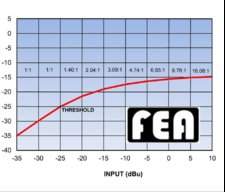
The lowest ratio settings are very soft-knee and the higher ratios are hard-knee. The discussion of "ballpark" numbers around the dial came up after I already had thousands of face-plates made. But here is the approx ratio positions around the knob:

MIN (7:00) = 1.5:1
9:30 = 4:1
12:00 = 6:1
2:30 = 11:1
Max (5:00) = 20:1

Thanks!
-Frank

Thanks for a great product Frank.
Looks like my quick test ended kinda close to 4:1
As you probably are ready know, many engineers will use approx. 4:1 on bass to get a decent level to tape.
Even with a pro player, a slight bump won't hurt the players intent and a more challenged part will still get decent S/N while allowing seemless further processing during mix down.

This bad boy works really well and look, 2 threshold indicators!
 
Whew! Just read through all 39 pages of this threat. Took a few days. LOL!

I've been running an MXR M87 for years. I basically use it for pick playing or if I need to get a "squashed" tone as I really don't like the neutering it does to my low notes on the B string. It seems those big notes just overwhelm it, even on my passive bass.

I am not a compression expert. I basically want a comp that can do the thinking for me. So I've ordered a Keeley Compressor Pro....then I saw the G-Lab BC-1 review. I'm a BIG fan of simple and effective. I like the set and forget nature of the BC-1 and with two channels I can have one for "normal" and one for "squashed" and switch between them. The kicker for me is that I've been selecting pedals with MIDI functionality for the purpose of using with my Source Audio Soleman MIDI controller. I can write MIDI macros and have specific settings for various tones, or I can put it in set list mode and walk through songs on my set list. No tap dancing on pedals. My Le Bass, H9, Source Audio EQ, and now the BC-1 are all able to be MIDI controlled giving me the ability to control everything with one tap.

So I'm going to end up with three compressors and will get to have my own comparison to see which one remains. I also have my name on the list to be notified with an FEA DE-CL is available.
 
  • Like
Reactions: Mohawk and Fuzzbass
After experimenting with my new Suave/Tough Smoothie Opto this morning, it's a definite that I prefer it set to the Suave setting. I'm not a big fan of strong compression that grabs my notes really hard. I prefer my compressor to simply fatten, smooth, and bring my sound a little more forward in the mix. I believe that's what the Suave setting does better. If I played slap, I'd probably prefer the Tough setting, but I never play slap.

I've been tinkering with the knobs in various positions, but I won't get to really settle in on those preferences until I have it in a full band mix at church tomorrow morning. However, I've had the OTA Smoothie for a while, so I'm familiar with how it functions.

In doing a brief comparison between my OTA Smoothie and my new Tough/Suave Opto Smoothie, I can say they're much more similar than they are different. Maybe this is just my ears hearing what they want to hear, but the Opto seems to have just a tiny bit more of that "magical tone sauce," similar to the Diamond compressor. And that would make sense, since the Diamond is also an optical compressor.
 
After experimenting with my new Suave/Tough Smoothie Opto this morning, it's a definite that I prefer it set to the Suave setting. I'm not a big fan of strong compression that grabs my notes really hard. I prefer my compressor to simply fatten, smooth, and bring my sound a little more forward in the mix. I believe that's what the Suave setting does better. If I played slap, I'd probably prefer the Tough setting, but I never play slap.

For me, it was a Tough choice -- bad pun intended. I went with the Tough because I already owned a pair of comps that do transparent smoothing very well (Empress, Cali76 G-P) -- and the FEA DE-CL I just got can do the same. I like that the Tough adds that little something extra.

Obviously I made the decision before the more versatile Smoothie came out. No big deal, stuff happens. Again, when I want Suave compression I have other comps that do that. I'm glad I have the Tough in my palette.
 
This arrived. FEA DB-CL

7B7B4FC9-5351-46FC-9B33-462ADEF84FDA.jpeg


Review coming but thoughts on Taurus Tux MK2 first.
 
Scubaduba sir, The work you've contributed here is much appreciated. Not sure if its on your list but I'd really like to find out more on the new Smoothie Tough+Suave version. Your reviews of the Suave version had me going back and forth between the Suave and Tough but now with the Tough+Suave version I'm almost sold. Being able to combine the 2 via the DIP switches seems flexible enough to cover most of the ground I'd need in a compressor
 
Last edited:
  • Like
Reactions: scubaduba
I've had enough of the hype and name dropping for a little pedal compressor compared to a pro $2.5K - 4.5K rack compressor...

There are many pedal manufacturers making the comparison of a $250 pedal compressor to a UA1176 and now a SSL compressor ($2K - 4.5K).
IMO, this is a total crock of marketing crap.

I used the stereo version of the 1176 on Saturday night. It sounds nothing like a guitar / bass pedal compressor. The 1176 and much of the UA line have a distinctive tone and compression action due to their custom wound output transformers which are about 1/2 the size of a pedal comp by itself.

I've only used an SSL stereo buss type compressor once and it was glorious.
We ran the 2-mix through it but without the drums and was used gently so that the mastering engineer could add a touch more compression to "glue" the mix together. I'm not aware that it was designed as a single instrument unit for bass.

Why stop here. How about a comparison to the Fairchild 660 & 670's of the 50's and 60's with something like 20 tubes and 10 transformers. It was used on nearly all of the Beatle's Abbey Road sessions. They sell for something like $20K used; let's compare it to a pedal. And then there are the Neve compressors.

The MXR does not sound very much like a 1176 to me although I have not A/B'd them.
It will be interesting to see if the Darkglass contains enough fairy dust to make their comparrisons accurate.
.02
 
I've had enough of the hype and name dropping for a little pedal compressor compared to a pro $2.5K - 4.5K rack compressor...

There are many pedal manufacturers making the comparison of a $250 pedal compressor to a UA1176 and now a SSL compressor ($2K - 4.5K).
IMO, this is a total crock of marketing crap.

I used the stereo version of the 1176 on Saturday night. It sounds nothing like a guitar / bass pedal compressor. The 1176 and much of the UA line have a distinctive tone and compression action due to their custom wound output transformers which are about 1/2 the size of a pedal comp by itself.

I've only used an SSL stereo buss type compressor once and it was glorious.
We ran the 2-mix through it but without the drums and was used gently so that the mastering engineer could add a touch more compression to "glue" the mix together. I'm not aware that it was designed as a single instrument unit for bass.

Why stop here. How about a comparison to the Fairchild 660 & 670's of the 50's and 60's with something like 20 tubes and 10 transformers. It was used on nearly all of the Beatle's Abbey Road sessions. They sell for something like $20K used; let's compare it to a pedal. And then there are the Neve compressors.

The MXR does not sound very much like a 1176 to me although I have not A/B'd them.
It will be interesting to see if the Darkglass contains enough fairy dust to make their comparrisons accurate.
.02

I've never used a high end rack compressor so I have no idea how close these pedals are or aren't. But, I will say that these rack compressors from the 50's, 60's, etc. were built the way they were not because someone WANTED to use tubes and custom hand wound transformers, but rather because they HAD to use them. They were the only technology available. Technology has come a little ways in the last 50 years though.

Digital may or may not be able to emulate them exactly, and for me personally I'll never know for sure as I know I'm never going to be in a situation where I'll have an opportunity to try a high end rack mount compressor worth thousands. However, I'd be willing to bet the stomp box version will be close enough that for most of us we won't know the difference nor care for the application we're using them for (which isn't recording albums as a member of The Beatles).
 
The MXR does not sound very much like a 1176 to me although I have not A/B'd them.

I believe that many of the “we have a famous rack in a stomp-box” compressors are due to the very similar attack and release dynamics. The MXR goes from fast to really, really fast attack times, like the 1176. I believe that is where the similarities end tho, because the 1176 uses a single FET in the very beginning of the audio path for gain control. I believe the MXR uses a VCA. The 1176 is designed to minimize the FET distortions, but there is sill a little distortion that is always in the signal. VCA's are designed to have nearly no distortions or the THD is so low (near zero) that you, as a human, would never hear them.

Even Bongo (golden eared Cyrus) did a side-by-side of the Cali76 (with TX) and an 1176. He said they were similar, but there were audible differences. When they released the Cali CB comps, Cyrus did another side-by-side between the big box Cali and the CB. I asked him if the CB got closer to the sound of the 1176 or further from it. He said that the CB got further from the 1176 sound, but said it was still an exceptional sounding comp. I believe the Cali comps are very similar circuit designs to the original 1176. Even with the very similar audio and sidechain circuits they have enough differences (I’m guessing internal operating voltages and attack times/dynamics) that Cyrus was able to hear them.

Even the WarmAudio 76 has been both reported to sound exactly like an 1176 and slightly different than an 1176. I believe that the WA76 is a perfect clone of the UA1176… So, I believe there will always be some eye-to-ear bias that will influence people’s perceptions.

BTW… I am in the process of stuffing a $20K rack comp into a stompbox! Please stand by….;)

-Frank
 

Latest posts