
Not even slightly. It's 2026: power supplies are smaller, more flexible, and more powerful than ever before. A Cioks DC7 + Crux powers a whole board of pedals plus a DLA-2A. If you only have a few pedals, you don't even need the Crux and can use the DC7 to power the DLA-2A by current summing four outputs.Adapters could be ok; but, the 1.5A power requirement is steep for a pedal board.
But, thanks for the suggestion.

Enjoy the benefits of a premium membership!
Upgrade Account
-
TalkBass has been independent since 1998. Add your voice.
Create a free account to reply to discussions, view embedded media, and browse with fewer display ads.
Join free Log in
Want zero display ads or expanded classifieds tools? Compare plans.
You are using an out of date browser. It may not display this or other websites correctly.
You should upgrade or use an alternative browser.
You should upgrade or use an alternative browser.
Testing Compressors: Cali, Smoothie, Empress, Diamond, Keeley, FEA, Darkglass, Doc Lloyd, Lusithand & more
- Thread starter scubaduba
- Start date
More options
Who Replied?


Echo Fix EF-P5 FET compressorIs there such thing as a compressor that can take a Line Level XLR Feed, perform subtle compression, and send the slightly compressed result via Line Level XLR?
Probably not, but thought I would ask.
I've been playing through one since it came out and it will do what you want and plenty else. It's not exactly cheap, but it's much more affordable than 1176 rack compressors, and probably better for bass with parallel compression and the sidechain high pass filter.


Many thanks.Echo Fix EF-P5 FET compressor
I've been playing through one since it came out and it will do what you want and plenty else. It's not exactly cheap, but it's much more affordable than 1176 rack compressors, and probably better for bass with parallel compression and the sidechain high pass filter.
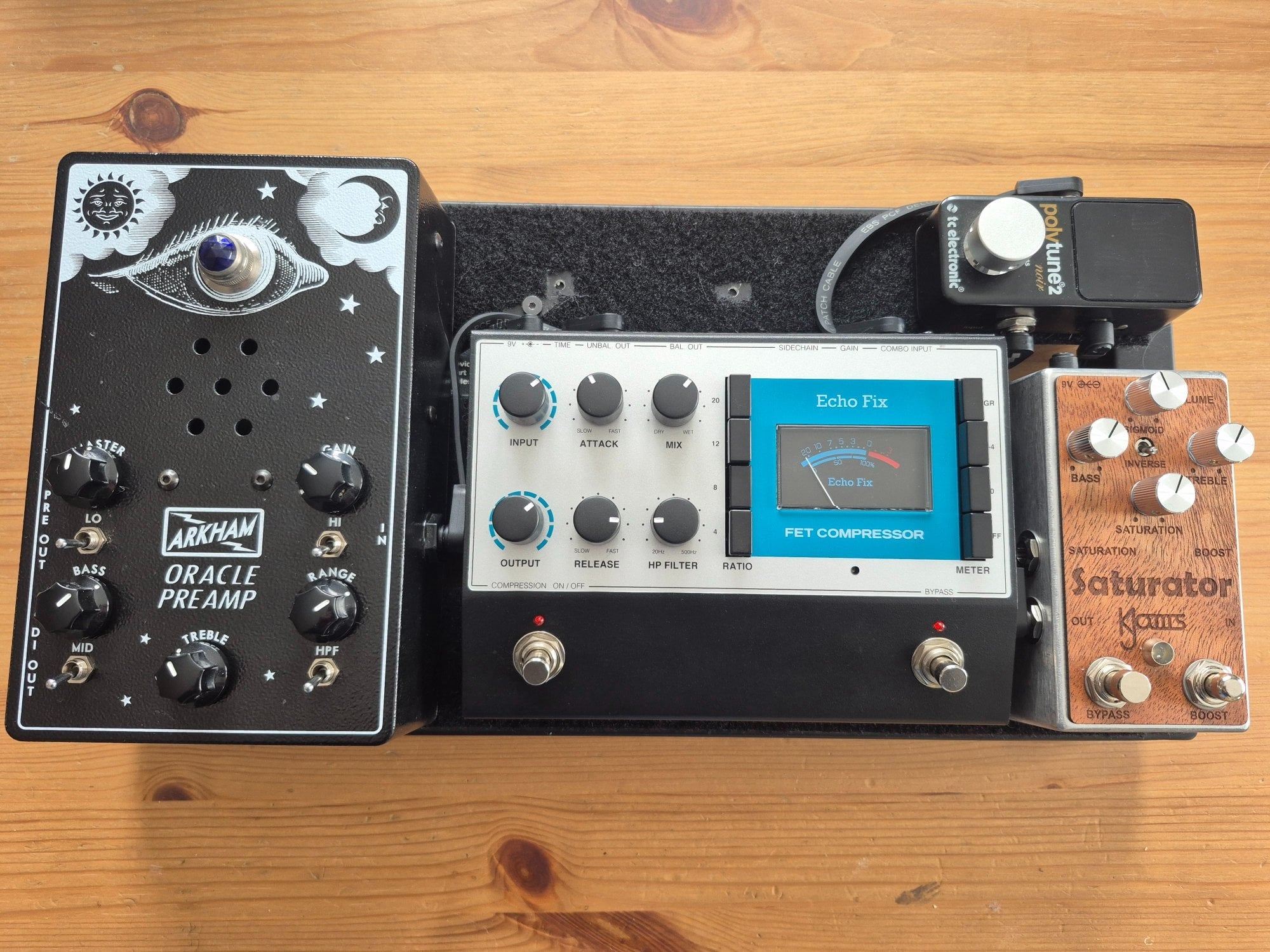
 Looks like it might well fit my need.
Definitely this. The Echo Fix has killed my compressor GAS (and their other pedals have done the same for reverb and chorus). The input is a combination XLR-1/4" plug that will take any signal, and it has a DI-out.Echo Fix EF-P5 FET compressor
I've been playing through one since it came out and it will do what you want and plenty else. It's not exactly cheap, but it's much more affordable than 1176 rack compressors, and probably better for bass with parallel compression and the sidechain high pass filter.



Interesting…
I bought the Cali Stacked out of curiosity awhile back. Like all Origin comps, quality is outstanding: high transparency, low noise. I understand the theory of stacking: two comps can sound more natural (fewer artifacts) than one when attempting to achieve the same result. There are other applications to stacking as well. However I didn't experience any noticeable improvement over the other comps in my collection, so I let it go.
I blame myself for this. I didn't give the comp the workout it deserved, in large part because I don't use compression all that often. I use overdrive much of the time, which can mask subtleties of a compressor (when I decide to use one).
Yeah, I know: I should have sent it to scuba before selling it.

With some further thought, all I really want in a compressor is to shave the peaks just enough to make the sound engineer happy, while maintaining transparency. I am NOT looking for tone refinement in a compressor. Happy with my tone. In fact, my pref would be not to change my tone at all.
Would the Becos Mini Pro fill that bill?
Appreciate this thread and the guidance. Never been a Compressor user; and complete ignorance about the array of pedals. Last year, I had very positive hookup with the various sound engineers using the Sansamp BDDI; and I believe part of that was the slight compression in that circuit. Now, I’d like to get into that space with some other preamp / DI’s; if that makes sense.
Would the Becos Mini Pro fill that bill?
Appreciate this thread and the guidance. Never been a Compressor user; and complete ignorance about the array of pedals. Last year, I had very positive hookup with the various sound engineers using the Sansamp BDDI; and I believe part of that was the slight compression in that circuit. Now, I’d like to get into that space with some other preamp / DI’s; if that makes sense.

I think you’d be happy with the mini.With some further thought, all I really want in a compressor is to shave the peaks just enough to make the sound engineer happy, while maintaining transparency. I am NOT looking for tone refinement in a compressor. Happy with my tone. In fact, my pref would be not to change my tone at all.
Would the Becos Mini Pro fill that bill?
Appreciate this thread and the guidance. Never been a Compressor user; and complete ignorance about the array of pedals. Last year, I had very positive hookup with the various sound engineers using the Sansamp BDDI; and I believe part of that was the slight compression in that circuit. Now, I’d like to get into that space with some other preamp / DI’s; if that makes sense.

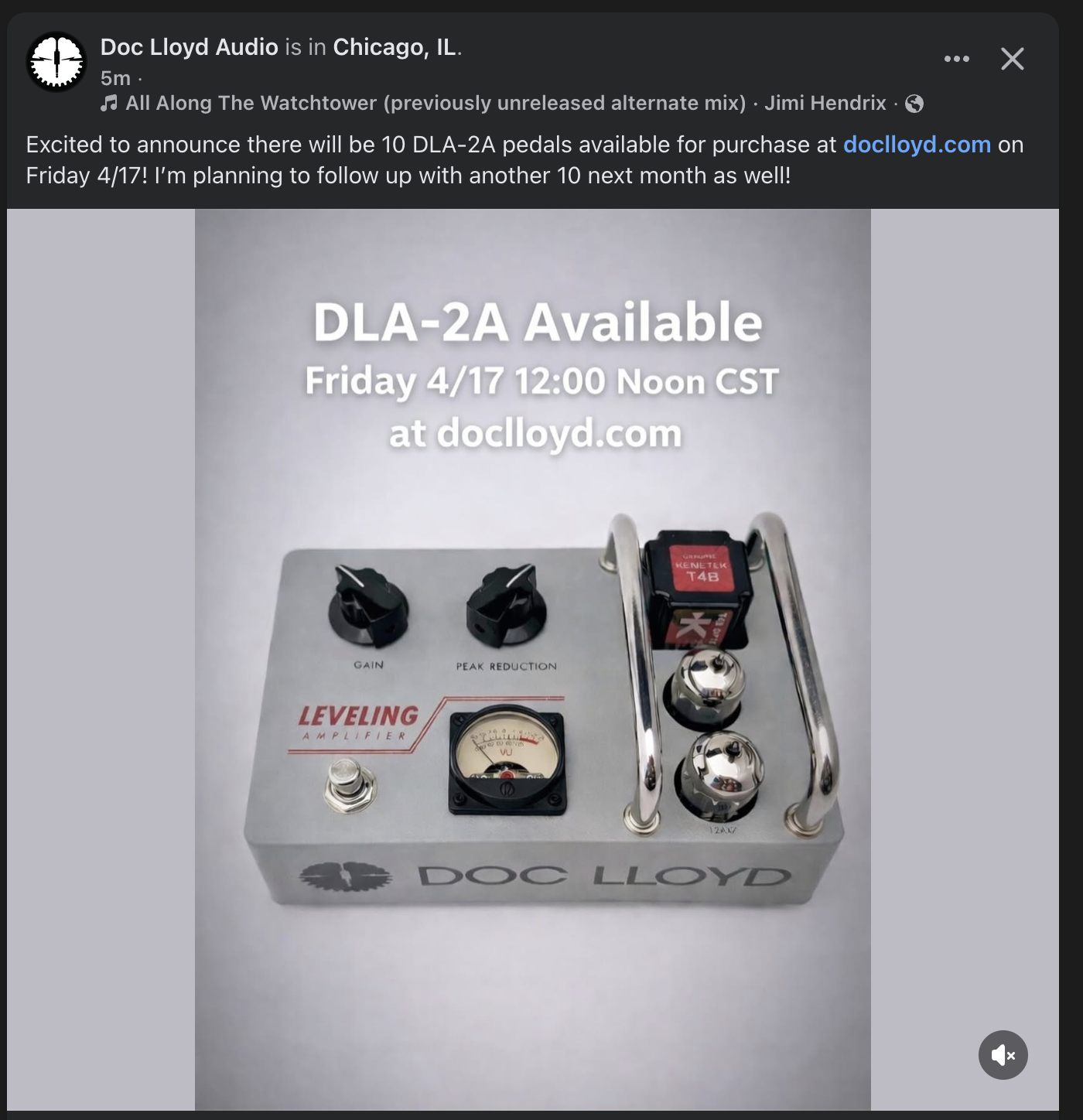
Just noticed this on the Doc Lloyd FB page.

Hey! Question for BECOS and/or Arkham Oracle users in general. I currently use the Oracle with an Echo Fix EF-P5 and a DCX Bass, and I’m looking for another compressor to alternate with.
I’ve been considering the BECOS Twain and the Lusithand Alma. For those who’ve used the Twain, would you say it’s very complex to use? I have some experience with compressors, but I wouldn’t call myself an expert. I do appreciate flexibility, though over time I’ve realized I’m more of a “set and forget” type.
I know there are more user-friendly options within BECOS, but I didn’t want to rule the Twain out without asking—maybe the learning curve isn’t that steep, and the potential improvement in results could make it worthwhile. On the other hand, I’d also like to avoid going for the Twain and ending up feeling overwhelmed by the number of controls.
I’d also value something that pairs well with a Jad Freer CAPO.
I’ve been considering the BECOS Twain and the Lusithand Alma. For those who’ve used the Twain, would you say it’s very complex to use? I have some experience with compressors, but I wouldn’t call myself an expert. I do appreciate flexibility, though over time I’ve realized I’m more of a “set and forget” type.
I know there are more user-friendly options within BECOS, but I didn’t want to rule the Twain out without asking—maybe the learning curve isn’t that steep, and the potential improvement in results could make it worthwhile. On the other hand, I’d also like to avoid going for the Twain and ending up feeling overwhelmed by the number of controls.
I’d also value something that pairs well with a Jad Freer CAPO.
Many thanks for the kind input I received.
I purchased the Becos Mini Pro, and should have it for testing by the upcoming weekend. Will post up.
I purchased the Becos Mini Pro, and should have it for testing by the upcoming weekend. Will post up.

I know this isn't exactly what you were asking (I have no experience with the Twain or Alma) - but I've paired a few different compressors with the Oracle, and have been really happy with the API TranZformer CMP. Definitely not as complex as the Twain, but I still feel like it has enough options to be flexible - and is easy to just "set and forget". I've loved the feel and sound of it in front of the Oracle.Hey! Question for BECOS and/or Arkham Oracle users in general. I currently use the Oracle with an Echo Fix EF-P5 and a DCX Bass, and I’m looking for another compressor to alternate with.
I’ve been considering the BECOS Twain and the Lusithand Alma. For those who’ve used the Twain, would you say it’s very complex to use? I have some experience with compressors, but I wouldn’t call myself an expert. I do appreciate flexibility, though over time I’ve realized I’m more of a “set and forget” type.
I know there are more user-friendly options within BECOS, but I didn’t want to rule the Twain out without asking—maybe the learning curve isn’t that steep, and the potential improvement in results could make it worthwhile. On the other hand, I’d also like to avoid going for the Twain and ending up feeling overwhelmed by the number of controls.
I’d also value something that pairs well with a Jad Freer CAPO.

The TWAIN ... I have one original version and I am too dumb to use it right. Can someone show some typical examples of settings for .. say ... a P-Bass finger-style and a Jazz-Bass slap-style?
I am unsure where to put the frequency split and how to treat the high and low spectrum differently.
Thanx in advance !
I am unsure where to put the frequency split and how to treat the high and low spectrum differently.
Thanx in advance !

Many YouTube mixing videos uses a split around 200-250 hz.
you can use different threshold for the low high band to achieve 3-5dB reduction, and use the gain the balance the volume.
For finger/slap tone, if you want aggressive tone, go for slow attack fast release, accentuate the peaks/snap.
If you want smooth tone, go for fast attack slow release.
Good luck
you can use different threshold for the low high band to achieve 3-5dB reduction, and use the gain the balance the volume.
For finger/slap tone, if you want aggressive tone, go for slow attack fast release, accentuate the peaks/snap.
If you want smooth tone, go for fast attack slow release.
Good luck

Have you tried any of the settings examples here?The TWAIN ... I have one original version and I am too dumb to use it right. Can someone show some typical examples of settings for .. say ... a P-Bass finger-style and a Jazz-Bass slap-style?
I am unsure where to put the frequency split and how to treat the high and low spectrum differently.
Thanx in advance !
As for where to split, you may think of a particular note or a string dominant frequency on your instrument and split there. Then you can adjust compression independently above and below that frequency. For bass instrument, as suggested, below 200-300Hz it is where it makes most sense; higher up for guitar, but not necessarily, even lower can be helpful. Perhaps bellow 100Hz it’s most practical for bass. It also depends on the pickups, playing style, songs, preference, other effects used, etc. Basically, there's no one setting that can suit all players, it all depends on several variables. But the settings page we provide (link above) are good starting points, then trim to your needs.
When I am using the Twain in dual band mode, I usually set the X-over control between noon and 3pm (150-300Hz).The TWAIN ... I have one original version and I am too dumb to use it right. Can someone show some typical examples of settings for .. say ... a P-Bass finger-style and a Jazz-Bass slap-style?
I am unsure where to put the frequency split and how to treat the high and low spectrum differently.
Thanx in advance !
My settings for lows and highs usually differ to some extent (for example, I tend to set higher ratio for lows) but the important thing to understand is: one does not have to use different settings for lows and highs. Even with exactly the same settings for both sides, one makes use of the benefit of dual band compression.
I would recommend starting with the X-over control at noon or slightly above, moderate ratio on both sides (between 9pm and noon) and setting the threshold so you get about 4db of gain reduction. Seek inspiration from "Setting examples" on Becos web.
Good luck and enjoy!
Last edited:
Becos Mini Pro received.Many thanks for the kind input I received.
I purchased the Becos Mini Pro, and should have it for testing by the upcoming weekend. Will post up.
I set it on a board ahead of a TC Spark Mini followed by the SLO Pre/DI; and first impressions are extremely positive. It seems to control the DI spikes while retaining an open, uncompressed tonal character. Excellent!
Need to spend more time with it; but, very positive so far.


