The other thing I've seen over the years in "venues" is an outlet on stage that has been used so many times that a plug will barely stay inserted. That seems like a hazard also.You never know what you are going to get at a venue. Although if it looks like a dive, you can usually count on the line power doing the same.

Enjoy the benefits of a premium membership!
Upgrade Account
-
TalkBass has been independent since 1998. Add your voice.
Create a free account to reply to discussions, view embedded media, and browse with fewer display ads.
Join free Log in
Want zero display ads or expanded classifieds tools? Compare plans.
You are using an out of date browser. It may not display this or other websites correctly.
You should upgrade or use an alternative browser.
You should upgrade or use an alternative browser.
More options
Who Replied?

- Feb 12, 2006
- 61,047
- 5
- 221,002
- Disclosures
- Development Engineer-Mesa Boogie, Development Engineer-Genzler (pedals), Product Support-Genz Benz
It IS a hazard!The other thing I've seen over the years in "venues" is an outlet on stage that has been used so many times that a plug will barely stay inserted. That seems like a hazard also.

That's why they have Gaffer's tape.The other thing I've seen over the years in "venues" is an outlet on stage that has been used so many times that a plug will barely stay inserted. That seems like a hazard also.

-Boys and girls, do not try this at home, or anywhere else for that matter.-

Bob Lee (QSC)
In case you missed it, I work for QSC Audio!
- Jul 3, 2001
- 12,668
- 2,036
- 67
- Disclosures
- Former Technical Communications Developer, QSC Audio
The other thing I've seen over the years in "venues" is an outlet on stage that has been used so many times that a plug will barely stay inserted. That seems like a hazard also.
Even the American Airlines Admiral's Clubs at DFW suffered from that. I'd try to plug in my laptop and charge my phone during a layover, and all the outlets I could find were loose.

BurningSkies
CRAZY BALDHEAD
- Feb 20, 2005
- 27,956
- 20,350
- Disclosures
- Endorsing artist: Dingwall Guitars
It IS a hazard!
Yes, these kind of poor connections can be a serious fire hazard.

When the receptacle springiness disappears, they generate heat because the connections then become less conductivd. The heat that's generate further weakens the clamping force on each tine..... resulting in more heat.... resulting in more resistance.....up to and sometimes including: immolation.
If they're loose now, they'll not get tighter and they are at that point in time, dangerous.
Sometimes you can extend service time by bending the male prongs to put more pressure on only one side of the contacts. If you don''t have something that calls for 80% of the circuit rating..... you may not burn up. Or not!
I recommend telling the venue person that you'll change out the cheap back-stab receptacle with a Hospital Grade, green dot 20 Amp. Then hope that you're receptacle isn't daisy chained to other overheated receptacles, closer to the supply.
Those 15 Amp back-stabs are a fire waiting to happen. You will NOT find any back-stabs in anything I own, live or work in.
If they're loose now, they'll not get tighter and they are at that point in time, dangerous.
Sometimes you can extend service time by bending the male prongs to put more pressure on only one side of the contacts. If you don''t have something that calls for 80% of the circuit rating..... you may not burn up. Or not!
I recommend telling the venue person that you'll change out the cheap back-stab receptacle with a Hospital Grade, green dot 20 Amp. Then hope that you're receptacle isn't daisy chained to other overheated receptacles, closer to the supply.
Those 15 Amp back-stabs are a fire waiting to happen. You will NOT find any back-stabs in anything I own, live or work in.

I’ve seen these on Amazon. I wonder about how effective it is, also if there is any regulatory approval.
THE SOCKET SAVER™ | Save That Wall Socket!
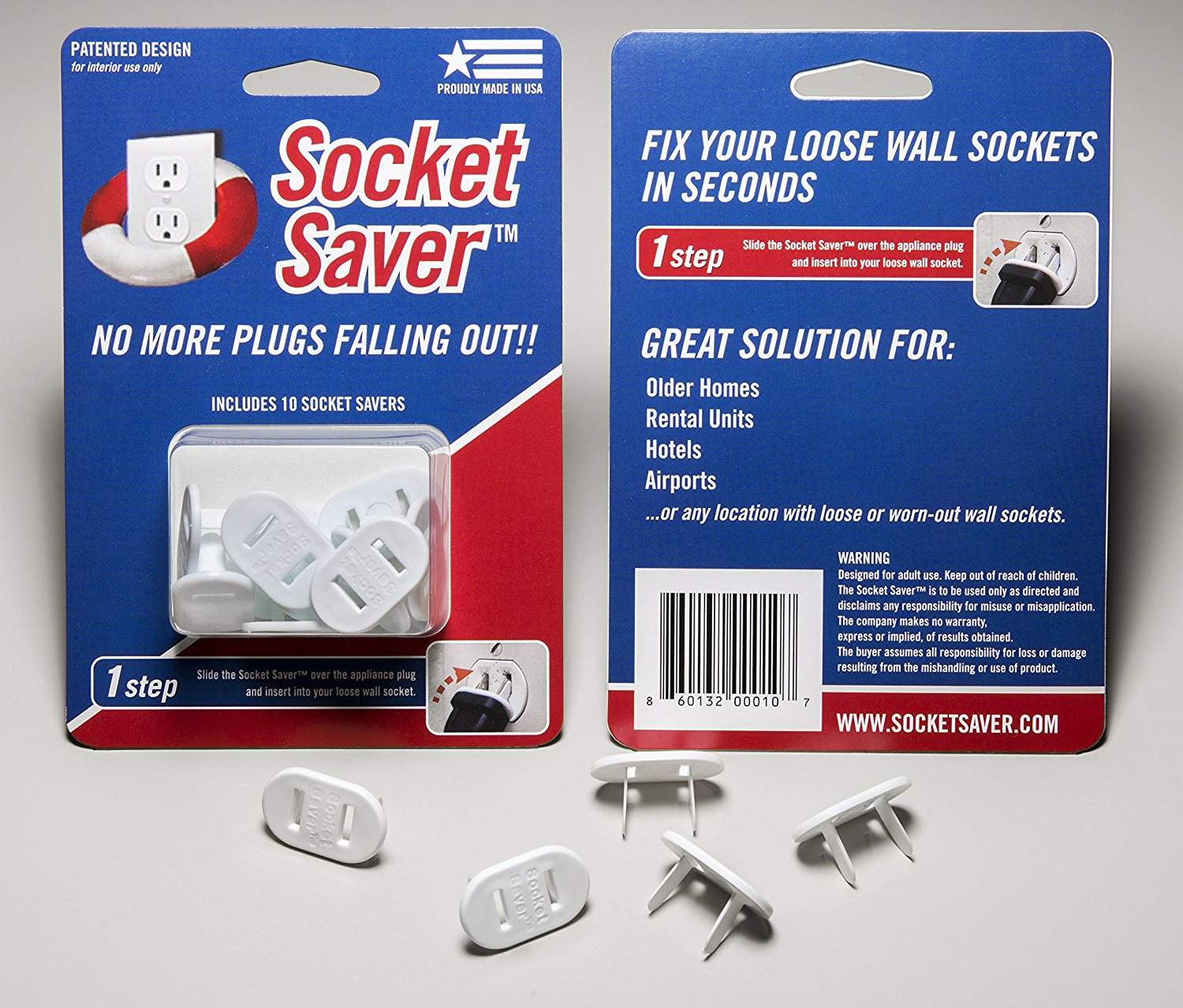
THE SOCKET SAVER™ | Save That Wall Socket!
I’ve seen these on Amazon. I wonder about how effective it is, also if there is any regulatory approval.
THE SOCKET SAVER™ | Save That Wall Socket!
View attachment 2878276
This forces the prongs to one side, cutting out half of the contact area. Like I say using just 50% of the connection MIGHT BE OK with a table lamp, a small clock radio or a telephone wall wart.
Asking for full rating Amps out of a worn out, jury rigged and tricked wall receptacle would be dangerous in my humble opinion.

So do these come with a reminder to check your smoke detector and pay up your fire Insurance
Last edited:
I would think they would eliminate one side of each contact in the wall outlet from making connection to the plug.I’ve seen these on Amazon. I wonder about how effective it is, also if there is any regulatory approval.
THE SOCKET SAVER™ | Save That Wall Socket!
View attachment 2878276
If you've already got sketchy contacts, this could make things worse by cutting down on the contact surface area even though it might make the plug a little tighter. If you think you need these, you REALLY need to just replace the wall outlet.
"Farewell and adieu my fair Spanish ladies..."
Beat me to it.This forces the prongs to one side, cutting out half of the contact area. Like I say using just 50% of the connection MIGHT BE OK with a table lamp, a small clock radio or a telephone wall wart.
Asking for full rating Amps out of a worn out, jury rigged and tricked wall receptacle would be dangerous in my humble opinion.


The only problem with this, which was covered in a thread some time ago, is code doesn't allow 20 amp receptacles on 15 amp circuits.When the receptacle springiness disappears, they generate heat because the connections then become less conductivd. The heat that's generate further weakens the clamping force on each tine..... resulting in more heat.... resulting in more resistance.....up to and sometimes including: immolation.
If they're loose now, they'll not get tighter and they are at that point in time, dangerous.
Sometimes you can extend service time by bending the male prongs to put more pressure on only one side of the contacts. If you don''t have something that calls for 80% of the circuit rating..... you may not burn up. Or not!
I recommend telling the venue person that you'll change out the cheap back-stab receptacle with a Hospital Grade, green dot 20 Amp. Then hope that you're receptacle isn't daisy chained to other overheated receptacles, closer to the supply.
Those 15 Amp back-stabs are a fire waiting to happen. You will NOT find any back-stabs in anything I own, live or work in.

I don't see the logic to that part of the code. As long as the circuit is protected by a 15A breaker, that's all you're gonna get, and you still realize the benefit of a more robust connector.The only problem with this, which was covered in a thread some time ago, is code doesn't allow 20 amp receptacles on 15 amp circuits.
The only danger is if someone changes the breaker to a 20 A or larger, however someone could do that and create a dangerous situation even without changing the receptacle
Lol. I didn't say it was logical but telling the venue owner to install a code violation could lead to some liability issues, no? How about just suggesting some properly installed and operating devices? There are 15amp receptacles that aren't stab-locks. They'd probably tell you to go scratch either way but at least you wouldn't be leading him to a potential fine.I don't see the logic to that part of the code. As long as the circuit is protected by a 15A breaker, that's all you're gonna get, and you still realize the benefit of a more robust connector.
The only danger is if someone changes the breaker to a 20 A or larger, however someone could do that and create a dangerous situation even without changing the receptacle
but the code does allow 15 amp recpt on a 20 amp circuit. ( at least residential) If the recpt has one what looks like a sideways t the the recpt is 20 amp. Look at the cords if they are iec, chances are they are 10 amp cords. Two vertical (usa) prongs indicate max of 15 amps. Some distance memory from 10 years ago, reminds me that stages should wired for 20 amps. But I know from experience it ain't so.The only problem with this, which was covered in a thread some time ago, is code doesn't allow 20 amp receptacles on 15 amp circuits.
I wouldn't use these units without the advice of a professional double e, the 4000 unit is not a plug in unit. I seen casitas with less breaker protection.If the line voltage is off, it can also affect the power amp stage bias on some amps. Some bands, with deep pockets, carry this 4000vA unit:
Invalid Link Removed.
The line voltage and frequency remains constant anywhere in the world.
I wouldn't use these units without the advice of a professional double e, the 4000 unit is not a plug in unit. I seen casitas with less breaker protection.
A lot of bands bands use them because they can sound the same anywhere in the world. Dial in your line voltage and frequency. Angus Young for example believes that there’s a sweet voltage setting, 236 VAC, 60Hz that makes his Marshalls sound the best. He has that dialed in where ever he plays, amps don’t need to be rebiased from one country to the next because the line voltage never changes.
one less variable to worry about. The 220-240 line voltages are more compatible than the lowly 120v available to the US. wonder how much it costs to get that dedicated power line. Not a bar gig equipment item.A lot of bands bands use them because they can sound the same anywhere in the world. Dial in your line voltage and frequency. Angus Young for example believes that there’s a sweet voltage setting, 236 VAC, 60Hz that makes his Marshalls sound the best. He has that dialed in where ever he plays, amps don’t need to be rebiased from one country to the next because the line voltage never changes.
The only problem with this, which was covered in a thread some time ago, is code doesn't allow 20 amp receptacles on 15 amp circuits.
I regularly pull 14 AWG out and fish 12 AWG THHN in place of it where I can and when I'm remodeling a wall. Otherwise I rewire the wall when I have it open.
But - yeah - just putting a 20 Amp wall receptacle on a 14 AWG run isn't smart - but it will surely beef up the contacts.
Besides - getting rid of the back-stabs for screw connex is the best idea.
Like I said though - it's all for naught if you're on the end of a string of back-stabs with overheated spring retainers and questionable-when-new push-ins that are just folly in a commercial building. People who run 14 AWG and 15 Amp receptacles in a commercial building should have their thumbs broken.
.
one less variable to worry about. The 220-240 line voltages are more compatible than the lowly 120v available to the US. wonder how much it costs to get that dedicated power line. Not a bar gig equipment item.
Crazy as it may seem, there's a lot of refers and compressors in bars for AC/HVAC and heat pumps, walk-ins, etc.
If 480 3ph is available - it's the bean counters who make the place unfit to be called 'commercial'.


