Thanks Jeff I’m looking forward to receiving this unit. I’ll check it out and post a quick review.Keep in mind the EQ controls are highly interactive, but great tones lurk within! I've had two, and keep thinking about another one.

Enjoy the benefits of a premium membership!
Upgrade Account
-
TalkBass has been independent since 1998. Add your voice.
Create a free account to reply to discussions, view embedded media, and browse with fewer display ads.
Join free Log in
Want zero display ads or expanded classifieds tools? Compare plans.
You are using an out of date browser. It may not display this or other websites correctly.
You should upgrade or use an alternative browser.
You should upgrade or use an alternative browser.
The Alembic F-1X Megathread
- Thread starter Michael Vee
- Start date
More options
Who Replied?
Keep in mind the EQ controls are highly interactive, but great tones lurk within!
Very true! Remember, too, that the “flat” setting on the EQ is 2-10-2 (bass-mid-treble). Start from there. This tone stack simulator is worth playing around with as it will help you understand the interactive nature of the EQ (thanks to Alembic Bill for the link):
TSC
To simulate the F-1X, use the Fender tone stack and swap the C2 and C3 values (make C2=47n, C3=100n).
Enjoy!
Last edited:

Well, received the unit yesterday and I was impressed by the quality. I plugged it in and started with a setting of 2-10-2 as suggested, I immediately heard that valve warmth in the sound and once I got to tweaking the settings I could go from molasses thick bottom to glass-shattering highs and everywhere in between.
Up to this point I had only read reviews on the F-1X and they all spoke very highly of the sound, confirmed: it sounds awesome! I'm mounting it in a rack this week so I can take if for a spin on the weekend.
Thanks to all for the great advice.
Up to this point I had only read reviews on the F-1X and they all spoke very highly of the sound, confirmed: it sounds awesome! I'm mounting it in a rack this week so I can take if for a spin on the weekend.
Thanks to all for the great advice.

To simulate the F-1X, use the Fender tone stack and swap the C1 and C2 values (make C2=47n, C3=100n).
Wouldn't swapping C1 and C2 values make C1=100nF, C2=250pF, and C3=47nF? Then again, I'm easily confused when it comes to this stuff.
Wouldn't swapping C1 and C2 values make C1=100nF, C2=250pF, and C3=47nF? Then again, I'm easily confused when it comes to this stuff.
You are correct, sir! Here's the correct tweak to simulate an F-1X:
When you first run the TSC, click on the Fender tab. Next you need to make two changes:
Double click on C2 and change its value from 100 to 47.
Double click on C3 and change its value from 47 to 100.
That's work
Phew! I'm not losing my mind after all.
Now I have to dig mine out again and play through it. It's been too long.
Now I have to dig mine out again and play through it. It's been too long.
Now I have to dig mine out again and play through it. It's been too long.
Every time I go a few months (or longer) without playing through mind when I finally do so again I always think "damn, this thing is amazing..."

Keep in mind the EQ controls are highly interactive, but great tones lurk within! I've had two, and keep thinking about another one.
- There are really two separate sections in the circuit. The first section involves the BASS and MID pots, two caps and a fixed resistor. When the BASS control is at 0, the MID control is essentially a level control for all frequencies for this section of the circuit. When the BASS control is turned up, more low frequencies are *added* to the output of this section, increasing the overall level.
The second section consists of the TREBLE pot and a cap. One side of the cap connects directly to the input of the tone stack. The value of this cap is such that only high frequencies will pass through it. The TREBLE pot provides the final output from the tone stack and is connected such that at one extreme setting (10) it passes *mostly* the output from the treble cap and at the other extreme setting (0) it passes *mostly* the output from the BASS/MID section.
Now here's the observation I haven't seen anyone else make...
The TREBLE knob is actually a *blend* control between the output of BASS/MID section and the output of the treble cap !
So when you turn up the TREBLE, you're actually *reducing* the level that's coming from the BASS/MID section at the same time you're *increasing* the amount of signal coming from the treble cap.
Realizing this made it easier for me to think about how the knobs work. For example, if you want to add more highs and keep the lows and mids the same, you need to not only turn up the TREBLE knob, but also turn up the BASS and MID knob to compensate. I've seen descriptions of this circuit that say the BASS and TREBLE controls are "boost only" and the MID control is "cut only", but that's somewhat misleading. I tend to think of the MID control as a "direct" level, the BASS as a low-frequency boost and the TREBLE knob as a "blend" control as described above.
Hope this is helpful and not too confusing
doctec, Nov 27, 2008
ReportBookmark
#1Like+ QuoteReply
iSteen, StayLow and MrSidecar like this.
markorbit
Apr 16, 2004
IIRC something else is worth noting... increasing the treble control MOVES the actual mid frequency lower to incorporate more high mids whereas the bass control doesn't move the mid frequency likewise.
A neat (and free) program that graphically demonstrates what many common tone controls do can be found here:TSC
turning up the TREBLE knob adds highs *and* reduces lows
This is true. If both the BASS and TREBLE controls are at or near '0', the frequency response if fairly flat and MID knob acts like a gain control.
start at all "0", turn up the mids to about 5-7 (it now gets obvious that this is a kind of "direct" level as opposed to a midrange-boost, as this will not honk or sound telephone-isa the way mid-only boost EQs will), add bass according to taste/needs (basically to "fatten" the direct sound), tweak maybe the treble a notch. Then, if necessary, give some more bass/mids.

What does a lowender have to do to get a number in this megathread? Been using mine in my rack for as long as I can remember.


I had a pair of those for a few years,and later on I got an Aguilar DB659 preamp, pretty nice, but sold it fairly quickly and bought another F-1X.

Fantastic preamp. My standard for about 10 years, mid 90’s to mid 00’s, after which I spent the last 15 years with Demeter. But, I decided I wanted to jump back in a year ago. Here is the current rack.
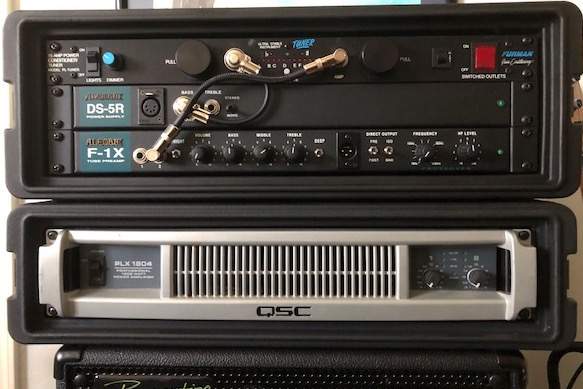
My last (really) upgrade will be to replace the wonderful PLX 1804 with a GX7, due in the end of this week. I think I’m done at that point. (I know, famous last words.)
My last (really) upgrade will be to replace the wonderful PLX 1804 with a GX7, due in the end of this week. I think I’m done at that point. (I know, famous last words.)
Last edited:

IIRC the F 1X is the Normal channel from a Fender Bassman. I wonder how they got permission to do that?
In 1968 I started to use a Leak TL50 Plus HiFi 50W tube power amp for my bass. To drive it I built the equivalent to the Normal channel. The pre-amp plugged into the power amp and was powered by it. It worked well.
In 1968 I started to use a Leak TL50 Plus HiFi 50W tube power amp for my bass. To drive it I built the equivalent to the Normal channel. The pre-amp plugged into the power amp and was powered by it. It worked well.
Showman. Main difference being the Middle control.IIRC the F 1X is the Normal channel from a Fender Bassman.
Showman. Main difference being the Middle control.
I'll accept that Jeff Lad. Thanks for the correction. I'm old remember - I can't be right all the time!
I'm not that far behind you!I'll accept that Jeff Lad. Thanks for the correction. I'm old remember - I can't be right all the time!

Correction was made for the historical record, otherwise these things become internet facts.


You are right...Always be mindful when we share "facts" as the truthI'm not that far behind you!
Correction was made for the historical record, otherwise these things become internet facts.
I see in 5 years the search function bringing up the truth...Hehe

Just found my rack with my F-1X > Ashley DPX200 (full rack unit with half parametric EQ and half compressor) and gave it a run with my PBass with flats.
Now I want to get one or two of these and use it as my main rig:
ISP Technologies Bass Vector 210 400-watt 2x10" Powered Bass Cabinet
Now I want to get one or two of these and use it as my main rig:
ISP Technologies Bass Vector 210 400-watt 2x10" Powered Bass Cabinet


