• TalkBass has been independent since 1998. Add your voice.
    Create a free account to reply to discussions, view embedded media, and browse with fewer display ads.
    Join freeLog in
    Want zero display ads or expanded classifieds tools? Compare plans.

The bassline for Penny Lane

hbarcat

Supporting Member
Aug 24, 2006
10,227
18,633
Rochelle, Illinois
I have questions about how the bassline for "Penny Lane" by the Beatles was recorded.

To my ear, there is a lot of overdrive tube "fuzz" on the bass. I'm wondering what amp was used to record it. I'm guessing an Ampeg B-15 cranked all the way, but I'm not sure.

I'm especially interested in the enormously deep and growly tone whenever Paul hits the D in the chorus (after the lyric, "Penny Lane is in my ears and in my eyes", but before the lyric, "there beneath the blue suburban skies"). It seems as if his bass is in a drop D tuning. Is this correct? Again, I'm just guessing here.


For the record, if you listen to the version of Penny Lane from the Beatles Anthology release (the demo version), the bass sound is far more pronounced.
 
Last edited:
I have questions about how the bassline for "Penny Lane" by the Beatles was recorded.

To my ear, there is a lot of overdrive tube "fuzz" on the bass. I'm wondering what amp was used to record it. I'm guessing an Ampeg B-15 cranked all the way, but I'm not sure.

I'm especially interested in the enormously deep and growly tone whenever Paul hits the D in the chorus (after the lyric, "Penny Lane is in my ears and in my eyes", but before the lyric, "there beneath the blue suburban skies"). It seems as if his bass is in a drop D tuning. Is this correct? Again, I'm just guessing here.


For the record, if you listen to the version of Penny Lane from the Beatles Anthology release (the demo version), the bass sound is far more pronounced.
Ampegs in the UK before the SVT/V-4 turnaround for the company were very rare. There is no documentation that the Beatles in particular ever used them(occasionally Selmer and Fender before the complete changeover in ‘68 were seen in the studio).

They were still in their Vox era in late ‘66. By then they had received a new line of hybrid amps(solid state pre, tube/valve power); Paul was using the model 430, but there’s the possibility of a Fender. Track down Andy Babiuk’s Beatles Gear or Mark Lewisohn’s Beatles Recording Sessions books for more details.
 
I don’t have any insight to address your question but am I only the only one who thinks the first few notes, the way the kick in, are just freaking brilliant? Macca RULES.

I started out as a heavy metal fan and only got into the Beatles in my 30s when I started playing in classic rock cover bands.

I discovered that covering Beatles songs was difficult because Paul's basslines tend to be rather intricate and don't conform to how most bass players typically follow basic note selections from a chord chart. I found the easiest way to play Beatles songs was to just memorize Paul's basslines, note for note.

"Penny Lane" is an absolutely brilliant song in every way. In fact it's my most favorite song. No matter how many times I listen to it, I never get tired of hearing it.
 
Ampegs in the UK before the SVT/V-4 turnaround for the company were very rare. There is no documentation that the Beatles in particular ever used them(occasionally Selmer and Fender before the complete changeover in ‘68 were seen in the studio).

They were still in their Vox era in late ‘66. By then they had received a new line of hybrid amps(solid state pre, tube/valve power); Paul was using the model 430, but there’s the possibility of a Fender. Track down Andy Babiuk’s Beatles Gear or Mark Lewisohn’s Beatles Recording Sessions books for more details.

Thanks for the suggestion. I'll look into finding that book.

I guess it might be a Vox amp driven into distortion. That's an interesting unit - a solid state preamp with a 30 watt tube power section.
 
Last edited:
  • Like
Reactions: DJ Bebop and nixdad
I started out as a heavy metal fan and only got into the Beatles in my 30s when I started playing in classic rock cover bands.

I discovered that covering Beatles songs was difficult because Paul's basslines tend to be rather intricate and don't conform to how most bass players typically follow basic note selections from a chord chart. I found the easiest way to play Beatles songs was to just memorize Paul's basslines, note for note.

"Penny Lane" is an absolutely brilliant song in every way. In fact it's my most favorite song. No matter how many times I listen to it, I never get tired of hearing it.

You and me both! My cousin brought a copies of SGT Peppers and Magical Mystery Tour over for me to listen to which he was on leave from the Navy. At the time I was about really 13 into the poppy earlier Beatle work and had not heard this new version of the Beatles.

At first, I HATED it. Then he pulled out a copy of Penny Lane pointing out the depth of creativity that was unheard of in the day. Every thing from the Fire truck bell to the English lilt and turn of a phrase..Then sat me down with SGT Peppers about 3 or 4 times through in a row and it all started to click. It was an indelible point in my musical development.
 
It's very highly likely that Paul ran his Rickenbacker bass direct on these sessions, played with a pick, a plucked the strings a little closer to the neck. Any overdrive is probably happening naturally due to the Ric's hot output.
Yep, I think that's what we're hearing on that tune. Definitely playing with a pick(as he mostly did), DI'd and the pre at the desk is being overdriven.
They did do some cool tricks with how they'd mic his amp at times on some albums(like not close-mic'd, and/or using a speaker as a mic), but I don't think this is a case of that. That usually resulted in a less "tight", more blossomy tone.
I also believe he often recorded his final bass tracks last, or very near the end of the overdubs, which really enabled him to craft those amazing bass parts that so completely define the songs. Dunno if Penny Lane is one of those, but could be. AFAIK that's how he did "Something" which is another stellar bass part. He went back in and overdubbed that final part as the last thing to go on the track, with his DI'd Jazz bass (though there's plenty of debate over that!)
 
Last edited:
I have questions about how the bassline for "Penny Lane" by the Beatles was recorded.

To my ear, there is a lot of overdrive tube "fuzz" on the bass. I'm wondering what amp was used to record it. I'm guessing an Ampeg B-15 cranked all the way, but I'm not sure.

I'm especially interested in the enormously deep and growly tone whenever Paul hits the D in the chorus (after the lyric, "Penny Lane is in my ears and in my eyes", but before the lyric, "there beneath the blue suburban skies"). It seems as if his bass is in a drop D tuning. Is this correct? Again, I'm just guessing here.


For the record, if you listen to the version of Penny Lane from the Beatles Anthology release (the demo version), the bass sound is far more pronounced.
Listening to the isolated tracks reveals that the deep, growly low D is a combination of Paul's Rick with a Harmonium (pump organ). There is also a (bowed?) double bass in there somewhere.


Bass:

Harmonium:
 
Last edited:
I have questions about how the bassline for "Penny Lane" by the Beatles was recorded.

To my ear, there is a lot of overdrive tube "fuzz" on the bass. I'm wondering what amp was used to record it. I'm guessing an Ampeg B-15 cranked all the way, but I'm not sure.

I'm especially interested in the enormously deep and growly tone whenever Paul hits the D in the chorus (after the lyric, "Penny Lane is in my ears and in my eyes", but before the lyric, "there beneath the blue suburban skies"). It seems as if his bass is in a drop D tuning. Is this correct? Again, I'm just guessing here.


For the record, if you listen to the version of Penny Lane from the Beatles Anthology release (the demo version), the bass sound is far more pronounced.

The best answer I've found was written by the engineer who recorded Paul's bass during the St. Pepper timeframe. From Geoff Emerick's book, Here, There and Everywhere: My Life Recording the Music of The Beatles (he was chief engineer on the Sgt. Pepper album), page 170:

"In turn, it was Paul's desire for perfection that enabled me to finally come up with a recording technique that yielded the ultra-smooth bass sound he and I had been pursuing for years. The key was that we would move his bass amp out of the baffles and into the center of the studio; I would then place a microphone about six feet away. With the studio empty, you could actually hear a little bit of the ambience of the room around the bass, which really helped; it gave the sound a certain roundness and put it into its own space. The sound we crafted effectively transformed the bass from a supporting rhythm instrument into a lead instrument."

He continues,

"There was one other unorthodox thing I would do with Paul's bass, and that occurred during the mixing stage. Most recording engineers begin a rock mix by getting the desired balance between the drums and bass--the all-important rhythm section--before adding in the other instruments and the vocals. I got in the habit of bringing the bass track in last. I'd essentially sculpt the bass sound around the other instruments so that you could hear every nuance. Not only is everything in proper balance, but all the individual components that go into the complex sound are carefully shaped to occupy their own sonic space and not interfere with one another."

Emerick covers many other technical aspects of capturing bass and other Beatles sounds. But in addition to his composition and technique, these two paragraphs seem to be the essence of Paul McCartney's Magic Bass tone that captured us all.

BTW, often the bass recording took place during the middle of the night when the studio was deserted. Just Paul and Geoff.
 
I always heard that Paul's intricate bass technique is because he's a guitar player who took up the bass when Stuart Sutcliffe left the group. The Geoff Emerick quote by @Ukiah Bass seems to verify that, "The sound we crafted effectively transformed the bass from a supporting rhythm instrument into a lead instrument."
 
FWIW, the book The Beatles: Complete Scores, which claims to be every song written & recorded by the Beatles, does not show double bass.
Also, at the risk of heresy, it has seemed to me that Paul's later bass parts can be as they are because they were no longer playing live. The bass's function could change, as Geoff Emerick states, from a supporting rhythm instrument into a lead instrument. There's nothing wrong with that, but I do wonder whether that made a difference, since Paul didn't have to worry about playing live and holding the band together. (Yes, I know that all the Beatles were terrific musicians and could probably have got along fine.)
 
  • Like
Reactions: LowendG and hbarcat
I have questions about how the bassline for "Penny Lane" by the Beatles was recorded.

To my ear, there is a lot of overdrive tube "fuzz" on the bass. I'm wondering what amp was used to record it. I'm guessing an Ampeg B-15 cranked all the way, but I'm not sure.

I'm especially interested in the enormously deep and growly tone whenever Paul hits the D in the chorus (after the lyric, "Penny Lane is in my ears and in my eyes", but before the lyric, "there beneath the blue suburban skies"). It seems as if his bass is in a drop D tuning. Is this correct? Again, I'm just guessing here.


For the record, if you listen to the version of Penny Lane from the Beatles Anthology release (the demo version), the bass sound is far more pronounced.

It's very highly likely that Paul ran his Rickenbacker bass direct on these sessions, played with a pick, a plucked the strings a little closer to the neck. Any overdrive is probably happening naturally due to the Ric's hot output.
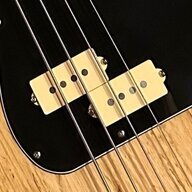
I believe this is right on. Keep in mind the horseshoe pickup on Paul's Ric was likely dead by this point, so what I hear (and duplicate as best as possible in my own Beatles band) with my Rics is using the front pickup only, tone control rolled way back, flatwound strings (TI's for me) and using a light gauge pick. There's no fuzz per se, only a slightly overdriven, compressed tone.
 
Bass for “Penny Lane” was recorded by Geoff Emerick on the night of Friday, January 6, 1967, on a session that went from 7pm to 1am. During that period (November 1966 thru August 1967) Emerick had made a practice of miking the bass cab with a Neumann U67 (though he occasionally experimented with a C12, STC 4038, and KM54). Emerick wasn’t fond of DI and rarely used it, and while there is evidence it was used at times starting on the Sgt. Pepper sessions later in 1967, at this early stage in the year, he would have combined it with the miked cab, if DI was used at all.

Rickenbacker 4001S, probably through a hybrid Vox 730 or 4120 into a 2x12” cabinet, which was a favorite set-up of Paul’s at this time. Probably compressed at the console with an Altec, as the Fairchild was found to kill the attack.

They recorded the bass simultaneously (and on the same track) with Ringo’s drums and John’s guitar (and congas, according to Recording The Beatles—though The Complete Beatles Recording Sessions credits John with congas), with the tape machine running on varispeed, synched to an oscillator at 47.5 cycles. So he would have actually played in B flat (+/- a few cents), with it being brought up to B when the tape was returned to full speed. That would have a small effect on tone, along with everything else.
 
Last edited:
Actually, the plot thickens. There’s a low E when Paul sings “Very strange,” which would be difficult to get if varispeed is making the bass sound a semitone higher than what’s played. That kind of suggests that Paul would have tuned the Rick down a semitone and played it with the proper fingerings for the written key—which also would have some effect on tone that you can’t easily replicate.
 
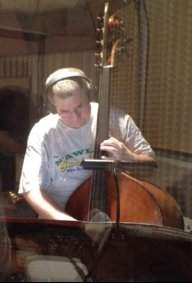
Listening to the isolated tracks reveals that the deep, growly low D is a combination of Paul's Rick with a Harmonium (pump organ). There is also a (bowed?) double bass in there somewhere.

THAT'S IT! @ 14:48 - 14:58 in this clip is a bowed double bass. That's what I'm hearing.


That's why I couldn't figure out what was going on. Paul is playing his electric bass pretty much clean and with a pick, but he's overdubbed a bowed double bass. Plus, the Harmonium is in the mix as well.

That also explains why I thought he might have played it in drop D tuning. I could definitely hear the D a whole step below the low E on a standard tuned 4 string electric bass. It's the bowed double bass playing that note, with the electric bass playing an octave above it.

Now I have an even greater appreciation for this song and for the creative genius of the Beatles.


Also, TalkBass rocks! So many knowledgeable people here and not just in music.
 
Last edited:
I’m not too familiar with the back stories on The Beatles recordings but I see on Spotify that there are remastered recordings. I was listening to the remastered “Something” and the bass track is definitely different from the original.
Still amazed at their music and the overall quality and sound of their songs.
 

Latest posts