• TalkBass has been independent since 1998. Add your voice.
    Create a free account to reply to discussions, view embedded media, and browse with fewer display ads.
    Join freeLog in
    Want zero display ads or expanded classifieds tools? Compare plans.

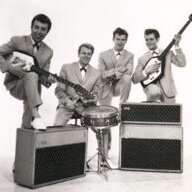
The Dave Clark Five - Identify this bass

The real question is.. what is on his strap?

upload_2022-12-30_8-44-14.png
 
The organist is playing a Vox of some sort, so they maybe had some sort of deal with Vox and/or a UK distributor. Any promo material had to have some prominent Vox content, even if it doesn't match anything used in the studio or at actual gigs?


Interesting to see the bassist miming. My band filmed a promo video a few years back. I play finger style 99% of the time, but used a pick and big wafty right hand movements. Playing finger style can look like you are busy doing nothing compared to drummers and guitarists.
 
Quote: "Dave Clark himself didn’t always play the drums. He used the same session drummer on hits that the Kinks also used."


Indeed, my old friend Bobby Graham, sadly no longer with us, played drums on most of my recordings, as well as, most of DC5’s biggest hits, as well as recording for the Kinks and numerous others.

Two session drummers, Bobby Graham and Clem Cattini came from Edmonton in North London. North London being area from whence DC5 emerged. Synchronicity, Jung might say.

Sometimes I would stay over night at Bob’s and enjoy his wife’s cooking. So did others like my great friend and mentor Jimmy Owens and Jimmy Page (a session guitarist).

Dave Clark specifically asked Bob to create very clear and simple fills on his recordings, so that they would be easy for him to duplicate for film and television and live performances.

As Dave was originally a film stunt man, he was very well versed in the need to create the right appearance, in an authentic manner as possible.

At the time, journalists were following Bob about and ringing him up asking if it was true, he played drums on DC5’s hits.

It wasn’t done for session players to admit such things in that era, so he denied it.


In those days, top recording studios were like factory’s that churned out recordings to a busy schedule.

Time was money and being on time essential. However good a musician might be, they could not always perform under extreme pressure.

Therefore, successful producers preferred to use session musicians with an established record of producing hits.

They could be relied upon to deliver the goods, in a timely, cost-effective manner.

Sometimes on the first take.

Like this.

Brenda Lee - What'd I Say (1964) - with Jimmy Page - YouTube
 
Quote: "Dave Clark himself didn’t always play the drums. He used the same session drummer on hits that the Kinks also used."


Indeed, my old friend Bobby Graham, sadly no longer with us, played drums on most of my recordings, as well as, most of DC5’s biggest hits, as well as recording for the Kinks and numerous others.

Two session drummers, Bobby Graham and Clem Cattini came from Edmonton in North London. North London being area from whence DC5 emerged. Synchronicity, Jung might say.

Sometimes I would stay over night at Bob’s and enjoy his wife’s cooking. So did others like my great friend and mentor Jimmy Owens and Jimmy Page (a session guitarist).

Dave Clark specifically asked Bob to create very clear and simple fills on his recordings, so that they would be easy for him to duplicate for film and television and live performances.

As Dave was originally a film stunt man, he was very well versed in the need to create the right appearance, in an authentic manner as possible.

At the time, journalists were following Bob about and ringing him up asking if it was true, he played drums on DC5’s hits.

It wasn’t done for session players to admit such things in that era, so he denied it.


In those days, top recording studios were like factory’s that churned out recordings to a busy schedule.

Time was money and being on time essential. However good a musician might be, they could not always perform under extreme pressure.

Therefore, successful producers preferred to use session musicians with an established record of producing hits.

They could be relied upon to deliver the goods, in a timely, cost-effective manner.

Sometimes on the first take.

Like this.

Brenda Lee - What'd I Say (1964) - with Jimmy Page - YouTube
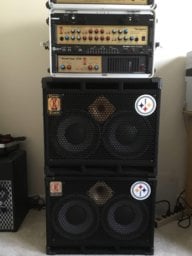
I got Bobby's biography book signed by him.

Sadly, he did not have a good journal to refer to for what he played on, but for the most part you can tell which DC5 tracks he did play on as he'd do his trademark ba-bing-ba drum roll at the end. Also, due to Bobby's drinking habit he's wasn't very dependable with recalling his entire list. He definitely played on the Kinks 'You Really Got Me', 'All Day and All of the Night', and 'Tired of Waiting for You', which were all at similar times of the DC5's popularity.

Dave did drum though as some will say he didn't drum at all, which is not at all true. Early tracks that have brushes is Dave on drums. The Red Balloon track is Dave on drums. He played drums on the opening track on 18 Golden Oldies album. Once you note the differences, (obvious on snare and rim shots) you can identify the songs that Dave did and did not play drums on. Casual listeners have no clue and just spread rumors.

Clem Cattini played on later tracks that featured horns with Les Reed arranging.
 
Last edited:
  • Like
Reactions: bobyoung53
Quote: "Dave Clark himself didn’t always play the drums. He used the same session drummer on hits that the Kinks also used."


Indeed, my old friend Bobby Graham, sadly no longer with us, played drums on most of my recordings, as well as, most of DC5’s biggest hits, as well as recording for the Kinks and numerous others.

Two session drummers, Bobby Graham and Clem Cattini came from Edmonton in North London. North London being area from whence DC5 emerged. Synchronicity, Jung might say.

Sometimes I would stay over night at Bob’s and enjoy his wife’s cooking. So did others like my great friend and mentor Jimmy Owens and Jimmy Page (a session guitarist).

Dave Clark specifically asked Bob to create very clear and simple fills on his recordings, so that they would be easy for him to duplicate for film and television and live performances.

As Dave was originally a film stunt man, he was very well versed in the need to create the right appearance, in an authentic manner as possible.

At the time, journalists were following Bob about and ringing him up asking if it was true, he played drums on DC5’s hits.

It wasn’t done for session players to admit such things in that era, so he denied it.


In those days, top recording studios were like factory’s that churned out recordings to a busy schedule.

Time was money and being on time essential. However good a musician might be, they could not always perform under extreme pressure.

Therefore, successful producers preferred to use session musicians with an established record of producing hits.

They could be relied upon to deliver the goods, in a timely, cost-effective manner.

Sometimes on the first take.

Like this.

Brenda Lee - What'd I Say (1964) - with Jimmy Page - YouTube

Look at the list of songs Carol Kaye isn't credited on, but claimed she played, even some Motown tunes, which gets some people very upset.
 
  • Like
Reactions: Steve Slate
Other way around.
You must recall how difficult to find and expensive the American instruments were to acquire back then in the early 60's (not talking mid or late 60's). Even the Beatles struggled pre-fame with this and even afterwards would acquire Epiphone. England was still in a post-war rebuilding campaign and specifically had laws prohibiting foreign goods.

I also understand Vox was big on endorsing artists.
 
  • Like
Reactions: bobyoung53
The organ Mike Smith played was most often a Vox Continental, an instrument that defined the mid-60s keyboard sound in the U.K. and Europe. As to miming, under the U.S. industry and union rules TV show producers had to pay a band more if they actually performed vs. just bobbing along to a recorded track. Nearly no one at the time gave a rat’s *** about whether the bass player plucked or picked and often the musicians had fun doing oddball things since they couldn’t play live.

I believe that the DC5 management tried to get them a deal with Vox like the deal Brian Epstein made for the Beatles but they weren’t successful. I think, too, that all the world’s attention focusing on the U.K. due to the “British Invasion” is what finally pushed them past their postwar doldrums and opened the doors to imports of “non-essential products” like instruments.
 
  • Like
Reactions: B-Mac
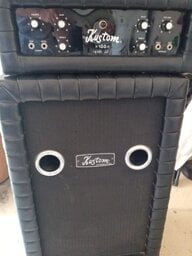
What bass amp did Huxley play through?
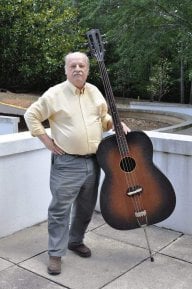
You can see the band with their Vox amplification in this video. Rick Huxley is using a separate head and cabinet. I’m guessing it’s a Foundation cabinet with an AC head. It doesn’t look like a T60. Maybe someone with more expertise on Vox amplifiers can identify it.


- Steve
 
  • Like
Reactions: ac100X and B-Mac
Quote: “Look at the list of songs Carol Kaye isn't credited on, but claimed she played, even some Motown tunes, which gets some people very upset.”


I was blessed to learn bass from Carol many years ago, fundamentally to be able to compose and arrange better bass parts.

In order to understand the many anomalies in people’s recollections which can of course become muddled after so long a time. One really needs to appreciate the musician unions rules which governed television appearances and studio recordings.

Thus, a hit record might involve one or even several demo studio recordings. Ray Davies needed several demos before he got “You really got me” as we know it for example.

Once there was a hit single recording, there would be other recordings made for television appearances, sometimes these would be recorded live, sometimes backing tracks were used.


The salient point being, using a backing track meant that professional musicians would be robbed of work, so the musician’s union insisted that an additional recording was made, either a complete re-recording or a backing track so musicians would be paid.

It would often be the case that different musicians would feature on these various recordings made for different reasons. Thus, the truth is that sometimes, several different musicians claim to have played on the same hit recording, because actually they did.

Few people kept records of what they played on with any real assiduity, but can remember playing the music, when it is oft repeated on TV and radio and know that they did a session to record it.

Some people make mistakes after so long. Bob once told me he played on a record that Ronnie Verrel actually played on, and was confused about that because of a signature lick he thought of as his. He owned the mistake to me as soon as he realised what had mislead him.

Some musicians have been known to exaggerate their influence, though why they would need to is a mystery to me as their influence is considerable.

Most of the time, there is a reason for the confusion. Let me demonstrate:

Bob played on a number of Tom Jones Hit recordings.

Here he plays on the first demo recording of “It’s Not Unusual” Tom’s producers are considering releasing.

Tom Jones its not unusual with Bobby Graham on drums - YouTube

Clearly, it’s a great song but it needs a far better, more punchy musical arrangement, to be proper material for a hit recording.

So, here’s the hit recording of the same song, on which top session drummer Ronnie Verrel plays Bob’s lick.

It's Not Unusual - YouTube

So who really created the hit recording?

Who thought of the signature licks?

It’s all more complicated than people like to think.


P.S. Anthony Buckeridge was a writer of incredibly amusing stories I greatly admired...
 
Other way around.
You must recall how difficult to find and expensive the American instruments were to acquire back then in the early 60's (not talking mid or late 60's). Even the Beatles struggled pre-fame with this and even afterwards would acquire Epiphone. England was still in a post-war rebuilding campaign and specifically had laws prohibiting foreign goods.

The later 60's Dave Clark 5 videos are in color (see below). Like this one where Rick Huxley is playing the Vox Symphonic (in sunburst). I believe the sequence in basses was as I stated before: "the early pictures were Fender Precision and Fender Jazz, then Burns, then Vox Symphonic". I agree about the lack of American made instruments in the early 60's but late 60's VOX had a way with endorsements and advertising. You can tell by the style of hair and clothes, in late sixties that were going for a Sargent Peppers type look.

 
DC5 was part of my musical upbringing. Like millions of people, I started playing after the arrival of The Beatles although I'd been a solid rock n roll fan for a few years before that.
I never felt the urge to own any Vox bass instrument although I've spent a fortune experimenting with the Vox line of bass amps (never really liked any of them but the V125 came close).
What bass amp did Huxley play through?

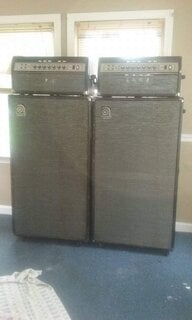
Yea, I have the tube VOX 125 with custom speaker cabinet with (2) 2x10 Edens, high frequency horn, one EV 15" with Super Beatle stand.
IMG_8258  VOX AC125.jpg
 
  • Like
Reactions: bobyoung53
From what I've read most, if not all, of the bass part of DC5 records were provided by session musician Eric Ford. He apparently used a Burns Split Sound six-string bass (which makes sense since he was primarily a guitarist) and Rick Huxley obtained the same model to use for concert and TV appearances.

I like the bass playing and tone on the DC5 records and I was disappointed to find out the Rick Huxley apparently didn't play on them. There are a lot of DCS videos on YouTube but they are miming in all but one of them, so it's hard to get a good idea what they sounded like outside of the studio.

Here's a DC5 song built around a thumping bass line.

Here's a DC5 song with a bass solo at the 1:24 mark! Rick Huxley is miming it with his Burns Split Sound six-string bass.

- Steve


Actually I was suspicious of that as the bass playing was always excellent on the records, great sound and played perfectly, I always thought it was a P bass though, I'm surprised it was a 6 string.
 
Quote: "Dave Clark himself didn’t always play the drums. He used the same session drummer on hits that the Kinks also used."


Indeed, my old friend Bobby Graham, sadly no longer with us, played drums on most of my recordings, as well as, most of DC5’s biggest hits, as well as recording for the Kinks and numerous others.

Two session drummers, Bobby Graham and Clem Cattini came from Edmonton in North London. North London being area from whence DC5 emerged. Synchronicity, Jung might say.

Sometimes I would stay over night at Bob’s and enjoy his wife’s cooking. So did others like my great friend and mentor Jimmy Owens and Jimmy Page (a session guitarist).

Dave Clark specifically asked Bob to create very clear and simple fills on his recordings, so that they would be easy for him to duplicate for film and television and live performances.

As Dave was originally a film stunt man, he was very well versed in the need to create the right appearance, in an authentic manner as possible.

At the time, journalists were following Bob about and ringing him up asking if it was true, he played drums on DC5’s hits.

It wasn’t done for session players to admit such things in that era, so he denied it.


I had read an article about Bobby Graham playing all the DC5 recordings someplace or other as well as on some of The Kinks stuff and his not wanting to publicize it, I think it was right after he died but the details escape me.
 
The Dave Clark Five appeared on the Ed Sullivan Show more times (18?) than just about any other band. I believe they appeared on the show before The Beatles yet you can't find a video performance anywhere. At that time the Ed Sullivan Show featured real live performances so the DC5 must have played live. Anyway, they didn't inspire people to play Rock like The Beatles did.