I attended an excellent presentation by Todd Coolman a few years back. He expressed that in his opinion drummers tend to play too loud when they hear too much of the bass player. His solution is to get his amp off the floor and away from the drummer. He keeps his volume just loud enough to hear himself and he tries to keep the rhythm section from getting into competitive bashing and volume raising. I've also seen/heard Larry Grenadier live several times, and he keeps his speaker at ear level behind him. Of course he mainly plays venues with pro sound reinforcement. Hope I haven't derailed this conversation...

Enjoy the benefits of a premium membership!
Upgrade Account
-
TalkBass has been independent since 1998. Add your voice.
Create a free account to reply to discussions, view embedded media, and browse with fewer display ads.
Join free Log in
Want zero display ads or expanded classifieds tools? Compare plans.
You are using an out of date browser. It may not display this or other websites correctly.
You should upgrade or use an alternative browser.
You should upgrade or use an alternative browser.
Double Bass The day the BG took over.
- Thread starter Paul Warburton
- Start date
More options
Who Replied?I learned a very valuable lesson in band dynamics from John Goldsby one night in Louisville. At the end of one of Jamey's camps, several instructors had a gig at a downtown hotel lounge. Naturally, a bunch of us went down to hear it. I can't quite remember the entire group (I think Rich Perry was playing tenor), but Barry Ries played drums(!) for the first set. At the conclusion of said set, John came up to our table and asked how the balance was. I said that the bass could be louder. John said that that might be but he wasn't going to turn up because, if he turned up, things would get out of control really fast. I always keep that in mind when the bandstand balance seems acceptable, but someone in the crowd wants more bass. Thanks, John.
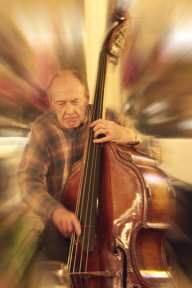
Not at all, Arnold. I've been preaching that same kind of thing here for a while. I put my 12" Polytone Mini-Brute on a KMD amp stand as close to the back of my bass as possible, almost touching it, in fact. The bass acts like a baffle, bringing the amped sound out and around the bass to the drummer, pianist and the audience. They're getting the ambient sound combined with the wood sound from the bass and I have total control of the amp knobs even on the fly. I also sit on a high stool which brings me even closer to the speaker so I figure if I can live with that sound (which is probably the worst possible in terms of just hearing the speaker sound) that the combination of amp and wood, sounds pretty good, side and out front.I attended an excellent presentation by Todd Coolman a few years back. He expressed that in his opinion drummers tend to play too loud when they hear too much of the bass player. His solution is to get his amp off the floor and away from the drummer. He keeps his volume just loud enough to hear himself and he tries to keep the rhythm section from getting into competitive bashing and volume raising. I've also seen/heard Larry Grenadier live several times, and he keeps his speaker at ear level behind him. Of course he mainly plays venues with pro sound reinforcement. Hope I haven't derailed this conversation...
I've done two live record dates with this concept that works to great advantage, at least for me.
Jazzdogg
Less barking, more wagging!
Not at all, Arnold. I've been preaching that same kind of thing here for a while. I put my 12" Polytone Mini-Brute on a KMD amp stand as close to the back of my bass as possible, almost touching it, in fact. The bass acts like a baffle, bringing the amped sound out and around the bass to the drummer, pianist and the audience. They're getting the ambient sound combined with the wood sound from the bass and I have total control of the amp knobs even on the fly. I also sit on a high stool which brings me even closer to the speaker so I figure if I can live with that sound (which is probably the worst possible in terms of just hearing the speaker sound) that the combination of amp and wood, sounds pretty good, side and out front.
I've done two live record dates with this concept that works to great advantage, at least for me.
No problems with feedback?
No. Never. Even when i've pumped it, but again, the idea is to keep the volume down in interest of dynamics.
Paul, I do essentially the same thing only I use the little GK 200 (the old one). I've never had a request to turn down my volume. On the contrary, I am usually asked to turn up--by drummers! But then as I always say, "drummers are plumbers." 
Perhaps it's because we both came through those dig-in days before amplification when clubs had their own sound systems and out of tune pianos, that our ears are used to a different sound blend? Remember when they used to say that the bass should be felt, not heard?
Perhaps it's because we both came through those dig-in days before amplification when clubs had their own sound systems and out of tune pianos, that our ears are used to a different sound blend? Remember when they used to say that the bass should be felt, not heard?
The only real negative that still bothers me to this day is the renaming of the DB by BG players and doublers. "Upright" bothers me, but "Stand up" really makes me want to call in My  Boyz.
Boyz.
In my day, just the word Bass said it all.
And, yes, the words "Fretboard" and "Headstock" for fingerboard and scroll gets my old goat.
BTW, Gerry, I still dig in as hard as I did before I started with the amp. I never was able to pull back and play lightly, except on ballads.
Boyz.In my day, just the word Bass said it all.
And, yes, the words "Fretboard" and "Headstock" for fingerboard and scroll gets my old goat.
BTW, Gerry, I still dig in as hard as I did before I started with the amp. I never was able to pull back and play lightly, except on ballads.

The other day on YouTube I was looking again at that Ray Brown master class he shot in the UK, 'round about 1970 or so. He called it "the string bass". Before I was a DB player, I thought that name was whack -- isn't it obvious that all stringed instruments have strings?? But when you think of it as the bass member of the string (i.e., violin) family, it makes sense. More obvious sense than "double bass", to my ears.
Yeah, Damon, we called it that to distinguish it from the bass horn, which is what some folks called the tuba or Sousaphone back then.

Yet it wasn't enough to distinguish it from the oboe.
http://www.talkbass.com/forum/f33/hey-oboe-780110/

http://www.talkbass.com/forum/f33/hey-oboe-780110/
Jazzdogg
Less barking, more wagging!
The only real negative that still bothers me to this day is the renaming of the DB by BG players and doublers. "Upright" bothers me, but "Stand up" really makes me want to call in My
In my day, just the word Bass said it all.
And, yes, the words "Fretboard" and "Headstock" for fingerboard and scroll gets my old goat.
BTW, Gerry, I still dig in as hard as I did before I started with the amp. I never was able to pull back and play lightly, except on ballads.
Gee, Paul, I've always considered you a stand-up guy.

Me, too! That's why I play such lousy fender. I can't get used to turning the volume way up and playing lightly like the real BG guys do. Jaco did that, but Scotty really had it down. He could play light and dig in--and with guts!
BTW, Gerry, I still dig in as hard as I did before I started with the amp. I never was able to pull back and play lightly, except on ballads.[/QUOTE]
BTW, Gerry, I still dig in as hard as I did before I started with the amp. I never was able to pull back and play lightly, except on ballads.[/QUOTE]
Before anyone comments. I know that Scotty didn't play fender. But as an aside-- check out Eddie Gomez on fender. He recorded one tune with Bill Evans and it's a hoot. He vows to never do it again



I am lucky to be in a band and be on call with a few folks for all three: tuba, DB & EB. I've played EB since 1976 when I was 14 years old in summer jazz band camp and learned how to read charts on the fly (handed my first charts on a Monday morning, played a concert that Friday evening). But here's where it's really interesting: the jazz band I play with now had EB players for years and years. Good players. They sounded fine, and the band sounded fine. They hire me. I play the charts well. But the more I play with them, the more I start to feel something is "missing." I realised that with the push and sustain of the EB, some of the swing charts sounded "pushed" or "edgy." So I changed from my "straight ahead" EB style with roundwounds. After a few months of experimenting with EB flat strings, shoving foam rubber under the bridge cover, different techniques, no compression, etc., it still just wasn't happening. So I went out and purchased a CCB with the $$ I could afford, spent several months getting it set up, finding a good set of used Spiros, Full Circle, new amp, practicing my @$$ off, and finally took it to a rehearsal after talking to the band leader about it. The character of the band immediately changed, and the swing charts started to really swing again.
This same band had an Independence Day gig a couple of years ago, and the tuba was indispensible for the Sousa marches and such. It just would not have happened well on either DB or EB. What I have mostly learned from 35+ years of playing everything from garage bands to national TV, from Friday night to Sunday morning, bars, shows, pits, church, even Dixieland funerals, is that each instrument has its place and its gigs. For the average guy like me who still earns income primarily from a day job, I really encourage a player to learn to play all three to be most available for the most number of possible gigs.
Sorry to Zombie this thread, but after reading this, I have to share an experience I had around 1980 with my college big band. We had Mel Lewis as a guest artist and I made the mistake of playing electric bass on one of his tunes. He grabbed me at the end of the rehearsal and told me to stick around. I spent the next hour or so getting a huge lesson about how you can't get that same swing sound from the electric that you can from the upright bass. He saw me a few years later playing electric and yelled at me for still trying to play swing with an electric. "The electric bass has no place in jazz!" he told me. My only thought at the time was "Dude, should you call Jaco or should I break the news?"
Still, his point was valid, the upright bass has it all over electric for walking bass lines. That sound cannot be played on the electric without really changing the quality of the groove. I suppose you could make the argument that many electric bass styles cannot be adequately imitated on upright either.
We need a splinter thread from here called "The day the bass guitar player took over TBDB."
Oh wait, that's every 3rd day. =^/
Oh wait, that's every 3rd day. =^/
I own Jules Ruggiero's fender p bass with a jazz neck. I bought it in 2005. I'd love to know more about it and more about him.I don't know if this is true but in terms of Television in New York in the early 60s, there was a guy I used to play with in late 70s and 80s named Julie Ruggiero who many said was the first to play the Fender bass in the Tonight Show band in the early 60s. I met pianist Ross Tompkins about 10 years ago and he indicated that he thought Julie was the first on the Show to play it. I thought Ross joined the band in L.A. in the 70s. Anybody know if this is so about Ruggiero or the exact date?

You'd better ask on the BG side than here on the DB side.
This very old thread is a rare specimen of BG talking on the DB side.
https://www.talkbass.com/forums/basses-bg.8/
This very old thread is a rare specimen of BG talking on the DB side.
https://www.talkbass.com/forums/basses-bg.8/


