• TalkBass has been independent since 1998. Add your voice.
    Create a free account to reply to discussions, view embedded media, and browse with fewer display ads.
    Join freeLog in
    Want zero display ads or expanded classifieds tools? Compare plans.

The end of tubes??? Thoughts?

From the developers and reviewers.
Some devs start with a schematic and completely model it in a spice. It's the same circuit.
They can measure and null this. Optimize the model and repeat. The final is not spice but it is modeled after the schematic.

Watch a lot of the high end VST reviews and you'll see null testing. Some reviewers don't have the real hardware so they rely on Invalid Link Removed for the originals.
An if you don't like a VST then you always have accessanalog for the original.
This site is amazing, and very affordable.

I'm familiar with null testing. The reason I ask is that I have not heard of a manufacturer making a claim that a model of something like a combo amp whose output can only be captured with a mic, would null against the same signal fed to the model. For that to even be theoretically possible, you'd have to try it with the actual amp used to make the model; and even then, I'm skeptical (to understate it a bit). Amps aren't that consistent. Mics aren't that consistent.

I mean, I have two old Vox AC15s that don't even particularly sound like each other. Which one is a model supposed to null to ? If it did with one, it couldn't with the other.

What seems to happen when this subject comes up is that people do the test and they have some resulting sound in the buss they used, but they don't think it sounds like much (or looks like much on a display), and feel that means it's something like an almost-null. But unless you're doing something like a shotgun approach to troubleshooting a console and need to find an outlier, that's not really a thing, it either nulls or it doesn't.
 
  • Like
Reactions: DJ Bebop
Because each amp and cabinet is different due to tolerances, a null test is only valid against the standard that the model was based upon.

This is no different than testing 10 of the same model amp against the "golden sample", they will all be a little bit different because of the thousands of inter-related component tolerances and the various permutations of how the tolerances interact. I deal with this stuff every day.
 
Because each amp and cabinet is different due to tolerances, a null test is only valid against the standard that the model was based upon.

This is no different than testing 10 of the same model amp against the "golden sample", they will all be a little bit different because of the thousands of inter-related component tolerances and the various permutations of how the tolerances interact. I deal with this stuff every day.
You can eliminate all those variables if you use one of those special $5000 IEC.power cords.:D
 
I mean, I have two old Vox AC15s that don't even particularly sound like each other. Which one is a model supposed to null to ? If it did with one, it couldn't with the other.

Schematics have the ideal values for components. Each component has specified has tolerances and they're never ideal.

Create a model of one AC15, created run sweeps through one of the amps and the model and match the curves and distortion. Every modeler out these has many different tweaks to it to allow for personal choice.
Once it matches the first amp, Make a preset. Then match the second amp and make another preset ...

Take a look at this patent by Brainworks
"Digital emulation of an analog device with tolerance modeling"
Link Removed
It is a brilliant patent.
Brainworks has created some of the most versatile amp sims and they have IP to model the tolerances. It is absolutely brilliant.
 
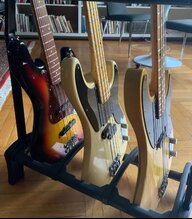
We play bass, “we don’t need no stinking tubes”..
3B632034-0EF5-4419-8826-1087E7285A36.jpeg
 
Schematics have the ideal values for components. Each component has specified has tolerances and they're never ideal.

Create a model of one AC15, created run sweeps through one of the amps and the model and match the curves and distortion. Every modeler out these has many different tweaks to it to allow for personal choice.
Once it matches the first amp, Make a preset. Then match the second amp and make another preset ...

Take a look at this patent by Brainworks
"Digital emulation of an analog device with tolerance modeling"
Link Removed
It is a brilliant patent.
Brainworks has created some of the most versatile amp sims and they have IP to model the tolerances. It is absolutely brilliant.
When you start splitting hairs, opinion and subjectivity dominates as to what is better, or just uniquely different. In the violin world there is a general consensus as to what a good instrument sounds like, but there are many instances when comparing good instruments where they sound different in A B comparisons, but each are still considered a great instrument.

Looking for the ultimate be-all-end-all sound, is a fools errand.
 
When you start splitting hairs, opinion and subjectivity dominates as to what is better, or just uniquely different. In the violin world there is a general consensus as to what a good instrument sounds like, but there are many instances when comparing good instruments where they sound different in A B comparisons, but each are still considered a great instrument.

Looking for the ultimate be-all-end-all sound, is a fools errand.

I agree, but there is a lot of naysayers who claim modeling doesn't work because "It doesn't sound like mine"
There's Kemper and software now that does profiling of any user's amp, but still profiling a bad amp is still a bad amp.
 
Jess Oliver suggested a solid state rectifier instead of a tube one in his B-15 offerings.

My question from the unknowing to the knowledgable is:

Do power tubes or other tubes have a drop in solid-state replacement or could one be made?
Maybe.
 
  • Like
Reactions: byacey and DJ Bebop

Latest posts