

Enjoy the benefits of a premium membership!
Upgrade Account
-
TalkBass has been independent since 1998. Add your voice.
Create a free account to reply to discussions, view embedded media, and browse with fewer display ads.
Join free Log in
Want zero display ads or expanded classifieds tools? Compare plans.
You are using an out of date browser. It may not display this or other websites correctly.
You should upgrade or use an alternative browser.
You should upgrade or use an alternative browser.
More options
Who Replied?
Smooth_bass88
vaxx!
- Oct 31, 2006
- 12,122
- 16,795
- Disclosures
- have been on nationally released albums, charting on the Billboard 200


- Feb 12, 2006
- 61,031
- 5
- 220,922
- Disclosures
- Development Engineer-Mesa Boogie, Development Engineer-Genzler (pedals), Product Support-Genz Benz
Agree on germanium ... but on topic: Did not Mesa discontinue the Prodigy/Strategy line of tube amps because it has gotten too hard to source KT88 tubes?
There were significant issues with consistency of specifically the KT-88s. Some production runs would be great, some abysmal and with some parameters we wouldn't know until the tubes had a couple hundred hours on them. It just became an unmanageable challenge in practice.
I will openly admit, I’m not an expert on it...I can just say that I like it when I hear it if I just want a slight fuzz or use it a boost situation.
Germanium transistors were notoriously unreliable (in part due to the limited manufacturing history of semiconductors, but also because of the materials involved). Germanium transistors have a positive temperature coefficient which is in fact manageable but combined with the wide variations in leakage current quickly become more trouble than it's worth. Additionally, the Hfe (DC current gain) of a Ge transistor is both low and greatly influenced by the wide range of internal leakage currents, so it's harder to design consistent circuits around.
That is some silly clickbait. Russian tubes aren't particularly good and are by no means the whole industry. I've got about 35 tube amps and have not used any Russian or Chinese tubes in over 20 years.
NOS tubes tend to last a crazy long time, making them a better deal than they appear, except for certain types where the prices are in the stratosphere. If NOS is not an option, JJ/Tesla almost certainly makes what you need.
Since Russia and China together represent somewhere around 75% (varies by specific tube family) of all tube manufactured today (and JJ used some internal components of Russian origin), it's very difficult for the majority of players to automatically (and practically) exclude these countries as a source.
My experience is that NOS tubes generally don't last any longer than quality new production tubes, I have samples of new construction tubes from all 2 regions of manufacture with over 10k hours without any difficulty.
You forgot JJ Electronics - made in Slovakia, Europe. Also known as Ruby, TAD and Groove Tubes ECC83 / ECC82 / ECC81
Ruby as a brand has tubes that are manufactured in all 3 regions and are not automatically JJ manufactured. The tubes manufactured in Slovakia in some cases use some Russian and Chinese internal components. Groove Tubes has also had their products manufactured in all 3 regions, in addition to early products being manufactured in CZ.
It's hard to say what their capacity is. I have read that Russian and probably most Chinese production is mostly for military/industrial applications with audio tubes as a small sideline.
The predecessor company Tesla was a high volume manufacturer in the 70s and 80s at least, but the current JJ/Tesla company apparently bought (at least some of) their equipment and only makes tubes (and capacitors and some amps) for audio.
That would suggest that they use tooling that once handled higher volume, but who knows what state it is in, or if they have the expertise or staff to increase production significantly. According to Wikipedia they grossed 8.5 million euros in 2015, so, it was not a huge operation.
If they can expand, right now looks like the perfect time.
Compared with the electronics industry as a whole, the entire tube manufacturing sector is pretty small and those destined for the MI market are less than 1/2 of that. We are talking about maybe $50M total market with MI taking $25M of that. The investment and maintenance of the equipment is very large, the labor involved is large, the materials are specialty and some of the processing is fairly toxic (but can be overcome with money). As a rough guess, it would cost $25M new to set up a true commercial production line, that would have to be amortized over a relatively small amount of sales, which is a discouraging scenario for anyone looking to invest $25M.
There are some SS bass amps that sound very nice and have the harmonic content and "Feel" that you expect out of a tube head. I think you just need a good designer who knows how to make it work.
I think that is coming for guitar as well... Pat Quilter is doing some pretty cool stuff in the guitar amp world. Fender also has the new "tone master" amps.
The Tonemaster amps are quite impressive IMO.
What about those Nu-tubes you hear about every so often? What the heck are they? I would think if they were viable they’d have caught on by now, but they haven’t really seemed to gain much traction.
I have some experience with them, they are quite limited and have some particular quirks that keep them from becoming replacements for traditional preamp tubes (and of course certainly not power amp tubes). That doesn't mean that they aren't useful or that they can't be used for some cool circuits, but that's not viable for existing designs.

for bass amps maybe for guitar NO WAY , nothing yet acts and or sounds like a good tube amp on guitar IMO.

I was going to say the exact same thing but you beat me to it.My $0.019:
Historically, Ge (germanium) was used to make the first transistor at Bell Labs, ca. 1947. Si (Silicon) pretty quickly replaced Ge, mainly due to the native oxide / Si-SiO2 interface; also, there are some thermal stability aspects. Silicon’s main weakness is that it is an indirect band gap semiconductor; but, that mainly affects photovoltaic applications.
There have been Ge discrete transistors available and used for some applications. I’m not familiar with those; but, the lower thermal stability would make such devices ill suited for power stages. Ge is also technically an indirect semiconductor; but has a direct transition that is active. I suppose that could create some kind of dispersion character that might be useful for MI uses; but, I don’t know if that’s just snake oil. IF (BIG IF) there is some kind of connection between band gap transitions and frequency dispersions (which I highly doubt), there would be FAR better direct band gap semiconductors than Ge for such devices.
More recently, Ge is getting a second look for logic, mainly due to carrier mobility in the channel at ultra-thin/small dimensions. That is not applicable to MI devices.
I know; TL-DR. FWIW anyhow.
Last edited:

Flower Power!BTW, what do geraniums have to with it?!?
Riis
Don't you love those doom prognostications? Glad they don't happen here on TB!

For bass I use a Rumble 100 and 200. On the other hand, for guitar I run A Dr. Z Z-Plus. The tubes in it are all relatively new and I have plenty of 12ax7s and 12at7s. I did order a matched pair of JJ double mica 6V6s and two ECC83 MG Standards from the great folks at Eurotubes on March 11th. Today, March 14th I got an email that said:
"As of 3/10/2022 our lead time to process most orders is 3-4 weeks from the date of purchase. This is not due to a lack of inventory. This is due to the fact that we still hand test and inspect every single tube we sell. This takes time and due to the huge volume of orders we're currently receiving it's pushing our ship times out. We will NOT sacrifice QC to ship orders faster!"
This is the only place I will buy tubes and I don't mind the wait. I appreciate knowing the tubes I receive have been tested and matched. They've always done it.
"As of 3/10/2022 our lead time to process most orders is 3-4 weeks from the date of purchase. This is not due to a lack of inventory. This is due to the fact that we still hand test and inspect every single tube we sell. This takes time and due to the huge volume of orders we're currently receiving it's pushing our ship times out. We will NOT sacrifice QC to ship orders faster!"
This is the only place I will buy tubes and I don't mind the wait. I appreciate knowing the tubes I receive have been tested and matched. They've always done it.

A tale of bringing old tubes back into production:
The old Western Electric 300B single triode tube was beloved by audiophiles, so is again in production. But dig these prices:
Matched Pair $1499 • Single Tube $699 • Matched Quad $3099
For a tube that cost only a few bucks before W.E. closed it's doors in 1988. They even come in wooden boxes you can use for your stash...
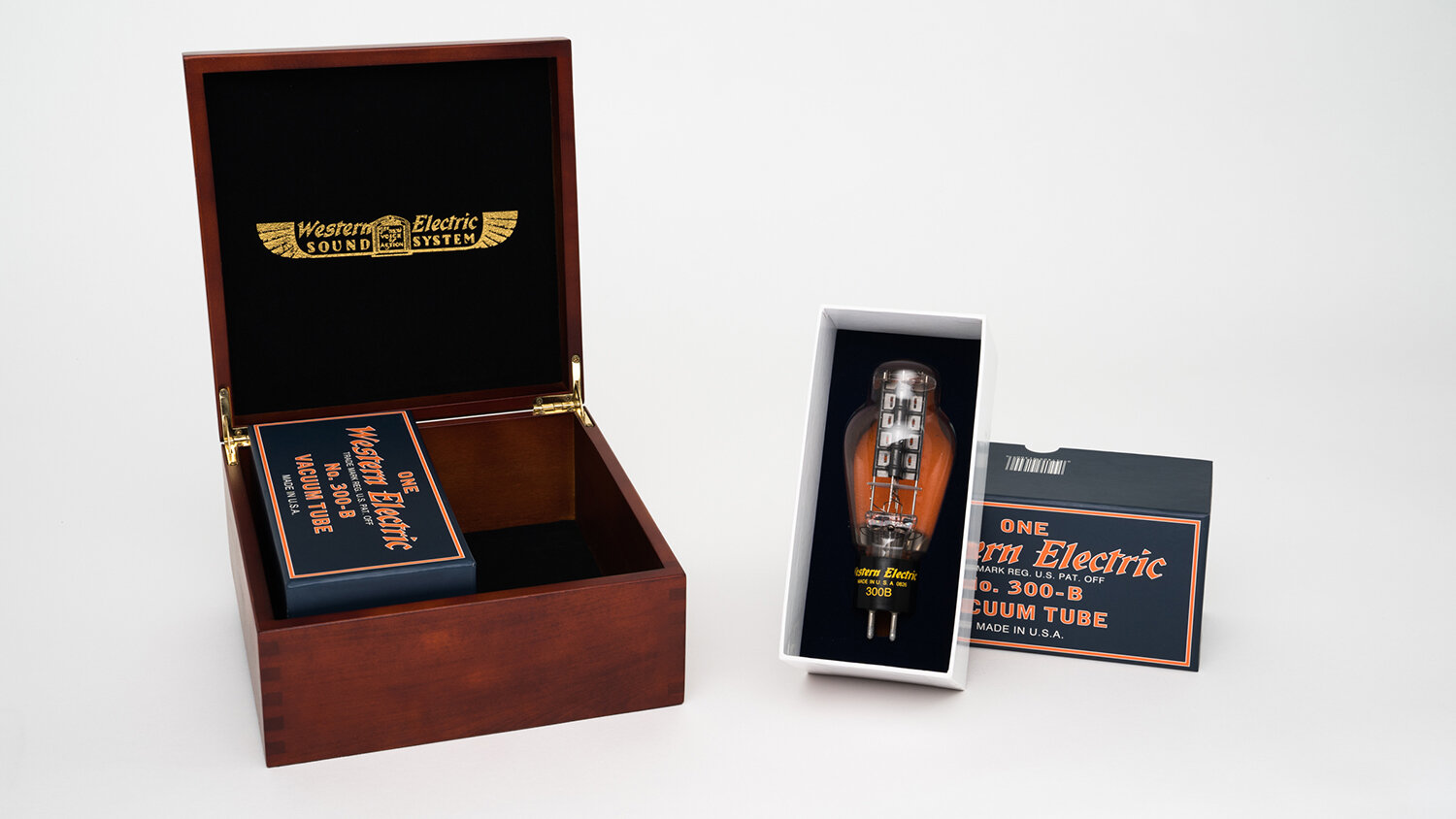
The company actually went out of business in 1988 after the AT&T breakup but some investors bought it just to make this tube. Production was restarted in 1997.
The new W.E. also sells a few audiophile components like a monoblock power amplifier (i.e. you need two to get stereo) with the following specs:
"The WE 97A’s specifications are beyond reproach with 80 watts per channel RMS and eight WE 300Bs per side, as well as three 6SN7GTBs and a single 6SL7."
Each 300B tube generates a mere 10 watts. These amps draw 400 watts of AC power and cost $50K each, so $100K for a stereo rig. A full retube is $12K. Be the first on your block to get one There's also a W.E. tube CD player and preamp if you've got some spare change.
The old Western Electric 300B single triode tube was beloved by audiophiles, so is again in production. But dig these prices:
Matched Pair $1499 • Single Tube $699 • Matched Quad $3099
For a tube that cost only a few bucks before W.E. closed it's doors in 1988. They even come in wooden boxes you can use for your stash...
The company actually went out of business in 1988 after the AT&T breakup but some investors bought it just to make this tube. Production was restarted in 1997.
The new W.E. also sells a few audiophile components like a monoblock power amplifier (i.e. you need two to get stereo) with the following specs:
"The WE 97A’s specifications are beyond reproach with 80 watts per channel RMS and eight WE 300Bs per side, as well as three 6SN7GTBs and a single 6SL7."
Each 300B tube generates a mere 10 watts. These amps draw 400 watts of AC power and cost $50K each, so $100K for a stereo rig. A full retube is $12K. Be the first on your block to get one
There's also a W.E. tube CD player and preamp if you've got some spare change.
Nah, only lovers of doom metal.Don't you love those doom prognostications? Glad they don't happen here on TB!

Personally, I can’t think for a worse technology for amplifiers. So many negatives combined with so few positives. There’s a reason that technology lasted only a relatively few years.
Thanks for a Germane comment.My $0.019:
Historically, Ge (germanium) was used to make the first transistor at Bell Labs, ca. 1947. Si (Silicon) pretty quickly replaced Ge, mainly due to the native oxide / Si-SiO2 interface; also, there are some thermal stability aspects. Silicon’s main weakness is that it is an indirect band gap semiconductor; but, that mainly affects photovoltaic applications.
There have been Ge discrete transistors available and used for some applications. I’m not familiar with those; but, the lower thermal stability would make such devices ill suited for power stages. Ge is also technically an indirect semiconductor; but has a direct transition that is active. I suppose that could create some kind of dispersion character that might be useful for MI uses; but, I don’t know if that’s just snake oil. IF (BIG IF) there is some kind of connection between band gap transitions and frequency dispersions (which I highly doubt), there would be FAR better direct band gap semiconductors than Ge for such devices.
More recently, Ge is getting a second look for logic, mainly due to carrier mobility in the channel at ultra-thin/small dimensions. That is not applicable to MI devices.
I know; TL-DR. FWIW anyhow.

I'm actually curious about silicon carbide transistors. They're already showing up in low voltage power supplies. If trends with other semiconductor technologies are any predictor, they'll work out the low voltage applications first, then start improving the processes until they can handle something that would work in a bass amp.
- Feb 12, 2006
- 61,031
- 5
- 220,922
- Disclosures
- Development Engineer-Mesa Boogie, Development Engineer-Genzler (pedals), Product Support-Genz Benz
Thanks for a Germane comment.
I'm actually curious about silicon carbide transistors. They're already showing up in low voltage power supplies. If trends with other semiconductor technologies are any predictor, they'll work out the low voltage applications first, then start improving the processes until they can handle something that would work in a bass amp.
The primary advantaged of SiC transistors are in low on resistance and fast switching times. They are not at all optimized for linear applications.

Please elaborate.
Personally, I can’t think for a worse technology for amplifiers. So many negatives combined with so few positives. There’s a reason that technology lasted only a relatively few years.

The video is right in that it's the young artist coming up that shape the market.
When they see others, and their heroes, that have success with VST's, modeling, sims, that's the route they're going to migrate.
Software and modeling are booming bigger than ever. And they're making the hit recordings.
There's always some little niche market with it's head in the past. I've even heard CDs are making a comeback, but it's only a niche.
US needs to focus on solid-state foundries, and other leading modern technologies. ROW is way ahead in solid-state and tech, and we can't get supplies we need for our tech - it is a wake up call.
When they see others, and their heroes, that have success with VST's, modeling, sims, that's the route they're going to migrate.
Software and modeling are booming bigger than ever. And they're making the hit recordings.
There's always some little niche market with it's head in the past. I've even heard CDs are making a comeback, but it's only a niche.
US needs to focus on solid-state foundries, and other leading modern technologies. ROW is way ahead in solid-state and tech, and we can't get supplies we need for our tech - it is a wake up call.

Tubes?
Been there, done that. Got the T-shirt and hat.
Got out fast.
I ain't never going back.
Give me SS any day. Love my Subway D-800+. Love my Gallien Krueger MB-500.
And I'm currently having a torrid love affair with an Epifani UL-901 (second gen).
I'll be "that guy" and say it.
Tubes suck.
Been there, done that. Got the T-shirt and hat.
Got out fast.
I ain't never going back.
Give me SS any day. Love my Subway D-800+. Love my Gallien Krueger MB-500.
And I'm currently having a torrid love affair with an Epifani UL-901 (second gen).
I'll be "that guy" and say it.
Tubes suck.

I've seen more and more guitar pedals that emulate amps and cabinets, similar to what's been going on in bass for a good while now. I've listened to side-by-sides with classic amps and they're awfully close. They certainly sound good.
Then there's the multi-effects and recording software with TONS of modeling options built in. So, it could be the nudge for guitarists to embrace newer tech like bassist have been. I doubt many will miss luging around a heavy tube amp after realizing they can just run straight out of a pedal into the board and still sound great.
Then there's the multi-effects and recording software with TONS of modeling options built in. So, it could be the nudge for guitarists to embrace newer tech like bassist have been. I doubt many will miss luging around a heavy tube amp after realizing they can just run straight out of a pedal into the board and still sound great.

The only unit I have heard even comes close it the Kemper GTR unit but its $3k so ?? a small 15 watt tube amp miced up cant be beat on GUITAR bass I like my MarkBass so .
Kinda like toilet paper back in the day LOL !!

Why do you want to keep looking backwards? At some point you probably should trust that something new can be great.
Just look at the new DSP-based Fender amps, or what companies like Bergantino are doing? No tubes in those, lots of tech, and they sound great. Maybe this will also put an end to some of the modern lousy tube implementations on some amateur recording gear, too? Surely we can move beyond 1940s technology, now?
Just look at the new DSP-based Fender amps, or what companies like Bergantino are doing? No tubes in those, lots of tech, and they sound great. Maybe this will also put an end to some of the modern lousy tube implementations on some amateur recording gear, too? Surely we can move beyond 1940s technology, now?


