
Enjoy the benefits of a premium membership!
Upgrade Account
-
TalkBass has been independent since 1998. Add your voice.
Create a free account to reply to discussions, view embedded media, and browse with fewer display ads.
Join free Log in
Want zero display ads or expanded classifieds tools? Compare plans.
You are using an out of date browser. It may not display this or other websites correctly.
You should upgrade or use an alternative browser.
You should upgrade or use an alternative browser.
The Evolution of Bass Guitar Technology and Beyond...
- Thread starter Tmoney865
- Start date
More options
Who Replied?
What technological advance has improved upon the fiddles made in Brescia and Cremona 300 years ago?
The instruments themselves have been modernized. Almost all Stradivari that are not museum pieces have been updated with longer necks and greater neck projection, making them louder. Violins have also been improved by steel and synthetic strings, and by the modern bow.
Aren't we talking evolution, though? Not just success. Civilization is built on failures.. If an idea didn't "succeed" (whatever that definition is in your mind), it at least might of sparked an idea for further wants, being the beginning of an evolution?
I always wondered if the action would be very uneven on those.
I've always wondered what sort of wizardry makes it all work properly.
If your neck was twisted, an additional truss rod would not have helped. They adjust the backbow of a neck- they don't prevent or adjust a twist in the neck. Multiple truss rods can potentially CAUSE a twist if one is adjusted to alter the bow on one side of a neck while the other isn't adjusted in a proportional manner.
There is some limited ability to fix twisted necks with a two-rod setup. I've seen it done before my eyes by a friend and luthier. But he did more than just torque one side and not another. Specifically he pushed the neck the way he wanted it and snugged up the rod on the offending side more than the other and it became straight.
You also have to realize you contradicted yourself. If they can't fix a twist, they can't cause it either. If they can cause it, they can also fix it, by the same mechanism--the two rod system being able, even if only a little, to add or remove a torque.

Cassius.
I feel vindicated!
Thanks! I was not going to call the Mod names nor challenge him directly, I would find myself censored faster than an IRS 6400 lawsuit.
The Mods here might have it in for me because of my spark of activity after 5 years.
I went over and turned the Warrior Club upside down and baited some people into addressing me. Some even keep e-mailing me complaining that I have them under mind control, that they own the thread etc.... but some people just love to drink the KoolAid.
Nuff said on that.
I feel vindicated!
Thanks! I was not going to call the Mod names nor challenge him directly, I would find myself censored faster than an IRS 6400 lawsuit.
The Mods here might have it in for me because of my spark of activity after 5 years.
I went over and turned the Warrior Club upside down and baited some people into addressing me. Some even keep e-mailing me complaining that I have them under mind control, that they own the thread etc.... but some people just love to drink the KoolAid.
Nuff said on that.

Basses are made from 'recyclable materials' wood does grow on trees. Trees grow back eventually. In the future nice grain patterns may be more scarce since they take time to develop and may not be present on new trees. At the same time there are plenty of tree types that have not yet been fully tapped to make guitars/basses
just sayin it's a possibility. recycled platics and such could be melted down and poured into molds, and into basses. there's a lot of labor that goes into producing wood instruments, from the people that harvest the trees, then to the mills, then the cutting/shaping finishing. if yesterday's milk juggs and kegger cups could be turned into tomarrow's basses/guitars with less costs and possibly sound as good as a wood instrument, without deforestation.
I had a Luthite Ergodyne.
Nothing there that meant much for the Instrument as a whole, so old Pop Bottles will probably bring nothing to snaping and popping.
Ooops! Did I make a funny?
Before we start going that direction we need to wear out all of the Boutique Orphans in the Pawn Shops.
Ooops! Did I say that?
Shame on me!
Nothing there that meant much for the Instrument as a whole, so old Pop Bottles will probably bring nothing to snaping and popping.
Ooops! Did I make a funny?
Before we start going that direction we need to wear out all of the Boutique Orphans in the Pawn Shops.
Ooops! Did I say that?
Shame on me!
just sayin it's a possibility. recycled platics and such could be melted down and poured into molds, and into basses. there's a lot of labor that goes into producing wood instruments, from the people that harvest the trees, then to the mills, then the cutting/shaping finishing. if yesterday's milk juggs and kegger cups could be turned into tomarrow's basses/guitars with less costs and possibly sound as good as a wood instrument, without deforestation.
One of the reasons Steinberger sold to Gibson was the difficulty in molding graphite basses. A decent percentage of the instruments off the mold were not usable and had to be disposed of. The whole collecting of materials, sorting, melting, molding would not be as cheap as you think. If graphite were cheaper or easier to produce, odds are we would see more graphite basses or atleast graphite necks these days.
did not know that about the steinies. well, it seemed like a viable option. if wood is an easier material to work with, then i guess things aren't gonna change much, unless they are able to make graphite/carbon fiber/composites cheaper.One of the reasons Steinberger sold to Gibson was the difficulty in molding graphite basses. A decent percentage of the instruments off the mold were not usable and had to be disposed of. The whole collecting of materials, sorting, melting, molding would not be as cheap as you think. If graphite were cheaper or easier to produce, odds are we would see more graphite basses or atleast graphite necks these days.

Bryan R. Tyler
TalkBass: Usurping My Practice Time Since 2002
Staff member
Administrator
Gold Supporting Member
Supporting Member
- May 3, 2002
- 28,948
- 20,938
- Disclosures
- Reviewer: Bass Player Magazine
There is some limited ability to fix twisted necks with a two-rod setup. I've seen it done before my eyes by a friend and luthier. But he did more than just torque one side and not another. Specifically he pushed the neck the way he wanted it and snugged up the rod on the offending side more than the other and it became straight.
You also have to realize you contradicted yourself. If they can't fix a twist, they can't cause it either. If they can cause it, they can also fix it, by the same mechanism--the two rod system being able, even if only a little, to add or remove a torque.
Good point on that! But you can twist a neck worse than you can fix it, similarly to how you can mess up a neck's by overturning a single truss rod and not be able to simply fix it by adjusting it back. This is also what I meant by the OP's statement that his bass was ruined because of the twist in the neck. If it was so badly twisted that the instrument was useless, then the addition of a second truss rod likely would not have helped (and could possibly have made it worse if the already bad piece of wood chosen for the neck was further weakened by routing for another rod).
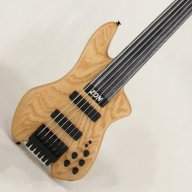
Bartolini pickups? Seriously? I use them, but how are they innovative? Wal, EMG, q-tuner and SGD are far more innovative in the field of pickups.
And I am wondering if the op has played lightwave basses or basslab basses. The "tunable composite" sounds like a fancy marketing phrase for mixed composites, something that Moses, Status, and Zon have been using for a long time.
And I am wondering if the op has played lightwave basses or basslab basses. The "tunable composite" sounds like a fancy marketing phrase for mixed composites, something that Moses, Status, and Zon have been using for a long time.

It will be forgotten next week, imho.2011: Programmable pick up switching aka Game Changer was born..
Violin i.e. is still called by many experts as an acoustic wonder, perfect acoustic machine etc...
But thats acoustics - so much can be done here, so many options, so many variables...
What I would like to see is new way of electrifying bass guitar:
When Alumitones came out, I was honestly thrilled - finally a pickup that doesnt have gazzilion coils and were such a simple solution to old ways of making pickup. Yet it was recieved very poorly, some say it lacks character etc, but IMHO its quite groundbreaking - i was lucky enough to try it on a electric guitar and was positively suprised.
Did anybody installed Alumitones in their old bass? I've seen reviews of new, modern basses with them, but i wanna know how it sounds and feels in old bass like jazz or P?
Otherwise, like I said, no matter the future, you'll still have:
a) a body
b) a neck
c) tuners
d) pickup
e) electronics with potentiometer and output
f) amp
And thats why P and J will stay as a basic shape of bass guitar. Predecesor to violin and bow we all know where different, but once the now known shape came together, there was no need to drastically change it, coz it was perfect. Tweak of a bracing here, tweak of tuning pegs there, but the basic shape was perfect. Same goes for P and J. Thats your basic shape and you can have all the variations in the world, yet they will stay as basic and perfect as they can be.
I like other shapes and scale-sizes, but they suit me better then P/J, yet I cannot say they ARE better that P/J.

What technological advance has improved upon the fiddles made in Brescia and Cremona 300 years ago?
Many old instruments like that have been extensively modded in the intervening years, just saying. Lots of prized old orchestral instruments are nowhere near stock.
As for me, well, I'm sure the OP would say I'm "living in the past." I play a bass from the 70's, another one originally based on a P-bass, so, from the 50's, through an amp from the early 80's, with the sound coming out of a cab built in the late 60's or early 70's.
The innovation I'm most curious about right now is actually having to do with amps, rather than basses. Through SMPS, Peavey has made a 300 watt tube amp that only weighs 37 pounds. I'm quite curious about that.
The innovation I'm most curious about right now is actually having to do with amps, rather than basses. Through SMPS, Peavey has made a 300 watt tube amp that only weighs 37 pounds. I'm quite curious about that.

not sure about that Carl Thompson "the 6 string bass is born" bit. fender's bass VI came out in 1963 and their Bass V came out in '65.
The Danelectro 6 string bass predated the Fender Bass VI.
Did anybody installed Alumitones in their old bass?
Sort of:
Link Removed
So, what do we all need next in the evolution to get us closer to Nirvana? (not the band)
I too think we're pretty much tapped out on the BG. You still hear the marketing speak on this from various companies "we all sat down in a room with a clean sheet of paper and asked ourselves 'what can we do to make our bass better?'".... and what they _truly_ come up with is.... well... nothing!
It's like trying to improve the bow and arrow - the quantum leaps on the bow (the compound, the center-shot riser) were exhausted pretty much from the get-go. After that, you couldn't get much further around the fact that, at the core, it's just a stick with a string on it. Same with the arrow - first aluminum, then composites. It's all been pretty much hype since then.
Innovation in the BG is similarly hampered by what it does (makes noises) and the anatomy of who plays it (homo sapiens). We got the quantum leaps out of the way off the bat (the Fender and the various other increasingly moderate innovations guys have cited here since then) and ever since then it's just been small refinements of those.
Now, after a good 50 to 60 years of fiddling, we're finally in the Good Old Days. Really, we were already about 90% there when the Fender came out, since then we've about nailed the other 10%. That's why you pretty much still can't go wrong going to Fender and getting a new P or J or going down to Fodera with your bank loan and getting an Anthony Jackson. There's that about 90% similarity between the two instruments for the job of making noises with our primate anatomy. You're still really close to the ideal with either one.
So I just wouldn't hold my breath on more "radical innovations". Unless the job of the BG changes dramatically or there's some sudden upheaval in human anatomy, just about everything out there is in that 90% finished range already and I wouldn't expect anything really radically new to appear from here on out.
I.e. to me my Carvin Bunny is at the top of the heap and put all my other BG's in their cases. But in the end, it's still got about the same major innovations as most other BG's on the market.
LS


