• TalkBass has been independent since 1998. Add your voice.
    Create a free account to reply to discussions, view embedded media, and browse with fewer display ads.
    Join freeLog in
    Want zero display ads or expanded classifieds tools? Compare plans.

The fatter the string, the fatter the tone?

Jay2U

Not as bad as he lóòks
Dec 7, 2010
5,988
11,584
22 ft below sea level
www.youtube.com
I don't think so!

A fatter string requires more tension in order to make it's higher mass resonate at a given frequency. More mass and tension require more energy for the same amplitude. Apart from the fundamental tone, harmonics appear along the string. The more energy, the more harmonics. As those harmonics are multiples of the fundamental frequency, the result will be a richer tone, not a fatter tone.

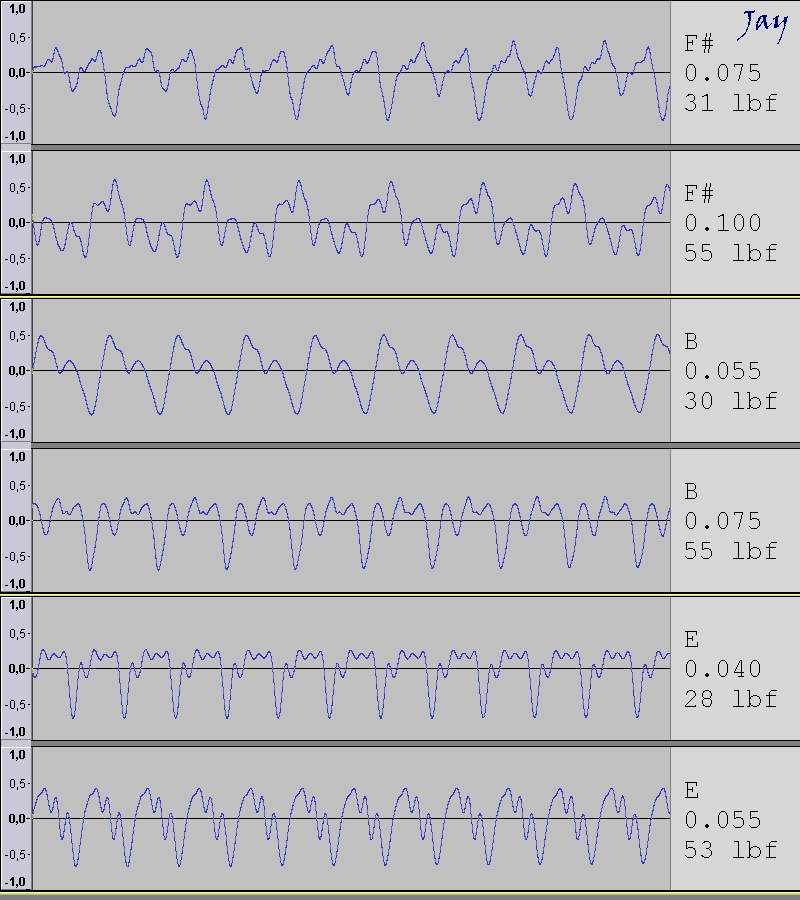
As the proof of the pudding is in the eating, I analysed the waveforms produced by both, thin and fat strings. It can be clearly seen that the percentage of harmonics versus the fundamental frequency depends on string gauge. In other words: Thinner strings produce more boom.

In the graph tone, gauge and tension are listed.
StringTensionCompared.jpg
 
Nice graphs! Confirming visually what we can hear aurally: A fat string at high tension has brighter harmonics (more "piano like" tone) than a thin string at low tension.

Yep.

One of the things that confuses people into thinking the opposite is true is when looser, thinner strings, due to their greater excursion and potentially less neck relief without a truss rod adjustment, result in more fret buzz, which adds frequencies similar to natural harmonic content. And vice versa with higher tension strings producing a 'cleaner', less buzzy sound.
 
bassdude51, the graphs simply show exactly what your ears are hearing.
Frequency analysis will show beyond doubt the balance of harmonics, it's more trustworthy than ears.
//////////////////

I agree the thread title is a myth and misunderstood.
Partly its down to what players mean by 'fatness of tone'.
More mass and tension require more energy for the same amplitude. Apart from the fundamental tone, harmonics appear along the string. The more energy, the more harmonics.
However this stuff about energy is a misunderstanding. String energy depends on how hard you pluck it, the balance of harmonics is independent of how hard you pluck it.

A higher tension string simply has less amplitude in it's lower harmonics relative to amplitude of higher harmonics, this is obvious from detuning a long way, like an octave, and seeing the middle of the string flopping from side to side (the fundamental) and the tone getting much darker.

However also, a larger gauge has a characteristic tone due to its gauge, it sounds like a larger gauge. Players may be referring to this when they mention 'fatness' of tone, and may be mistaking this for more 'low end' even though there is actually less.
Maybe players hear richness (more higher harmonics) as fatness?

The graphs seem a little inconclusive, better to do a frequency analysis, your audio software may do this.
 
Last edited:
There are a lot of details in string construction that are uncontrolled variables, and which could be confusing things here.

For example, if a lighter gauge means less winding layers, or a higher core to cover ratio, I can see the conclusions here making sense.

But I remain skeptical, as my Acoustical Physics training (I studied string vibration, among other things) and playing experience are at odds with the conclusions arrived at here. I play very light gauge strings, in part for the tension, in part for the increased harmonics, in part for the twang, and in part so I can get fret growl at reasonable playing effort.
 
...However this stuff about energy is a misunderstanding. String energy depends on how hard you pluck it, the balance of harmonics is independent of how hard you pluck it...
I understand your reasoning, but I think it's realistic to assume that strings having more resistance will be plucked harder. At least that's what I tend to do.
 
  • Like
Reactions: EatS1stBassist
I don't think so!

A fatter string requires more tension in order to make it's higher mass resonate at a given frequency. More mass and tension require more energy for the same amplitude. Apart from the fundamental tone, harmonics appear along the string. The more energy, the more harmonics. As those harmonics are multiples of the fundamental frequency, the result will be a richer tone, not a fatter tone.

As the proof of the pudding is in the eating, I analysed the waveforms produced by both, thin and fat strings. It can be clearly seen that the percentage of harmonics versus the fundamental frequency depends on string gauge. In other words: Thinner strings produce more boom.

In the graph tone, gauge and tension are listed.

View attachment 3251726
Even with that kind of proof people are going to question it. Too bad ! I love my “FunkMasters”
 
  • Like
Reactions: onosson
Nice graphs, but players with a light touch tend to sound better with light gauges, players with a heavier touch will probably sound better with heavier gauges, so there's really no earth shaking news here, is there?

Tons and tons of people on Talkbass think that thinner strings sound brighter. I used to correct them until I got tired of it. So yeah, this earth shaking news to a lot of people, unfortunately.
 
There are a lot of details in string construction that are uncontrolled variables, and which could be confusing things here.

For example, if a lighter gauge means less winding layers, or a higher core to cover ratio, I can see the conclusions here making sense.

But I remain skeptical, as my Acoustical Physics training (I studied string vibration, among other things) and playing experience are at odds with the conclusions arrived at here. I play very light gauge strings, in part for the tension, in part for the increased harmonics, in part for the twang, and in part so I can get fret growl at reasonable playing effort.

Take your A string and downtune it to match your E string. Now you have two E strings: a fat one and a skinny one. Play them and you'll find that the fat one is brighter.