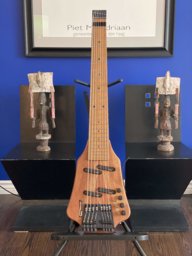
Update: Since December of last year I've strung up my sixer in fifths (CGDAEB) and my fiver in B standard. I've since returned the sixer to fourths (BEADCG)
BEADGC, surely?

TalkBass has been independent since 1998. Add your voice.
Create a free account to reply to discussions, view embedded media, and browse with fewer display ads.
Join free Log in
Want zero display ads or expanded classifieds tools? Compare plans.
Update: Since December of last year I've strung up my sixer in fifths (CGDAEB) and my fiver in B standard. I've since returned the sixer to fourths (BEADCG)
Yup, just switched the last two.BEADGC, surely?

Update: Since December of last year I've strung up my sixer in fifths (CGDAEB) and my fiver in B standard. I've since returned the sixer to fourths (BEADCG) and switched my fiver back to fifths (CGDAE). As fun as it was having nearly five octaves at my fingertips, there were a few things of note that pushed me to make the switch:
A fiver in fifths still has a huge range (almost as much a seven string in fourths!), so it's not that much of a range downgrade.
- The glaring difference in sound output between the strings, even after messing with pickup heights. A multiscale might help mitigate this but I can't justify myself splurging on an Ibanez EHB (let alone a Dingwall!) anytime soon.
- My fifths-tuned ukulele project has found more success with a tenor uke tuned in viola/mandola CGDA and a concert uke tuned in violin/mandolin GDAE. I find that the high notes are more pleasing to my ear on acoustic nylon strings than on electric steel (or nickel or whatever) strings.
- And most importantly of all! Both basses had a dead string, so it was high time for a restringing regardless.

What did you think of them on BG?If anyone wants to try the Lenzner 5ths for 5-string, pm me, i think im passing mine on. Very little use, unclipped ends i believe.

Maybe a 5 string set tossing the "E"Has anyone found strings for 5ths tuning a Uke Bass?
Has anyone found strings for 5ths tuning a Uke Bass?
Maybe a 5 string set tossing the "E"
I'm guessing they meant the E from a 5-string set in fourths (BEADG)? Then for CGDA, I'm guessing it would be
- B up to C,
- A down to G,
- D stays the same, and
- G up to A.


Speaking of CGDA vs. GDAE, after messing around with both tunings in 3 octaves, I prefer CGDA every time!
Not having a bass tuned G1-E3 (yet) I've found C2-A3 to be better for chords then the top strings of my C1-A2 instruments.I wonder if you could elaborate just a bit on this (I presume you're meaning C1-A2 vs. G1-E3). I personally found G1-E3 more practical for melodic solo playing.
Not having a bass tuned G1-E3 (yet) I've found C2-A3 to be better for chords then the top strings of my C1-A2 instruments.
That makes sense. I happen to be more focused on solo melodic lines (e.g., Bach, etc.) than chordal playing, and I've found that G1-E3 helps me to retain note definition and clarity while still sounding more like a bass than, say, a baritone guitar.
I wonder if you could elaborate just a bit on this (I presume you're meaning C1-A2 vs. G1-E3). I personally found G1-E3 more practical for melodic solo playing.