• TalkBass has been independent since 1998. Add your voice.
    Create a free account to reply to discussions, view embedded media, and browse with fewer display ads.
    Join freeLog in
    Want zero display ads or expanded classifieds tools? Compare plans.

The Great Bass Preamp/DI Comparison

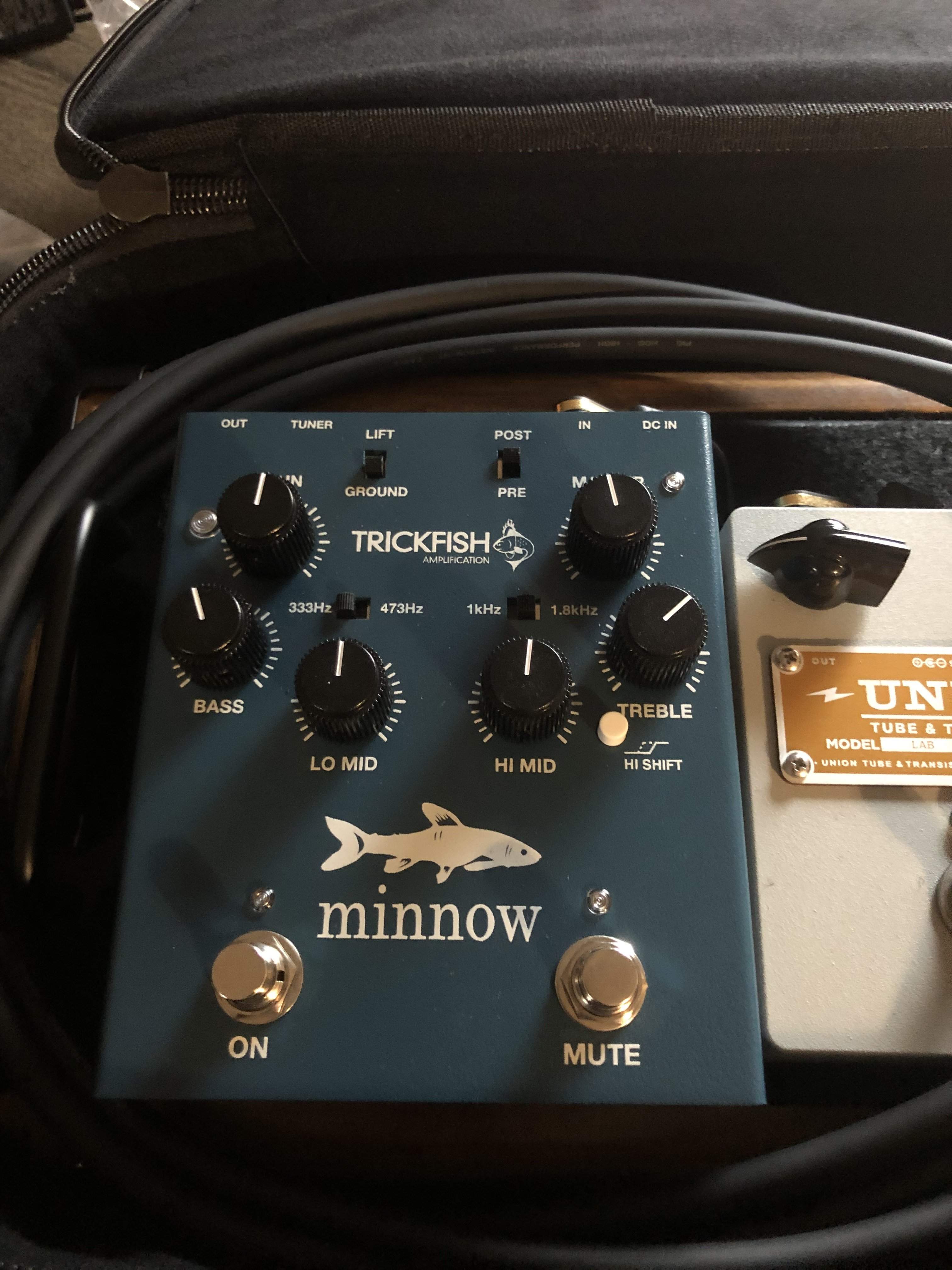
Giving my Trickfish Minnow some run as I have 4 gigs between now and Tuesday of next week. The Starlifter has been my exclusive for the last 4-5 months but this is a close 2nd.
1E85448E-34E5-40CA-81AA-AD332B74713D.jpeg
30DA388B-AD80-4AD0-B61B-5048C95B09A6.jpeg
 
I starting using my RNDI at the end of my chain when I used the SLO and am now doing so with my Trickfish Trilobite even though both had their own DI. Why? Just sounds sweeter. There is some subtle tone sweetening that the RNDI delivers.

that’s not crazy at all. I was doing some side by side testing today with my Starlifter and Minnow and decided to run the Minnow into the Starlifter. It was by far the best my Genzler stack has sounded. Sounded much better and punchier than either by theirselves. Talk about overkill, but it sure sounded amazing lol.
 
  • Like
Reactions: tedsalt
So, the title of this thread refers to both Preamp and DI... and I've seen several comments from folks indicating that DI is essential to them in a preamp. For me it's the opposite; I often have a H/LPF after my preamp and prefer to keep a separate DI either on my board or in a gig bag to have flexibility in where I place it. The Stagebug from Radial is very small and fairly low cost, sounds really good and provides transformer isolation. But I have so many boxes that either are dedicated DI's or include a DI along with other features, that I could probably use a different one every day of the week. Anyone else?

Some folks prefer to keep their pedalboard small and will use all-in-one or combined function pedals, but in my experience I find that separate devices with separate functions can perform their specified function better, so I am using a basic small pedalboard with separate pedals performing their specific function. The board is not too large, just four pedals: tuner, compressor/limiter, preamp, DI. I've tried several combo pedals but at this point that it what I am using. YMMV

It all depends on your budget and goals
 
  • Like
Reactions: Btbp
So, the title of this thread refers to both Preamp and DI... and I've seen several comments from folks indicating that DI is essential to them in a preamp. For me it's the opposite; I often have a H/LPF after my preamp and prefer to keep a separate DI either on my board or in a gig bag to have flexibility in where I place it. The Stagebug from Radial is very small and fairly low cost, sounds really good and provides transformer isolation. But I have so many boxes that either are dedicated DI's or include a DI along with other features, that I could probably use a different one every day of the week. Anyone else?

Not crazy at all. For example my Broughton Studio One preamp also contains a highly-rated DI, but lately I've been putting it at the beginning of my signal chain, because I like the touch-sensitivity with my bass. Then I have a Radial DI at the end of the signal chain.
 
477C52FE-3EDF-4225-8527-916F34D10F07.jpeg


So the J48 came today and I did some quick A/B-ing.

I have to respectfully disagree %100 with a couple of folks on here that said they similiar.

They sound nothing alike to my ears almost at all. The JDI does mellow out everything and mellows the highs quite a bit in comparison to the J48.

It felt like the differance between a bass with broken in strings on a rosewood board to a bass with new strings on a graphite neck.

You could play amazingly fast with the JDI and it was smooth, the J48 was much more clinicial and every high end nuance was there. Which is neither good or bad.

I honestly think your average player would totally be happy with the JDI.

I can’t wait to put the RNDI in the mix.
 
View attachment 3723886

So the J48 came today and I did some quick A/B-ing.

I have to respectfully disagree %100 with a couple of folks on here that said they similiar.

They sound nothing alike to my ears almost at all. The JDI does mellow out everything and mellows the highs quite a bit in comparison to the J48.

It felt like the differance between a bass with broken in strings on a rosewood board to a bass with new strings on a graphite neck.

You could play amazingly fast with the JDI and it was smooth, the J48 was much more clinicial and every high end nuance was there. Which is neither good or bad.

I honestly think your average player would totally be happy with the JDI.

I can’t wait to put the RNDI in the mix.

My prediction: RNDI for the win.
 
My prediction: RNDI for the win.
Well since I'm not playing tonight I got a chance to really play around with this and its pretty safe to say that the J48 is not going to work out for me.
I'm cringing now, realizing what how my old FOH engineer had to eq me with the JDV I used almost a decade back. If the JDI had a bit more top end glass man it would be stellar.
I preferring the Q-strip over the JDI in "EQ tone" but its not nearly as smooth or as quite.

Question for You, do you find the RNDI mellows out the top end compared to the active Radial boxes?

I know there is a little color in the lower register, which is fine. The high end of my set up is a touch much through the Radial active boxes. I know some folks reading this are going to say cut your highs on your bass BUT it comes out to my GKs perfectly and won't do that.
 
Well since I'm not playing tonight I got a chance to really play around with this and its pretty safe to say that the J48 is not going to work out for me.
I'm cringing now, realizing what how my old FOH engineer had to eq me with the JDV I used almost a decade back. If the JDI had a bit more top end glass man it would be stellar.
I preferring the Q-strip over the JDI in "EQ tone" but its not nearly as smooth or as quite.

Question for You, do you find the RNDI mellows out the top end compared to the active Radial boxes?

I know there is a little color in the lower register, which is fine. The high end of my set up is a touch much through the Radial active boxes. I know some folks reading this are going to say cut your highs on your bass BUT it comes out to my GKs perfectly and won't do that.

Yeah, you might notice some "mellowed" top end in the RNDI compared to the JDI. However, I prefer to call it sweetening. You can certainly make up for any perceived attenuation with a little tweak of treble EQ.
 
So, the title of this thread refers to both Preamp and DI... and I've seen several comments from folks indicating that DI is essential to them in a preamp. For me it's the opposite; I often have a H/LPF after my preamp and prefer to keep a separate DI either on my board or in a gig bag to have flexibility in where I place it. The Stagebug from Radial is very small and fairly low cost, sounds really good and provides transformer isolation. But I have so many boxes that either are dedicated DI's or include a DI along with other features, that I could probably use a different one every day of the week. Anyone else?
I think we are of somewhat similar minds on this and I have posted similar things to this effect.

For me it is more about having the DI and HPF/LPF as the final module, so if a preamp has this, as does my Broughton Messenger, then good. However that ties me to the Messenger as my preamp whereas I would rather have another preamp like SLO before the HPF/LPF. I can do that but with the expense and board space of another preamp.

The only solutions I am aware of are the Vong and discontinued Broughton Studio One, but I am sure I am wrong about this. And by HPF/LPF I mean fully adjustable and not a preset switch where you can't sweep the frequencies.

Possible simple solutions (which I have asked for) would be the Broughton HPF/LPF or Broughton RFE to have a DI.

Are we talking the same things?
 
  • Like
Reactions: Zbysek and TonyP-
I think we are of somewhat similar minds on this and I have posted similar things to this effect.

For me it is more about having the DI and HPF/LPF as the final module, so if a preamp has this, as does my Broughton Messenger, then good. However that ties me to the Messenger as my preamp whereas I would rather have another preamp like SLO before the HPF/LPF. I can do that but with the expense and board space of another preamp.

The only solutions I am aware of are the Vong and discontinued Broughton Studio One, but I am sure I am wrong about this. And by HPF/LPF I mean fully adjustable and not a preset switch where you can't sweep the frequencies.

Possible simple solutions (which I have asked for) would be the Broughton HPF/LPF or Broughton RFE to have a DI.

Are we talking the same things?
yes, same thing - multiple functions in one pedal saves pedal space and cost, but the downside is less flexibility in placing each function where you like it best. First world problems!
 
  • Like
Reactions: Btbp
a few thoughts on the API Transformer LX... (long post)
This is another monstrous pedal, very heavy and awkward size - not just a big footprint but also very tall. Requires 18v AC which would usually cause me to walk away, but being that it is API... well I could not resist. Supposedly all the circuitry is the same as in high end studio API gear, just with less control - for example fixed frequencies for the EQ. Really wish this would become a trend - I'd love to see Neve, Avalon, Manley, etc building lower cost / reduced functionality pedal versions of their rack gear! So, kudos to API for making this effort.
There's also a GT version of this pedal for guitar. As far as I can tell the only difference is in EQ frequencies.
The LX has input gain, three band EQ, an interesting compressor, and 1/4" as well as XLR balanced output. There are also phase switches on each output. XLR out is very hot, your mixer needs to be able to handle line level +4db.
There's a clip LED at the input; with a moderate output bass (P bass, Ric 4004) I turned up the input all the way to get the clip LED to light up. Very present sound; no distortion or harshness but a lot of depth. There is no gain reduction metering unfortunately; however I found that with the input set as described, the compressor is getting an appropriate level of input to respond easily to the comp switch. There is a 6 position switch for the compressor. All the way left is 2:1 comp with fairly high threshold for moderate compression. That was my preferred setting for bass. Positions 2 and 3 reduce the threshold for more obvious compression. At position 4 the ratio kicks to 20:1, and the next 2 positions further decrease threshold for more extreme limiting. Compression action is very audible - this is not a subtle or transparent unit. No pumping or weird artifacts though. I like it a lot.
EQ is three band peaking at 100hz, 400hz, and 2k. First glance I thought man, not what I would choose... and yet, when I want a bit more low end the 100hz gives me just that. More presence? 2k sounds surprisingly good. Small adjustments in EQ are easy to hear, and very musical.
The LX is not something that I drag around much just due to form factor and power requirement. Also, I like to dial in some OD for my tone which I've not been able to do with the LX. But even without any distortion it has a ton of character, and a super aggressive tone. Rock and roll!
I recently plugged my bandmate's acoustic guitar through the LX - just the output from the onboard piezo / preamp and it blew us both away. Set the input to where clip was just lighting up (about 3 oclock), and tried the various comp settings - settled on position 3 (2:1 with low threshold), a few little tweaks on the EQ. Really easy to set up, and sounded fantastic!