• TalkBass has been independent since 1998. Add your voice.
    Create a free account to reply to discussions, view embedded media, and browse with fewer display ads.
    Join freeLog in
    Want zero display ads or expanded classifieds tools? Compare plans.

The Hossenfeffer III Build

Nowhere near the Liquid Lava appearance and grain of my source image, but then nothing is. The Alembic wood stock is unbelievable, but from what I've seen, tops like that are unobtanium for the average human, at least at any price I can afford . I bought this bookmatched set from another TB'er. Here it is with a little alcohol sprayed on it to pop it a little. In person it has a little chatoyance I can't seem to photograph, but I think it will look good with Tru-Oil. The Alembic samples are very red/orange, I wonder if I shoud try black dyeing it and sanding back, or otherwise adding some reddish stain? Never worked with Cocobolo before, advice welcome.
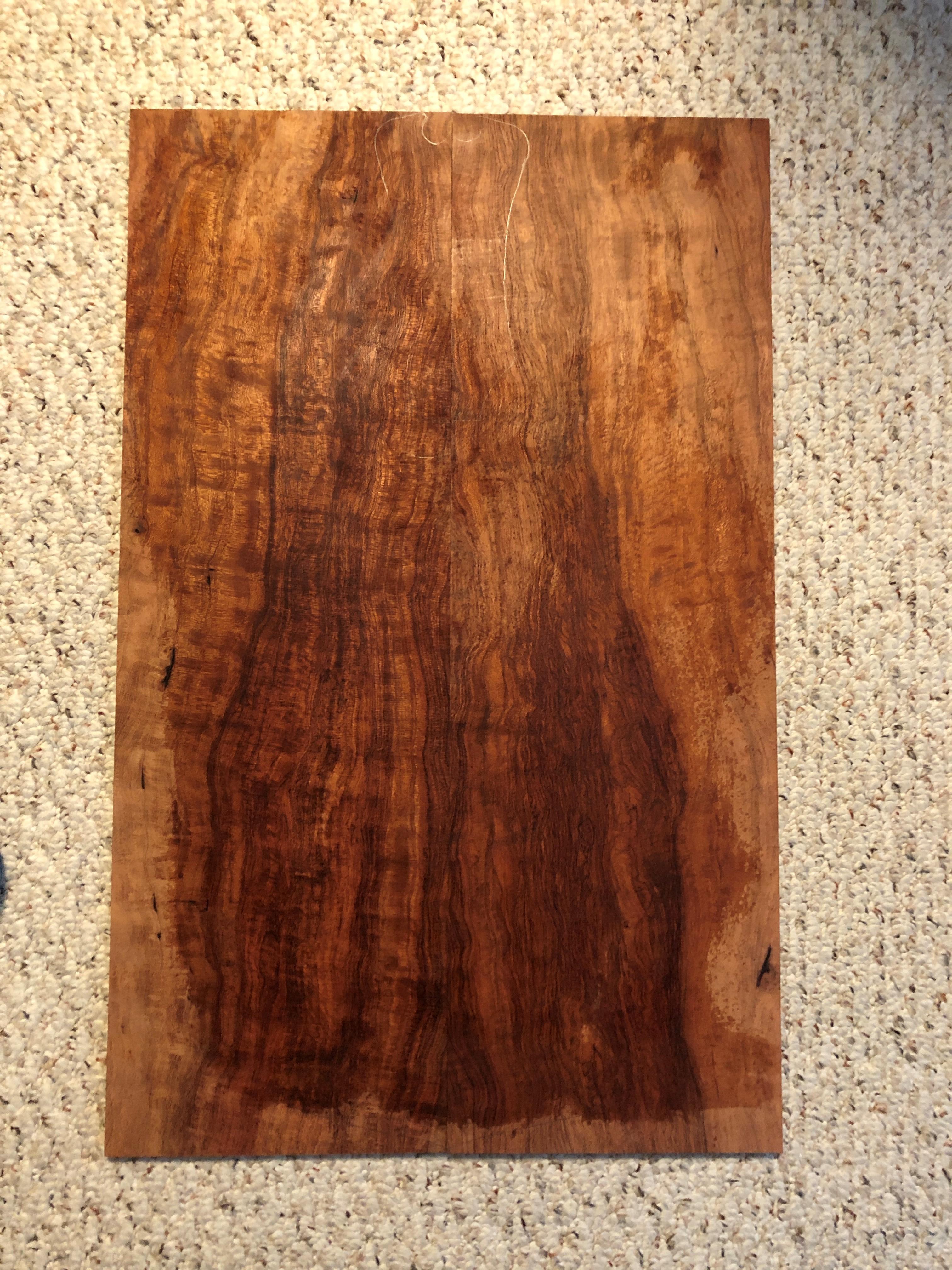
sIxqiOc.jpg


The boards have some wide sapwood sections, but by pure chance, i can cut out 99% of it, per the attached printout overlaid. It will be tight, less than 1/4" clearance to the board edge, but I think it will work if I'm careful.
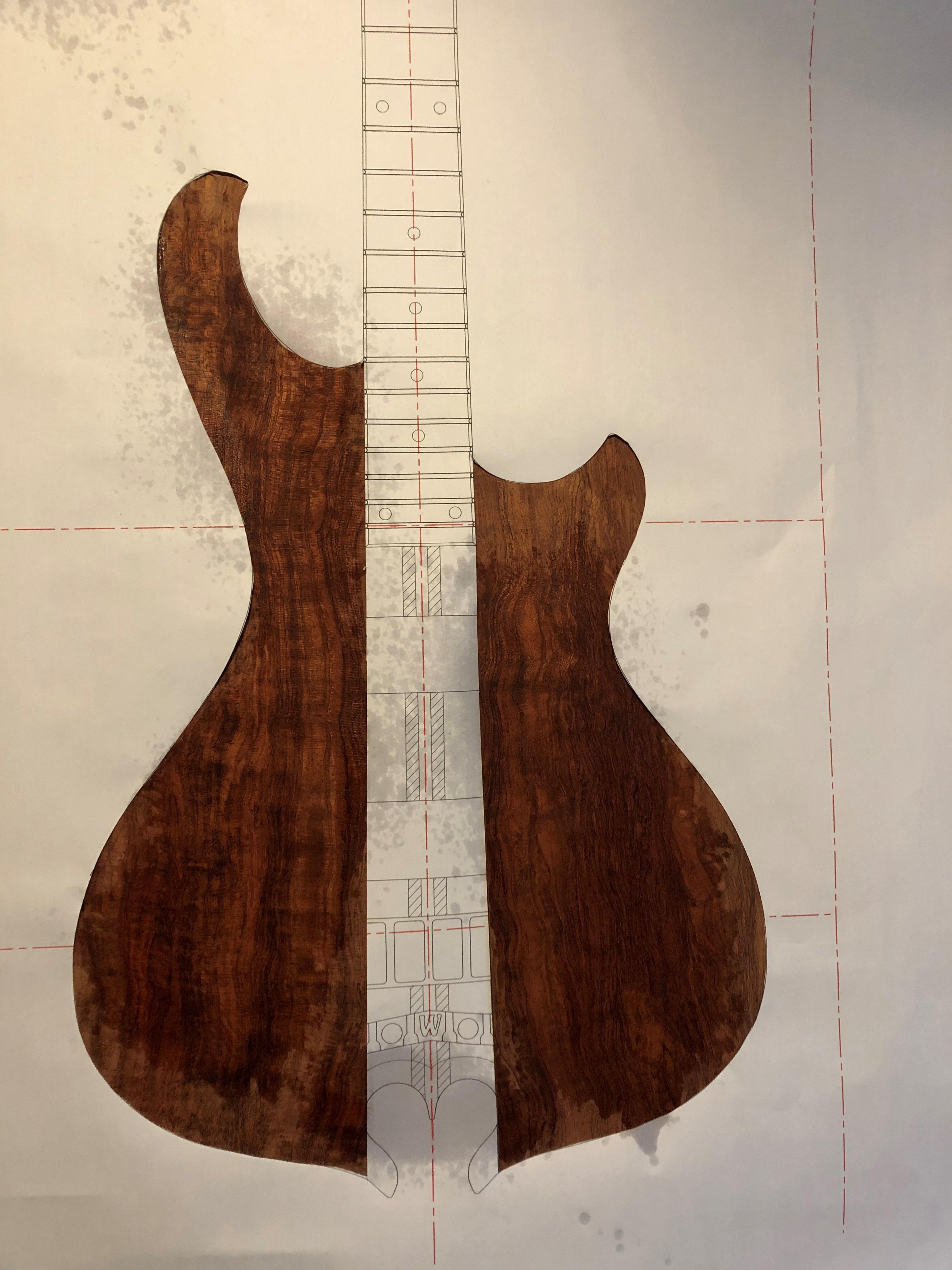
hgWBXiy.jpg


And Ill have JUST enough left for a bookmatched headstock. Win!
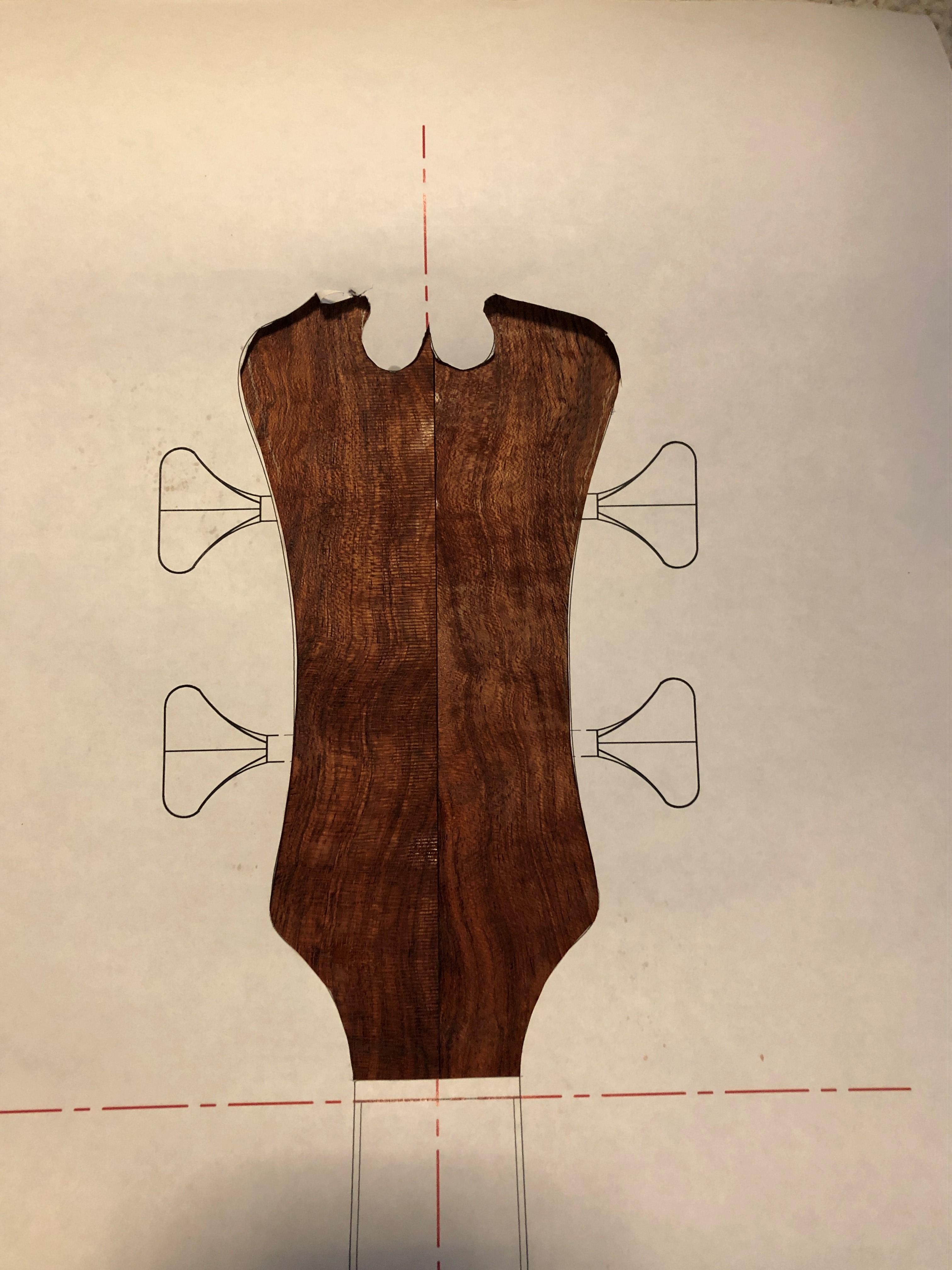
G25nenA.jpg
 
Last edited:
Nowhere near the Liquid Lava appearance and grain of my source image, but then nothing is. The Alembic wood stock is unbelievable, but from what I've seen, tops like that are unobtanium for the average human, at least at any price I can afford . I bought this bookmatched set from another TB'er. Here it is with a little alcohol sprayed on it to pop it a little. In person it has a little chatoyance I can't seem to photograph, but I think it will look good with Tru-Oil. The Alembic samples are very red/orange, I wonder if I shoud try black dyeing it and sanding back, or otherwise adding some reddish stain? Never worked with Cocobolo before, advice welcome.
View attachment 4095272

The boards have some wide sapwood sections, but by pure chance, i can cut out 99% of it, per the attached printout overlaid. It will be tight, less than 1/4" clearance to the board edge, but I think it will work if I'm careful.
View attachment 4095273

And Ill have JUST enough left for a bookmatched headstock. Win!
View attachment 4095274
I wouldn't think that the black dye would enhance the already well defined grain, and might serve to subdue the chatoyance. Light needs to reflect through the fibers, and dying the lighter (open/soft) fibers would reduce the amount of light getting in.
 
  • Like
Reactions: Gilmourisgod
A question for the TB Hive Mind:
What,if any, purpose does the gradual thickening front to back (not side to.side) of the neck on many basses serve? I can see an increase in strength as it climbs towards the maximum deflection at the midway point, is there a rule of thumb on that slight angular increase? On my Ric builds, i matched the Ric taper, which is tiny, I think it was only about 1/8" from first to heel. It fels.fine, and the neck is stable. Other than expectation, is there any reason neck depth needs or should increase along its length?
 
Last edited:
Ok then....no it is! I really dont know.much about finishing natural wood other than Watco Danish or Tru Oil. I know Tru Oil adds some amber tint that might punch it up a little. I can try that out on the waste cutoffs from the bookmatch, might try some reddish stain just in the interest of science. It looks like Alembic uses a very thick poly finish to get that almost glass-like finish, not sure I want that. I dont mind seeing a bit of grain telegraph. Having seen Cocbolo in the raw now, I think they are staining or dyeing it to get that real reddish color. Got a good long while to consider, knowing how slow my builds go.
 
  • Like
Reactions: /\/\3phist0
Ok then....no it is! I really dont know.much about finishing natural wood other than Watco Danish or Tru Oil. I know Tru Oil adds some amber tint that might punch it up a little. I can try that out on the waste cutoffs from the bookmatch, might try some reddish stain just in the interest of science. It looks like Alembic uses a very thick poly finish to get that almost glass-like finish, not sure I want that. I dont mind seeing a bit of grain telegraph. Having seen Cocbolo in the raw now, I think they are staining or dyeing it to get that real reddish color. Got a good long while to consider, knowing how slow my builds go.
[Invalid or Expired Link Removed]
Moderator
Username: mica

Post Number: 3360
Registered: 6-2000
Posted on Thursday, June 08, 2006 - 6:20 pm:
tree_s.gif

The polyester we use a 2-part catalyzed finish. We don't package it for resale (hazmat and shipping nightmare!).

Many Orions have a proprietary polyurethane coating. It's the one that looks like an oil finish when new. Newer Orions use the same polyester coating as the rest of the line now.

Thin layers, sanded between each give a nice, smooth result. The final rubout with ultrafine abrasives before a trip to the buffing wheel makes the polyester look like glass. I buy paste for oil finished from these guys, they might have some coatings available in smaller quantities, and Invalid Link Removed certainly does, though I'm not familiar with either company's coatings first hand.


[Invalid or Expired Link Removed]
 
  • Like
Reactions: Gilmourisgod
Well... Polyester is Out! From what I've read, the toxicity alone is a bit daunting, I've done somne fiberglass work with polyester resin, and it's nasty stuff. I tried the water based finishes like Varathane, and they do indeed go on very clear, but don't have great scratch resistance. Another finish I may try is Solarez, was that you that posted some threads on it
@/\/phist0? I'm attracted by the idea of a sun cure. Hmmm......... so many finishes, so little time....
 
  • Like
Reactions: /\/\3phist0
I have been pretty pleased with the SprayMax 2K aerosol poly, although adhesion is not as good as Varathane and it’s pretty nasty stuff.

I spray Everclear shellac on anything with chatoyance because it was the big winner in my tests.
 
Funny, the guy I buy my epoxy from has tried to get me to move to a polyester finish a couple of times. When I describe what I want, glossy, hard, durable; he says 2 part polyester. He's got a variety because of the boatbuilding around here. Too much fuss and poison for me though.
 
Well... Polyester is Out! From what I've read, the toxicity alone is a bit daunting, I've done somne fiberglass work with polyester resin, and it's nasty stuff. I tried the water based finishes like Varathane, and they do indeed go on very clear, but don't have great scratch resistance. Another finish I may try is Solarez, was that you that posted some threads on it
@/\/phist0? I'm attracted by the idea of a sun cure. Hmmm......... so many finishes, so little time....
Redwood clock for Xmas for Moms.
26" along the base, 6" clock face.
You know what I finished it with.
Sealed and glossed, 3 coats of clear. One day.
Sanded and polished out imperfections the next day. It is water clear.
13684.jpeg

I have also tested a grow light from Wally World, and it takes about an hour to cure as opposed to minutes, but cheap , to handle those dark days. Or night finish after sun goes down.
 
Last edited:
A question for the TB Hive Mind:
What,if any, purpose does the gradual thickening front to back (not side to.side) of the neck on many basses serve? I can see an increase in strength as it climbs towards the maximum deflection at the midway point, is there a rule of thumb on that slight angular increase? On my Ric builds, i matched the Ric taper, which is tiny, I think it was only about 1/8" from first to heel. It fels.fine, and the neck is stable. Other than expectation, is there any reason neck depth needs or should increase along its length?
Dan Armstrong plexiglass basses had no tapers at all.
 
  • Like
Reactions: Gilmourisgod
In person it has a little chatoyance I can't seem to photograph, but I think it will look good with Tru-Oil. The Alembic samples are very red/orange, I wonder if I shoud try black dyeing it and sanding back,
Call me late to the party with please don't mess that up with dye. As for capturing chatoyance, you pretty much need video to do that.
 
I've done about three dozen samples trying to dye figured wood in the last few months, and I have to say I'd agree with the people suggesting to not do it. It does really highlight the figure, but it also freezes it. You pretty much lose the chatoyance and replace it with an amazing but very flat and two dimensional look. If you want to color the wood without freezing the figure like that, try a thin wash coat of shellac to seal the grain, then a second light coat of shellac with some dye mixed into it.
 
Im in the Great Covid Slow Package Delivery mode. Unbeknownst, USPS has chosen to prioritize saving lives over delivering bass parts and lumber. My bridge is someplace in Germany, and my nut and purpleheart in USPS warehouses. Apalling! I guess ill have to dial back my innate selfishness and wait, like everybody else. :) USPS is not delivering packages from most of Europe, which shows you just how serious this whole thing is, stay safe everybody.

In the meantime , Ill be Impatient Template Boy which is about as fun to watch in process as drying mud, but i gotta get my sawdust fix somehow.