
My pet peeve of headstock design is a 5-string with BEA-DG tuners instead of BE-ADG tuners. Let's start with the G string: it doesn't matter how close it is to the nut, because the typical 40-50 gauge G string will wrap around anything, I mean, after all, a typical 54 acoustic E string wraps around the small guitar tuner. Next are the D and A strings, which being higher up on the headstock, almost always have enough silk or taper where it is not an issue. Now to the other side of the headstock. The E string will usually also be up high enough that there is enough silk that there is no binding. The B string is the kicker. Except for La Bella and Fender who make a 36 1/2 inch speaking length B string for the Fender-style cramped headstocks, everybody else makes a B string that is at least 37 inches long, if not longer, for their "standard" length string for "standard" 34-inch scale basses. The longer winding length will bind on a B tuner that is not offset up the headstock, which you can do easily with a 2+3 arrangement, but not with 3+2, as the B tuner is too close to the nut to give enough clearance for the taper or silk to do its job without binding the speaking length of the B string. The only exception I know is the Lakland headstock, which does offset the B tuner, but at the expense of making the headstock large enough that it can cause neck dive.

Enjoy the benefits of a premium membership!
Upgrade Account
-
TalkBass has been independent since 1998. Add your voice.
Create a free account to reply to discussions, view embedded media, and browse with fewer display ads.
Join free Log in
Want zero display ads or expanded classifieds tools? Compare plans.
You are using an out of date browser. It may not display this or other websites correctly.
You should upgrade or use an alternative browser.
You should upgrade or use an alternative browser.
The importance of design...
- Thread starter Bebo2020
- Start date
More options
Who Replied?

With all this said, what I am GASsing for is a copy Tele with a Lollar in the slot, Tennessee silver maple body, maybe translucent milky or caramel color, just enough to pop the grain. Add a 5A rainfall pick guard with a little orange or amber tint, volume, tone, flats, let's go! And knowing full darn well that it's not an engineered solution but a work of art that I can wear out with my hands. I could work with this. And yes, I know binding doesn't do anything.


Nothing disappoints me more than seeing a stunningly designed (anything), beautifully made and put together, but with one aspect/part that's been poorly styled/positioned or colored, in a way that brings down the rest of it as a whole. I always maintain if you possess great skills at building/ machining, (in this case, bass building), but lack solid styling/visual talent, you should always, where ever possible, get someone in on it who does.
Otherwise it's a bit of a wasted opportunity IMO.
Otherwise it's a bit of a wasted opportunity IMO.

I wonder how important for all of you is the design of a bass. There are many well built instruments that sell poorly due to an ugly or poorly conceived design. One particular issue is the headstock: must of them are horrendous. Is it me, or some of the bass builders have a poor understanding of the value of design?
Dont give a crap about a headstock. Everyone's taste is different anyways.
As long as the bass feels good and sounds good, I dont care about anything else.
You sound like the type that wouldnt be interested in a beautiful woman becaue you dont like her little toe.......

The headstock needs to balance out with the body. There is some great body designs with an unmatched headstock.
ask sporting good manufacturers how
important graphics are
To their equipment. They could make the best performing equipment but if it’s not appealing,
No one would use it.
ask sporting good manufacturers how
important graphics are
To their equipment. They could make the best performing equipment but if it’s not appealing,
No one would use it.
Your rigte, must of then ar.I wonder how important for all of you is the design of a bass. There are many well built instruments that sell poorly due to an ugly or poorly conceived design. One particular issue is the headstock: must of them are horrendous. Is it me, or some of the bass builders have a poor understanding of the value of design?
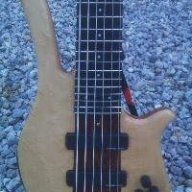
Everyone has different tastes. I like pointy headstocks even though they are not well received here on TB, but they must be tasteful. I also like unconventional bodies. So that is why I built this. It was designed for playability, balance, comfort and looks. Some may dislike it, but I love it.


Maybe I'm interpreting the word too broadly but to me, design is EVERYTHING. The whole bass has been designed, all it's features. Every choice of material and construction. All of the best properties it has, it's usability, playability, utility, come from it's design.
*itsMaybe I'm interpreting the word too broadly but to me, design is EVERYTHING. The whole bass has been designed, all it's features. Every choice of material and construction. All of the best properties it has, it's usability, playability, utility, come from it's design.
Being a lefty 5 string player with some pretty specific ergonomic requirements and a functional preference for vintage size frets and 19mm bridge spacing, I really can’t be picky about appearance. In fact, I just bought a Kiesel JB5, and I think the headstock looks sort of nondescript. I really couldn’t care less. When you need a unicorn, it’s not worth worrying about whether you like the color of his eyes.
Sometimes I think it would be cool to have so many good choices that aesthetics were a real consideration. Honestly, though, I’ve developed an appreciation for bonding with a single quality instrument and using it 95% (or more) of the time. It makes me relatively immune to instrument GAS. You might expect that to save me some money, but there’s always more gear to obsess over - pedals, PA, stands, cases, covers, and bags...
Fortunately for me, one of the few advantages to playing lefty is nobody else cares what your bass looks like. A lefty instrument is already so exotic to most people that everything else becomes incidental.
Sometimes I think it would be cool to have so many good choices that aesthetics were a real consideration. Honestly, though, I’ve developed an appreciation for bonding with a single quality instrument and using it 95% (or more) of the time. It makes me relatively immune to instrument GAS. You might expect that to save me some money, but there’s always more gear to obsess over - pedals, PA, stands, cases, covers, and bags...
Fortunately for me, one of the few advantages to playing lefty is nobody else cares what your bass looks like. A lefty instrument is already so exotic to most people that everything else becomes incidental.
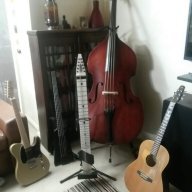
The Railboard looked great, in theory, to me too. Then I bought one and found it really alien to play as well as othe issues... Swapped it for a nice maple 10 string and never looked back!
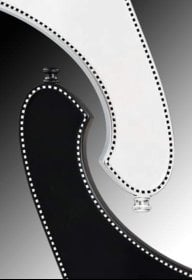
I was going to go on a long rant about the overall superiority of the Headless Steinberger design, but @Killing Floor beat me to it quite succinctly. If people wanted a minimalist solution to instrument design that has everything you need, and nothing you dont, we'd all be playing Steinbergers. I've had one since 1983, and have yet to see anything that approaches it technically, other than Ned's newer NS Design basses, or the Kubicki Ex Factor. As a class of people, we must be Anachronists, basically clinging to 1950's technology because it's comfortable. Don't get me wrong, I do love beautiful wood and fancy headstocks as much as the next guy, just goes to show that actual design utility is only a small part of the appeal of a bass.
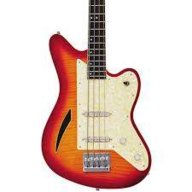
Like clothes , I have to wear it. Should be comfortable and look good.I wouldn't own an instrument if I disliked its looks for any reason. It's easy enough to find perfectly good instruments that also look nice.
Function and form.
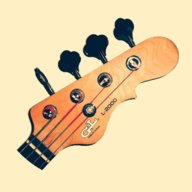
I totally agree and my next bass will probably be a classic old style precision bass.It's an interesting topic for sure. It's a fun topic because as a market basis, musical instruments are not typically designed for performance, but aesthetics.
If you look at physics (acoustics, vibrations, tension/compression) headless basses simply perform better. In a purely engineering context, double ball end strings are physically better, they are stronger. But the aesthetics present a challenge to the market. An instrument string is pulled in tension to "tune" but traditionally 1 end is anchored (ball) and bent over a cantilever (bridge) and the other end rolls through a nut and is then wrapped around a peg.
OK, why then? Bass strings work this way because stringed instruments have been tuned with cylindrical tuning pegs since at least the Han Dynasty, more than 200 years BC, not because it is best but because it is oldest. A cable in tension anchored equally on both ends will last longer and overall perform better in any application, not just bass guitars. But "We" don't like the way double ball basses look so we don't buy them, no matter what.
Even if you don't care for Steinberger type instruments (I personally do not like the aesthetics) you cannot argue that no head = no neck dive. Also, let's talk about dead spots. No headstock almost completely eliminates the possibility of dead spots.
We do not "like" carbon fiber. There is not a wood from any tree in nature that conducts musical vibrations more effectively than properly aligned fiber. But it's not bubinga or ebony or ash or maple. So we gloss over the part about "not as good" and stick with what we "like". Instruments have been made from wood for as long as humans have made instruments. But it's easy to prove in a lab that wood is a distant second place to graphite composite.
Even if you (and I ) love traditional wood "single pull" strung basses with headstocks, can we at least acknowledge that the least effective, least comfortable, most obstructive method of holding them is a guitar strap? Placing the weight of a large bass guitar across your collar simply and conclusively impedes your range of motion and increases stress that ultimately impedes your plucking/slapping and performance. But ain't nobody gonna pivot their bass on a waist belt. But why not? Because we are used to wearing shoulder straps.
34" scale? Leo Fender's folks said so.
Magnetic cylinder pickups? Because we simply haven't embraced optical pups even though they are 2 orders of magnitude more precise and more adaptable. Mags worked in the '40's so why change?
Nuts instead of zero fret? Really? No reason whatsoever, just a habit leftover from violins.
Jacks on the top of the control plate? Think about it. If you step wrongly you break the cable, the plate, or the jack. Or if it's on the bottom side, you step on the cable and it falls out, saving your bass. Duh.
Control plates? Pick guards? Thumb rests / tug bars? Ash tray bridge covers? Single coil option switches on a humbucker? Those ballpoint pen springs that they put on bridges? Bolt-on necks? Really?
So rant over, it's all about the aesthetics and meeting the historic status quo, and actual industrial design almost never touches our industry. But I like it anyway. We like wood and headstocks and tort and leather straps and tubes. Even if we know better.

I work as an engineer. We wouldn’t think of building anything without a design. We can fit the technology into almost any shape, but the chances of us picking a nice one are slim to none. We do work with the designers if there are form-factor considerations we need to meet the specs, but also just in general.Clearly all of those things are relevant to evaluating a bass, but I think the OP phrased it in such a way as to imply he was only talking about the aesthetics—that's certainly how I interpreted it. I think that's what @Mustang Surly was reacting to.
Anyway, @Killing Floor has it almost completely right. If you handed a modern engineer the specs for what you wanted and the instruction to build what would work best, not to be constrained by current convention, you'd get something that's almost certainly better in terms of sound, durability, ergonomics, etc.: a carbon fiber headless with optical pickups, etc. (Probably expensive, though.) We are slaves to both tradition and aesthetics. As someone who was originally trained as an engineer (though I'm not one by profession), I have to say when I see things like the Chapman Railboard some part of me just knows that's a better design in many ways.
This is not unique to basses, either: a great many musical instruments could probably be improved by a radical modern redesign. But most people won't go there. That's not necessarily wrong, either—there's value in the familiar and in working with limitations.
I know way back in engineering school “design” simply meant making the purely technical decisions to meet a spec: sizing the boiler, sizing the turbines, determining the values for automatically controlling the valves (mech e). But even then RISD and similar places existed.
In the work place “design” certainly covers aesthetic choices, but also encompasses work flows, ergonomics, and functional form-factors. It is done by professionals called designers. It is the designers that make those ergonomic and form-factor decisions, not the engineers, although in reality it is a group effort where we have conversations with the designers over design proposals to arrive at something that meets all of the requirements.
Headed vs headless is such a major decision that that would most probably be dictated by the product owner/stake holders before we started, with full acknowledgement of the technical advantages and drawbacks, as well as the market and aesthetic impacts of that choice. I could see a few different targets given to design, depending on input from sales and the stakeholders: make something headless but that will appeal to a traditionalist buyer. Or, make something really modern that leverages all of the latest technological advances because we’re targeting the small sector of high-end buyers who want the best no matter what, and for whom cost is not an option. So that level of decision would be determined by a high-level group of stakeholders depending on where they would want that new product to fit in the overall portfolio.
The designers would then try to meet those requirements. Once the basic set of drawings was approved by the stakeholders, then engineering comes in to discuss with the designers and stakeholders, basically to douse it with the cold spray of reality, lol.
All of which is to say that even if you were only talking about aesthetics, it would still be called “design”. At least in my professional experience.

Beauty is in the eye of the beholder - but for my money nobody tops Sheldon Dingwall when it comes to design 


really elegant headstocks can be rare. I've always loved this one. not the greatest photo, but it's magnificent in person.
i agree that some designs sometimes look like no thought was put into it. nothing more gross than a "clever for the sake of being clever" type of thing.
what makes musical instruments beautiful is the intersection of form and function. a violin has its shape for very specific reasons, the c-bouts are so the bow has room to travel without striking the body. bass guitars have similar reasons for cutaways, with things like headstocks leaving lots of room for interpretation as their only function is to house tuning gears which can be placed countless different ways.

JeezyMcNuggles
Inactive
- Feb 23, 2018
- 14,723
- 20,970
- Disclosures
- I suck, but nobody really notices
Hahaha, dude I can't believe some of the builds I've seen on here. Some are amazing, others...why would you ever conscientiously decide to do that? One example is: There was a build a couple months ago by someone who cut the headstock into a male extremity. He took a piece of wood, designed, drew, and cut the headstock of this gorgeous bass straight into a wang. What were you thinking?! You drew it, you saw it, you knew it, and you did it anyway? Then posted it on here going, "look at my latest build!" 34" dong. Couldn't believe it.I wonder how important for all of you is the design of a bass. There are many well built instruments that sell poorly due to an ugly or poorly conceived design. One particular issue is the headstock: must of them are horrendous. Is it me, or some of the bass builders have a poor understanding of the value of design?


There are plenty of functional designs that don't have an attractive look.
And there are plenty of attractive basses with functional design flaws.
(Then of course, there are basses with bad looks and function, but we're not here to just rail on {sorry, I can't say them here, it gets you in trouble}).
In my experience, what I tend to find the most attractive to actually purchase is something with the best balance of both function and aesthetics.
That said, there are some functional design flaws in "traditional" basses which have been used for many years. It boggles my mind that they still do the same thing to this day... but they have to make what people will buy and it sells the most. So basically, my desire for those basses is nonexistent because I think the flaws outweigh the reason to actually own them.
And there are plenty of attractive basses with functional design flaws.
(Then of course, there are basses with bad looks and function, but we're not here to just rail on {sorry, I can't say them here, it gets you in trouble}).
In my experience, what I tend to find the most attractive to actually purchase is something with the best balance of both function and aesthetics.
That said, there are some functional design flaws in "traditional" basses which have been used for many years. It boggles my mind that they still do the same thing to this day... but they have to make what people will buy and it sells the most. So basically, my desire for those basses is nonexistent because I think the flaws outweigh the reason to actually own them.
Latest posts
-

-
 Uber Eats class action lawsuit alleges their priority delivery is a scam
- Latest: buldog5151bass
-

-

