• TalkBass has been independent since 1998. Add your voice.
    Create a free account to reply to discussions, view embedded media, and browse with fewer display ads.
    Join freeLog in
    Want zero display ads or expanded classifieds tools? Compare plans.

The importance of design...

Rojo and JRA, thanks for this discussion. I'm new to making truss rod adjustments, and my two main basses disagree on this: one has headstock access (and a cover that needs to be unscrewed), and the other it's at the heel. The heel sure seems easier to me (it's as Rojo described: channel, just takes an allen wrench), so I'm interested in the pros and cons.
 
  • Like
Reactions: rojo412 and JRA
if I have my druthers, it's heel all the way.
i get it.....now! :laugh: actually, i think you/others have mentioned this before, but it's just now sinking in, rojo412! that was a great rationale/explanation --- i'm convinced! i'm fairly over-stocked with the other necks, however, at the moment. :D

thanks for taking the time to respond with those two posts. good stuff for all to read/consider! :thumbsup:
 
  • Like
Reactions: rojo412
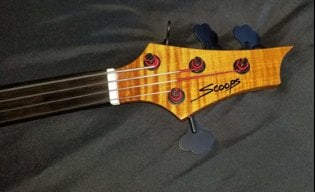
I wonder how important for all of you is the design of a bass. There are many well built instruments that sell poorly due to an ugly or poorly conceived design. One particular issue is the headstock: must of them are horrendous. Is it me, or some of the bass builders have a poor understanding of the value of design?

Maybe perhaps the OP could design a bass that exemplifies what a great bass design should look like
 
Now if they'd all just make the truss rod threaded parts an even finer thread, always ruggedly mount the fixed end, and put in a life-long-lasting lubricant so it never binds up even when tuned...

fwiw, the typical truss rod is threaded 10-32 UNF and in the #10 size, taps and dies aren't made any finer. also, there's a fail point with too fine a thread in that it will be striped pretty quick which is a liability for a volume mfg.

a superior system would be a differential thread. i knew of one acoustic builder who made his own da t-rods out of titanium that did this. i understand how he did it, but he was trying to get the system patented and that needs to be respected. otoh, kinematic stands used in the lab for laser alignments often have this feature and i've designed more than one myself.

lubricant wise there are many long life choices. non are "life-long-lasting" unless the mating materials are impregnated with the substance or have it a significant part of their make up like graphite or teflon, etc.. going with a bronze alloy could be helpful but at the risk of stripping the threads. another option is a conversion coating like molykote, or a plating, etc.. not something i suspect a large mfg would take up. again, this is where boutique builders have an advantage.
 
  • Like
Reactions: OogieWaWa
My original comment was intendent as a diplomatic nod towards certain manufactures that, to my understanding, have been unable to synthesize a well designed instrument, but also aesthetically pleasing, to my eye at least. Since it has been previously mentioned, I was precisely thinking of Kiesel instruments. They are consistently good, functional players, but nevertheless, have a very weird notion of aesthetics, again, to my eye. My comment goes to companies like them, in the sense that they should hire some consultant to increase their sales just by changing the appearance of their instruments. Someone has to say that I guess... no offense please.
 
fwiw, the typical truss rod is threaded 10-32 UNF and in the #10 size, taps and dies aren't made any finer. also, there's a fail point with too fine a thread in that it will be striped pretty quick which is a liability for a volume mfg.

Good counterpoints. I just hate that initial snap when old threaded parts start moving under a lot of effort, I'm always afraid that it's going to be the wrong kind of snap. Too fine of a thread may strip more easily, but I suppose one could make up somewhat for that with a longer "nut" portion.

For lubrication, besides the threads themselves maybe something could be better with the load bearing contact area that the force is against; perhaps a thin Kynar-coated washer or the like.

I wasn't familiar with the differential screw jacks, and I found some interesting information on them. A real Aha thing! So simple, yet... Thanks!
 
Last edited:
Design is paramount, and good design rules. However, taste is subjective so even if something is well designed - there will always be people who don't "get" it. This is why there are P-basses and a few others (abet being well designed) which a majority of players have a favoritive aesthetic response to.
 
I've mostly run into the (to me) terrible headstock ruining an otherwise great design on the guitar side, but yeah. The two biggest repeat offenders on this for me have been Schecter & PRS, a few of them have seemed like really nicely designed & built instruments that I just can't bring myself to grab due to their headstocks.
Totally understand were you're coming from and agree the PRS headstock is not athetically a thing of beauty. That said however, the PRS headstock has an ingenious design as it eliminates any harsh angling of the strings across the nut. Makes for much better tuning stability...and it does this well.
 
  • Like
Reactions: SidNitzerglobin
I don't disagree. I should have put "better" in quotes. I meant technically better, but that doesn't necessarily imply subjectively better.


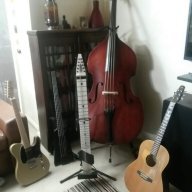
And here's a perfect illustration of that. The Railboard appeals to the engineering side of me—it seems like it has to be technically better than your typical bass guitar—but in the end it results in a design that's so radically different it's foreign. There are so many fewer resources for learning how to play it, for instance. That's what I was getting at when I said we are, in part, slaves to history. The bass guitar has a lot more of it, and that matters.

Walking in blind with no resources or predefined parameters is a fundamental aspect of stick learning. Most of us purchase an instrument before we have even held one in our hands. I understand the point that you are trying to make and it is interesting and valid, however I was more alluding to the actual feel of the instrument.

It was a complete redesign of the existing Stick but to me it felt cold and the full metal construction was doing strange things to my joints (although perhaps imagined?). It was also heavy. I came to it from a polycarbonate version from the 80's. When I settled on my current maple one, it made a huge difference, lightweight, resonant, nice smooth feel etc.

Steinberger, on the other hand, I can't go past. The instruments that I use are a marvel of engineering and forward thinking. The traditionalists STILL can't get past the aesthetics (where's the headstock... derrr... ).
 
Hahaha, dude I can't believe some of the builds I've seen on here. Some are amazing, others...why would you ever conscientiously decide to do that? One example is: There was a build a couple months ago by someone who cut the headstock into a male extremity. He took a piece of wood, designed, drew, and cut the headstock of this gorgeous bass straight into a wang. What were you thinking?! You drew it, you saw it, you knew it, and you did it anyway? Then posted it on here going, "look at my latest build!" 34" dong. Couldn't believe it.

King Missile tribute band?
 
I wonder how important for all of you is the design of a bass. There are many well built instruments that sell poorly due to an ugly or poorly conceived design. One particular issue is the headstock: must of them are horrendous. Is it me, or some of the bass builders have a poor understanding of the value of design?

A luthier/bass builder can incorporate the appropriate functional elements needed to create a playable and good sounding instrument but... without a keen sense of visual aesthetics related specifically to its 'design' - I personally feel it can fall short of an exceptional bass, one that 'checks all the boxes'. It is a point that separates an artist from a competent bass builder.