• TalkBass has been independent since 1998. Add your voice.
    Create a free account to reply to discussions, view embedded media, and browse with fewer display ads.
    Join freeLog in
    Want zero display ads or expanded classifieds tools? Compare plans.

The joy of root-fifth playing

Totally agree. The simpler the line, the easier it is to play (by definition), but the harder it is to get the timing exactly right to make the tune groove in whatever way the tune wants to groove.
Yep, I always tell people, putting in my time in the trenches in country and reggae are what made me a "real" bass player. It's in these kinds of genres where every note - and every space between the notes - is an event. Love it.
 
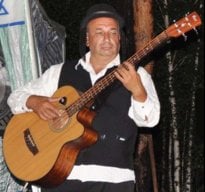
The sound in that video is not great but the verse is / Dm / A / A / Dm / which I play as D DE / A E / A AE / D A / So it's root-fifth with a sort-of-passing tone.

Chorus is fun D7 / Gm / C / F / Dm / A / A / Dm / repeat. Practice your circle of fifths!

You can always add C# to lead in to Dm from A . And F# of D7 to lead into Gm - its third an Eb to the third of C which is E before the downbeat. Since it is a little bit Mid East or Klezmer, You can flatten the fifth of A to Eb to drop back to Dm. It doesn't have to root and fifths. Just be on time because that dumbek may forget it.
 
Nah, I just listened to a random album that he plays on and it's pretty much like I said above. Although I only found the "triple two-step" type, not the Texas two-step.

Random illustration that he and I can probably agree on (different bass player though):


I stand by my previous response, and that you are missing or misconstruing the overall point of Dave's statement. Also, you didn't share the 'random album that he plays on' that you tossed off without further qualification, so you can add proper context for the rest of us to evaluate your categorical dismissing of his work.
 
And F# of D7 to lead into Gm [ ... ] can flatten the fifth of A to Eb to drop back to Dm.
1. On the D7 is where I start walking scales.
2. Enharmonic substitution works nicely, especially since the music is indeed middle-eastern-like. (This may be Armenian. I'd have to ask.) But be careful not to clash with the accordion.

We also play Misirlou which has a lot of flat & sharp scale notes. Opening line: D Eb F# G A Bb C# Bb A
 
Yup, playing a root five ass-kicker is probably the most fun you can have with your pants on.
Gotta say, playing for a rowdy (OK, sometimes drunk) crowd of line dancers and two steppers is a heckuva lot more fun than when I'm playing original rock for people standing there with their arms folded wondering what kind of strings I use ;).
 
  • Haha
  • Like
Reactions: fig and Hot Rats
As long as you don't stand between me and the dancers I'll let you stand wherever you want.
Dave's recorded work, his resume, and my firsthand experience seeing and hearing him play at MerleFest, along with my own experience playing country and bluegrass is all the proof I need of whose opinion I trust. Carry on.

And since the point still seems to be 'danced around', what Dave was implying in the context where I read his quote was that most people who try to 'fake' Country bass lines, or think they are 'boring and simple', play too much in trying to do it. It's very easy to overplay when you don't know the genre well. They aren't comfortable just playing long, sustained whole notes, half notes, or well-placed, fat quarter notes. And it IS a discipline. So while I respect that you are trying to discuss very specific stylistic and harmonic aspects of particular subgenres/styles of Country, that's more pedantic than the discussion needed to be, especially when it got to the point of dismissing someone of Dave's stature and experience in the genre. Now... we can carry on.
 
Last edited:
  • Like
Reactions: fig and pbass2
Wow, I would never dream of hearing melodies of my childhood at the Texas folk dance. ;)
The verse melody was called "Karapet" and is more than 100 years old. The chorus, though, is from the Red Army March. Both probably originated from some Klezmer songs.
 
Wow, I would never dream of hearing melodies of my childhood at the Texas folk dance. ;)
The verse melody was called "Karapet" and is more than 100 years old. The chorus, though, is from the Red Army March.
Interesting. I'll check with our experts. I'm just the bass player.... (The clarinetist is Armenian.)
We usually play this song in a medley with "Seven Uncles". Does that ring a bell?
 
Gotta say, playing for a rowdy (OK, sometimes drunk) crowd of line dancers and two steppers is a heckuva lot more fun than when I'm playing original rock for people standing there with their arms folded wondering what kind of strings I use ;).
Yeah, even my co-musicians are not too concerned about gear. I once showed up with my Steinberger and the only comment was "Do you have a new bass?" It's refreshing.
 
  • Like
Reactions: Eli_Kyiv
I-V is such a broadly used style, Italian waltz's, Polka's, Trad Country, Bossa's. It's hard to avoid. If you don't embrace it, it may drive ya a little crazy.

I played club dates for 20 years. By the 3rd gig in a weekend, I'd mentally check out. I was in an ethnically diverse repertoire band, and despite that, alot of ethnic music was I-V heavy. What kept me going was the view. a Joyful crowd dancing happily would always supercede the monotony of the I-V played for umpteen measures per gig.

Glad those days are behind me. I only play scream-o now…….
 
  • Like
Reactions: fig and pbass2
Yeah, even my co-musicians are not too concerned about gear. I once showed up with my Steinberger and the only comment was "Do you have a new bass?" It's refreshing.
Ah, well the guys in the country band I play in, (with the exception of the front man, but he's getting there....) are all as geeky as anyone about gear (man, the steel players we use really get into some wild nuanced stuff). But I encounter far less musicians in the audience than I do at rock shows. Fine w me, these folks know how to party.
 
And since the point still seems to be 'danced around', what Dave was implying in the context where I read his quote was that most people who try to 'fake' Country bass lines, or think they are 'boring and simple', play too much in trying to do it. It's very easy to overplay when you don't know the genre well.
Yep, or alternatively, they over-simplify and only play root/five and don't understand how to create movement and tie the whole thing together harmonically and rhythmically. I hear lotsa rock players do this when they first take a crack at country, especially in - for lack of a better term - what I'll call "hipster country", where nobody's gotten their hands dirty learning the nuances of the genre.
Here's IMO an excellent example of how cool country bass can be, by the great David Hungate. Sure, there's some root/five in there, but check out everything else....:
 
Here's IMO an excellent example of how cool country bass can be,
That would get me two-stepping around the floor.

(I was in Gruene a few weeks ago, location of one of the few historic dance halls left in Texas. There was an excellent band playing, and the dance floor was something like an 18 wheeler *squared*. Partner & I had a grand ol' time dancing. )
 
  • Like
Reactions: RicheyLather
That would get me two-stepping around the floor.

(I was in Gruene a few weeks ago, location of one of the few historic dance halls left in Texas. There was an excellent band playing, and the dance floor was something like an 18 wheeler *squared*. Partner & I had a grand ol' time dancing. )
Saw Joe Ely at Gruene Hall forever ago, classic place!


This is one of my essentials for country bass playing. A real masterclass in feel, restraint, and note length. The bass sits just behind the beat without ever dragging, uses exactly the right number of notes, and lets space and duration do as much work as pitch. The line is warm and beautifully supportive, never stepping on the vocal. Not sure who the player is - probably an LA session cat - but whoever he is, the bass line is hittin'. As good as it gets, IMO.
 
  • Like
Reactions: Eli_Kyiv