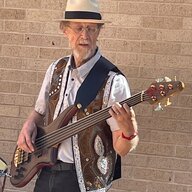
I played for a folk dance this weekend. Very appreciative audience and I don't mind playing lots of root-fifth stuff (and a bit of walking around the circle of fifths) at all.

TalkBass has been independent since 1998. Add your voice.
Create a free account to reply to discussions, view embedded media, and browse with fewer display ads.
Join free Log in
Want zero display ads or expanded classifieds tools? Compare plans.






Yep....sometimes, alternating between the higher and lower 5th is just the ticket.Is it best in country to play the lower 5th?


All depends. Playing the higher fifth is often the vibe that gives a section of the tune that bounce and lift, while the lower fifth makes that part feel more "planted". Just see what feels and sounds best and as I always say helps to "tell the story of the song" - listen to the lyrics as well as the other instruments and what they're doing.Is it best in country to play the lower 5th?


This right here. When even your whole notes propel the song forward you're in that zone.And above all, do NOT underestimate how hard it can be to make simple parts like this groove. Get it wrong, and big simple stuff can kill you fast.
I played for a folk dance this weekend. Very appreciative audience and I don't mind playing lots of root-fifth stuff (and a bit of walking around the circle of fifths) at all.
This right here. When even your whole notes propel the song forward you're in that zone.
Sounds like someone who doesn't dance.... The bass is what drives the dance rhythm so need to play enough notes to keep the feet moving.Dave Pomeroy once said of playing country and country-adjacent bass parts: 'Think of the simplest thing you can play, and then play half of that.'
You're welcome to question a well-respected legend of the Nashville live and studio scene as much as you want, but in doing so you've missed his point, and I'd caution against that assessment.... not before you check the very-danceable and substantial discography of people he's worked with over the decades. I had the pleasure of hearing Dave live before at MerleFest and there were plenty of people dancing. Dave didn't get to where he is by playing bass parts that didn't fit or didn't groove.Sounds like someone who doesn't dance.... The bass is what drives the dance rhythm so need to play enough notes to keep the feet moving.
At a typical two-step / polka tempo of 160bpm (that's very moderate polka btw) that means you play half notes with an occasional quarter note on 2 or 4. As a basic principle.

Totally agree. The simpler the line, the easier it is to play (by definition), but the harder it is to get the timing exactly right to make the tune groove in whatever way the tune wants to groove.And above all, do NOT underestimate how hard it can be to make simple parts like this groove. Get it wrong, and big simple stuff can kill you fast.
Pomeroy is one the Nashville GOATs, for sure!You're welcome to question a well-respected legend of the Nashville live and studio scene as much as you want, but in doing so you've missed his point, and I'd caution against that assessment.... not before you check the very-danceable and substantial discography of people he's worked with over the decades. I had the pleasure of hearing Dave live before at MerleFest and there were plenty of people dancing. Dave didn't get to where he is by playing bass parts that didn't fit or didn't groove.