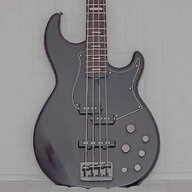
ButcherBass? Is it good for metal?A whole new line, CounterBass and ButcherBass, sshhh don't tell J.H.


TalkBass has been independent since 1998. Add your voice.
Create a free account to reply to discussions, view embedded media, and browse with fewer display ads.
Join free Log in
Want zero display ads or expanded classifieds tools? Compare plans.
ButcherBass? Is it good for metal?A whole new line, CounterBass and ButcherBass, sshhh don't tell J.H.
Really? Check this place out: InventoryWait, "unfinished butcher block to cut up to make necks, fretboards"?
This is the first time I think I've heard of people making necks and fretboards out of butcher blocks.
Are we talking this kind of butcher block?
View attachment 4423576
Or (unlikely) this kind?
View attachment 4423577
Not sure as a buyer I'd pay top dollar for either to be made into necks or fretboards. My max price would probably top out in the $500 range.

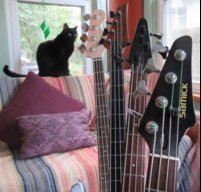
Not exactly the same thing, is it?

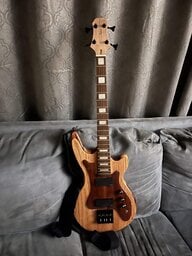
Wait, "unfinished butcher block to cut up to make necks, fretboards"?
This is the first time I think I've heard of people making necks and fretboards out of butcher blocks.
Are we talking this kind of butcher block?
View attachment 4423576
Or (unlikely) this kind?
View attachment 4423577
Not sure as a buyer I'd pay top dollar for either to be made into necks or fretboards. My max price would probably top out in the $500 range.
I think you misunderstood my post. I did not name a weakness, I said it seems to be of lower quality. When pricing wood, I find that nice long good pieces the length to make a neck are often more expensive than a butcher block counter material. It's a mater of aesthetics and perceived quality. As far as fretboards, I would not want to see those finger joints looking back at me.the top version with the grain running in line with the neck. Actually the glued joints are stronger than the wood is, and a butcher block is stronger than the equivalent lumber. so i see no reason that a neck made that way would suffer any weaknesses.

...
...
- Thirdly, i changed my standard controls.... I now use 3 knobs (made of wood with glittery inlays on the top) the controls are Volume, Tone, and balance. The balance knob works like a 3 way switch, but instead of choosing the neck pup, the bridge pup, or both. there is total control from 100% neck to 100% bridge and anywhere in between.

Welcome, nice bass, and you're exactly in the right place. No limits here, modding, building, half building, projects experimental or not, it's all ok.MirandM et al, I would like to join the club. I am not a builder, but I am attaching an image of a bass I put together around a Modulus/Alembic BassStar carbon fiber neck, serial number 57, manufactured in the late 1970's. Gerry Dorsch, an original employee of Modulus Graphite, re-furbished the neck for me about six or seven years ago and he did a fantastic job. The string nut is brass. The body is mahogany, from Warmoth. The pickup is an original Lane Poor, and the bridge is a Hipshot. I wired it using PEC potentiometers, challenging as their stainless cases don't solder well, and a 0.039 microFarad Styroflex capacitor. I auditioned many capacitors, including new and older PIO's, ceramic disks, and Mullard mustards and tropical fish, using temporary alligator clips. My favorite is a military grade silver mica in 0.059 microFarad, but it was just too big for the routed cavity. I settled on the polystyrene as the next best sounding in this guitar. It is strung with Pyramid flats. It does not hum, and is pretty heavy. My amplifier is a Fender Bassman.
View attachment 4437211
This is called a blend control, widely used btw.
I really like what you have put together here, @versalog ! As a proud and lucky (for the price) owner of a mid-80s Modulus fretless 5, I have been somewhat (in my mediocre way) keen on acquiring a FSN (neck)-equipped carbon fiber bass. I predict I will be more-or-less happily hunting for one for a long time. Again, kudos to you for yours!MirandM et al, I would like to join the club. I am not a builder, but I am attaching an image of a bass I put together around a Modulus/Alembic BassStar carbon fiber neck, serial number 57, manufactured in the late 1970's. Gerry Dorsch, an original employee of Modulus Graphite, re-furbished the neck for me about six or seven years ago and he did a fantastic job. The string nut is brass. The body is mahogany, from Warmoth. The pickup is an original Lane Poor, and the bridge is a Hipshot. I wired it using PEC potentiometers, challenging as their stainless cases don't solder well, and a 0.039 microFarad Styroflex capacitor. I auditioned many capacitors, including new and older PIO's, ceramic disks, and Mullard mustards and tropical fish, using temporary alligator clips. My favorite is a military grade silver mica in 0.059 microFarad, but it was just too big for the routed cavity. I settled on the polystyrene as the next best sounding in this guitar. It is strung with Pyramid flats. It does not hum, and is pretty heavy. My amplifier is a Fender Bassman.
View attachment 4437211

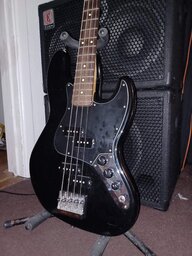
An couple hours with the heat gun and scraper has see the solid Alder body (if my research is correct) back to natural. A few scorch marks that the sander has taken care of and, next week I should be in a position to start oiling her up as it were.Good evening, thought I'd post an update on what was supposed to be a summer project but has barely started until now.
A while ago I bought this off Gumtree along with a Yamaha 6 string acoustic that had been covered in graffiti with a sharpie. I paid £20 the pair. The Yam shall (and still is) be cleaned and moved on to hopefully cover initial outlay plus a bit more.
View attachment 4438208
The other (pictured above) by my Internet sleuthing appears to be a Hondo H830n and was in need of some tlc.
I've disassembled and, found that this has the Dimarzio pickup (score!) but the poly finish was cracked all over so, the plan became simple (simple he says!) strip off the old poly finish, clean the brightwork sand the back of the neck, reglue the headstock, oil the body, rewire pickup and put back together.
This was back in June. I have finally completed part 1, remove the old poly finish.
View attachment 4438217 View attachment 4438218 View attachment 4438219


Looks like it was sitting in water for a while. I like it!Good evening, thought I'd post an update on what was supposed to be a summer project but has barely started until now.
A while ago I bought this off Gumtree along with a Yamaha 6 string acoustic that had been covered in graffiti with a sharpie. I paid £20 the pair. The Yam shall (and still is) be cleaned and moved on to hopefully cover initial outlay plus a bit more.
View attachment 4438208
The other (pictured above) by my Internet sleuthing appears to be a Hondo H830n and was in need of some tlc.
I've disassembled and, found that this has the Dimarzio pickup (score!) but the poly finish was cracked all over so, the plan became simple (simple he says!) strip off the old poly finish, clean the brightwork sand the back of the neck, reglue the headstock, oil the body, rewire pickup and put back together.
This was back in June. I have finally completed part 1, remove the old poly finish.
View attachment 4438217 View attachment 4438218 View attachment 4438219
I kinda like the look of cherry, personally. At the risk of starting a 'tone woods' debate, I think that for a typical 1.5 - 1.75" thick slab-o-caster, the species of wood is not that relevant as long as it's hard enough to hold the bridge screws against string tension. Your floating top instruments are of course, a different animal. I do some internal chambering which may make wood choice more relevant. Yes, I've seen a few basses made out of Radiata Pine also Fender has instruments in its American Pro line that are using Roasted Pine for the body wood.I have a question for this group.
When building an instrument, if you are anything like me you want both a beautiful instrument, but also one which sounds as good as it looks. some of the best tones especially if you like the warm hollow body sound require using a little softer wood for the body... Basswood, Alder, poplar, i've even heard that some coniferous softwoods make good body woods.
Here is my question. These good body woods rarely have beautiful grains like Oak, Maple, Pecan, or cherry... So i was thinking that natural finishes wouldn't be the best choice for when using them. I suspect that might be why so many electric guitars have non-transparent finishes like Laquer, or epoxy, etc. I would like to experiment with finishing the body with a metalic stain, or marble looking stain or a pearl, or even glittery.... But i don't know what is good and what will look like ...... well you know.
Does anybody have some suggestions for finishes which will completely cover the wood while still looking classy and not tacky.
Many years ago I had a neighbor who dedicated his time in finishing violins.I have a question for this group.
When building an instrument, if you are anything like me you want both a beautiful instrument, but also one which sounds as good as it looks. some of the best tones especially if you like the warm hollow body sound require using a little softer wood for the body... Basswood, Alder, poplar, i've even heard that some coniferous softwoods make good body woods.
Here is my question. These good body woods rarely have beautiful grains like Oak, Maple, Pecan, or cherry... So i was thinking that natural finishes wouldn't be the best choice for when using them. I suspect that might be why so many electric guitars have non-transparent finishes like Laquer, or epoxy, etc. I would like to experiment with finishing the body with a metalic stain, or marble looking stain or a pearl, or even glittery.... But i don't know what is good and what will look like ...... well you know.
Does anybody have some suggestions for finishes which will completely cover the wood while still looking classy and not tacky.
An couple hours with the heat gun and scraper has see the solid Alder body (if my research is correct) back to natural. A few scorch marks that the sander has taken care of and, next week I should be in a position to start oiling her up as it were.
After that the brightwork and neck shall have their turn.
Looking good. You can dissolve that rust with white vinegar.View attachment 4441166
Progress is being made. It shall however be a long job...