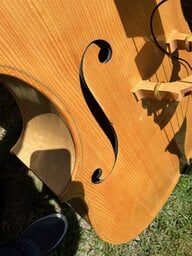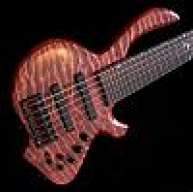
Yes, ash/maple. How heavy is your bass?
I will tell you a denser bridge will help with compression, sustain, and focus, removing some of the natural dampening of the wood (which also translates to what people refer to as "punch")... this is why they became so popular even back in the 70's, back before low B strings were really very prevalent on basses.
It's a balancing act between the dynamic punch of a bass, which is about the attack, but also initial decay, vs compression, which translates to sustain, focus, and tonal purity. You want dynamics of course, but not so much that that's all you have... unless of course all you do is like thumb mute work.
I realize I'm speaking extreme cases here, but that's to illustrate the core points.
If you have a fairly non-dense wood, then the wood is going to get a lot more involved in the dynamic component, and sometimes, compensating with a dense coupling (bridge) balances it out nicely by providing some isolation from the wood's involvement.
If you have a fairly dense wood (like a 11-12 pound bass, for example), the wood won't be as invasive to the string vibration, so you want a coupling that's more transparent and involves the wood more, as opposed to isolating the strings from it.
Hope this helps.
Those are hopeful words to my ear Vic! My alder bodied bass weighs 9.2. What you're describing is exactly what Mike said would happen with a brass bridge. I'm keeping my fingers crossed. I'm really loving the E-G strings. All sound great. Terrific slap sound as well. I'll definitely be posting on here the results of the bridge swap!