
Enjoy the benefits of a premium membership!
Upgrade Account
-
TalkBass has been independent since 1998. Add your voice.
Create a free account to reply to discussions, view embedded media, and browse with fewer display ads.
Join free Log in
Want zero display ads or expanded classifieds tools? Compare plans.
You are using an out of date browser. It may not display this or other websites correctly.
You should upgrade or use an alternative browser.
You should upgrade or use an alternative browser.
The official "Show your basses" thread part 17!
- Thread starter smperry
- Start date
- Status
- Not open for further replies.
More options
Who Replied?

Spalted Maple and Abalone inlays. Plays as good as it looks!
Invalid Link Removed
Beautiful.........and the bass is awesome too, would love to see how they get those colors mixed within that


Here they are !
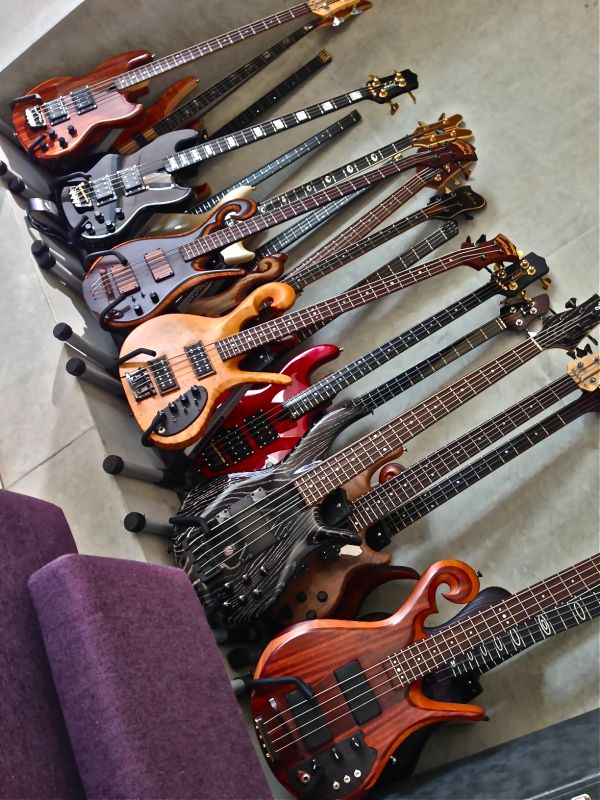
So, at the moment I'm living in Halifax, Nova Scotia. Lovely place to visit in the summer. How about a house exchange?
(Deal's off if you pack those babies away...I want 'em all splayed out...just like that...you got butter in the fridge, right?)


Tslicebass
Commercial User
Interesting Marshall rig you have. What's the details on it?
It is Marshall DBS 7200 head and 7152 cabinet. Here you can find some more info about those:
Link Removed
hi all! im still a beginner and i love playing bass.
technically, this is not my own bass. My nephew who played it only once and never tried it again he lend it to me. So it was so cool of him.
anyway, this is the only decent pic of my bass have

technically, this is not my own bass. My nephew who played it only once and never tried it again he lend it to me. So it was so cool of him.
anyway, this is the only decent pic of my bass have

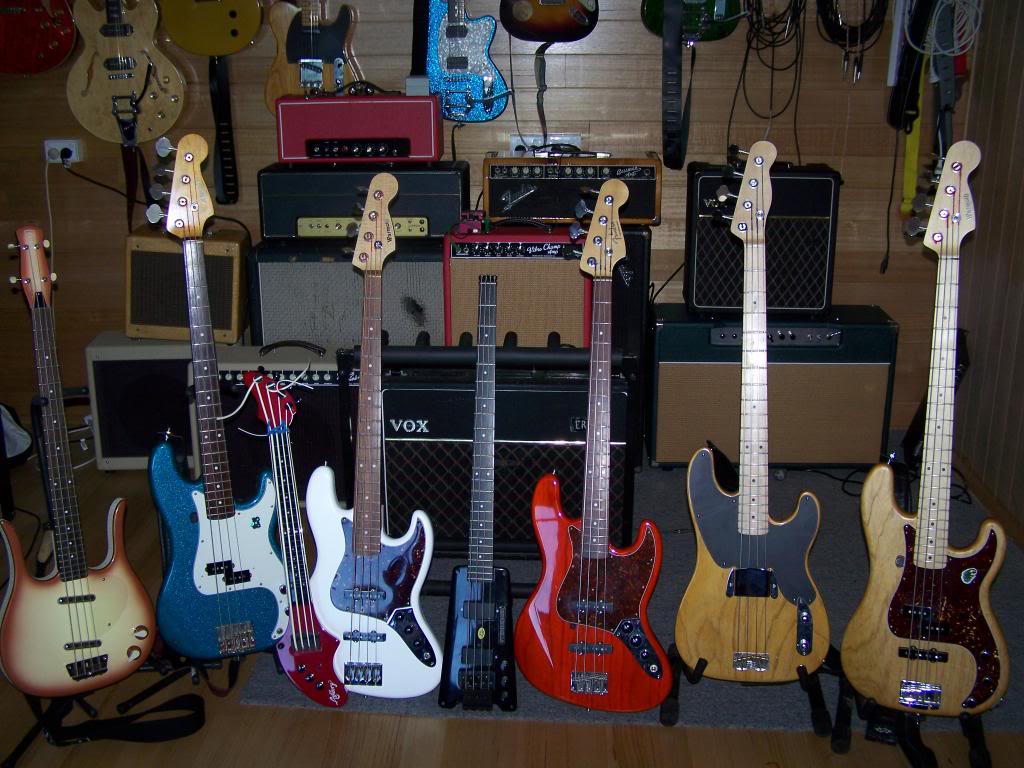
Here are mine. '12 MIK Danelectro Longhorn, early '90s Fender Japan 'Custom Edition' (their version of the custom shop), Ashbory, Warmoth J, '83 Steinberger L2, Warmoth J body with Musikraft neck, Warmoth '51 P, Warmoth P/J.


Link Removed
This is built from the salvaged body and parts of a Squier Jaguar from eBay. The fit and finish of these Indonesian bodies is generally excellent, and this one is a flawless beauty, if you're not hung up on the whole 'thin lacquer so the wood can breathe' nonsense.
The neck is hand-made 32" scale plain rock maple, from Home Depot. Very dense straight solid wood, perfect for this use, and not expensive. Fingerboard & fittings are StewMac, tuners are whatever, I forget, good enough. Home-made single-action truss rod for the 32" scale - nothing off the shelf would fit - more Home Depot parts. Thin satin poly finish & custom decals.
The highest fret overhangs the end of the neck like some Strats, so no modifications to the neck pocket or bridge location are needed. My neck is a bolt-on substitute for a 34" stock one. This was my first attempt at a bass neck, I'm surprised that it came out usable, let alone pretty darned good!
The stock pickups are surprisingly good, I just changed the covers. Strat knobs and a proper pickup switch in the lower horn complete the Jazzmaster conversion. Stock Squier pickguard & control plate. Lots of internal shielding & grounding added.
The Squier semi-active electronics were not so good, I replaced them with fully active electronics: bass/treble boost/cut, with a series/parallel switch on the volume knob. Front jack is active out, stock side jack is now a dead-battery emergency passive out. Stock battery box.
The generic MusicMan style bridge is functionally no better than stock, I just like the look, a big old hunk of chrome at the boring end of the guitar. D'Addario 50-105 Roundwound strings.
Plays great. As comfortable and lazy as a short scale, without all the sloppiness resulting from under-tensioned strings. No buzzes or dead spots, nice low action, which I think can still be tweaked a bit. The neck is a little on the chunky side, more P than J. Nut is J-width.
Good stock pickups combined with upgraded electronics sound great. Incredible tonal range, from a reedy jazz bass sound to a classic 'P', to an outright roar in series mode.
A fun little project that came out pretty nice on the first try.
Lame Disclaimer that probably wouldn't stand up in a court of law:
The reproduction Fender decals are not an attempt to fake-out anything - Fender obviously never made anything like this, ever, so it couldn't possibly be real. This is clearly not an attempt to re-badge some cheap import and pass it off as a real Fender. The decals complete my tribute to the original and greatest electric guitar designer of all time - Leo Fender. I build these for myself as a hobby. Items are not for sale, and never will be, so please, no one sue me, FMC.
This is built from the salvaged body and parts of a Squier Jaguar from eBay. The fit and finish of these Indonesian bodies is generally excellent, and this one is a flawless beauty, if you're not hung up on the whole 'thin lacquer so the wood can breathe' nonsense.
The neck is hand-made 32" scale plain rock maple, from Home Depot. Very dense straight solid wood, perfect for this use, and not expensive. Fingerboard & fittings are StewMac, tuners are whatever, I forget, good enough. Home-made single-action truss rod for the 32" scale - nothing off the shelf would fit - more Home Depot parts. Thin satin poly finish & custom decals.
The highest fret overhangs the end of the neck like some Strats, so no modifications to the neck pocket or bridge location are needed. My neck is a bolt-on substitute for a 34" stock one. This was my first attempt at a bass neck, I'm surprised that it came out usable, let alone pretty darned good!
The stock pickups are surprisingly good, I just changed the covers. Strat knobs and a proper pickup switch in the lower horn complete the Jazzmaster conversion. Stock Squier pickguard & control plate. Lots of internal shielding & grounding added.
The Squier semi-active electronics were not so good, I replaced them with fully active electronics: bass/treble boost/cut, with a series/parallel switch on the volume knob. Front jack is active out, stock side jack is now a dead-battery emergency passive out. Stock battery box.
The generic MusicMan style bridge is functionally no better than stock, I just like the look, a big old hunk of chrome at the boring end of the guitar. D'Addario 50-105 Roundwound strings.
Plays great. As comfortable and lazy as a short scale, without all the sloppiness resulting from under-tensioned strings. No buzzes or dead spots, nice low action, which I think can still be tweaked a bit. The neck is a little on the chunky side, more P than J. Nut is J-width.
Good stock pickups combined with upgraded electronics sound great. Incredible tonal range, from a reedy jazz bass sound to a classic 'P', to an outright roar in series mode.
A fun little project that came out pretty nice on the first try.
Lame Disclaimer that probably wouldn't stand up in a court of law:
The reproduction Fender decals are not an attempt to fake-out anything - Fender obviously never made anything like this, ever, so it couldn't possibly be real. This is clearly not an attempt to re-badge some cheap import and pass it off as a real Fender. The decals complete my tribute to the original and greatest electric guitar designer of all time - Leo Fender. I build these for myself as a hobby. Items are not for sale, and never will be, so please, no one sue me, FMC.


Link Removed
Nice one, but the MM-Bridge bites, same as the Strat-Knobs. Congrats anyway!
Whatever, yo!
That bass looks pretty sweet! Strat knobs actually look pretty cool considering the creme pickup covers, and what bass doesn't look cool with a little extra chrome real estate at the bridge?

Whatever, yo!
That bass looks pretty sweet! Strat knobs actually look pretty cool considering the creme pickup covers, and what bass doesn't look cool with a little extra chrome real estate at the bridge?
Imho Leo Fender always achieved perfection in design (or at least very close to)... so a Strat is a Strat, a MM is a MM and crossing parts of them does bend its beauty to randomness.
Of course everyone is free to create its own but it's kinda unwritten law to be careful with Leo's heritage; see what i mean?

Hello folks. Looking forward to spending a bit of time here and hoping to pick up some ideas that will help me re-learn bass and become a better player.
I'm 53 and started playing guitar when I was about 12. Not really a natural, but I always enjoyed playing even though there were several hiatuses during my life. I first picked up a bass in 1983. I had met a few guys who had a band (but no bass player), and after sitting through one of their practices and jamming a bit on one of their guitars, they told me "Get a bass and you can join the band". I found an old Precision and a cheap Westbury amp and began playing with these guys and played with them and a few other bands over the next 6 or 7 years. Mostly small gigs playing 70's and 80's rock covers. Ended up with a Peavey Combo 300 and 118 cab. Coming from guitar, I became a pick player and never really got the hang of fingerstyle playing. Starting around 1990, I got away from playing, and really played very little guitar and almost no bass until 2007. During that period I sometimes owned a guitar and would play a bit, but not very much.
In 2007 I decided I wanted to start playing again and I bought a custom Carvin SC90, promising myself that I would play for at least an hour a day. I've done pretty well with that promise and have become a better guitar player than in my youth, but still by no means as good as I would like. I've gotten a bit addicted to Carvin products and have 4 Carvin guitars.
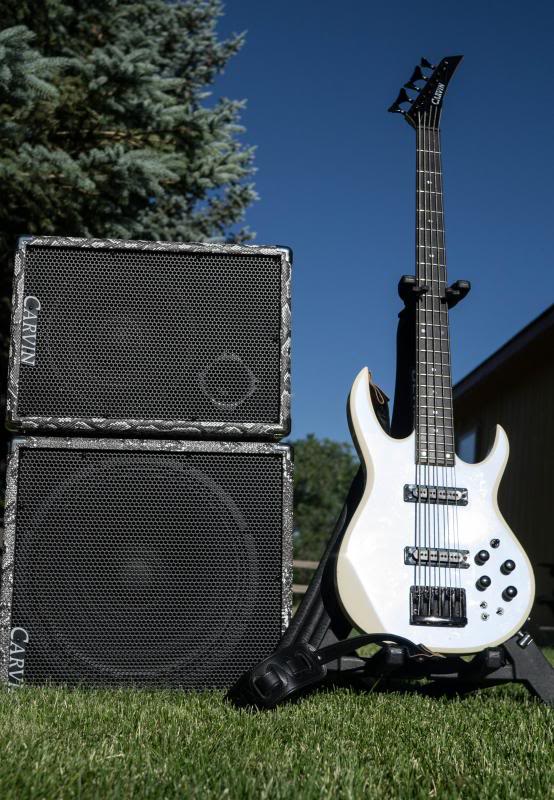
After not playing bass for the last 25 years I recently I stopped by the pawnshop with my wife and hanging on the wall was a pearl white 1988-89 Carvin LB75, 5 string bass. I pulled it down and played it a little and was pretty impressed my the condition of this 25 year old bass. They were asking $695 which seemed awfully high to me, but after some negotiation I was able to get the bass for $400. I then bought a new Carvin MB1015 Microstack amp and have been having a great time getting reacquainted with the bass.
I am finding myself really enjoying the bass after all this time, re-learning some of the tunes from the old days and working on learning the basics. I still find myself mostly playing with a pick, as it feels natural to me and I really like the percussive sound it gives me.
Here are a couple shots of my new rig.....

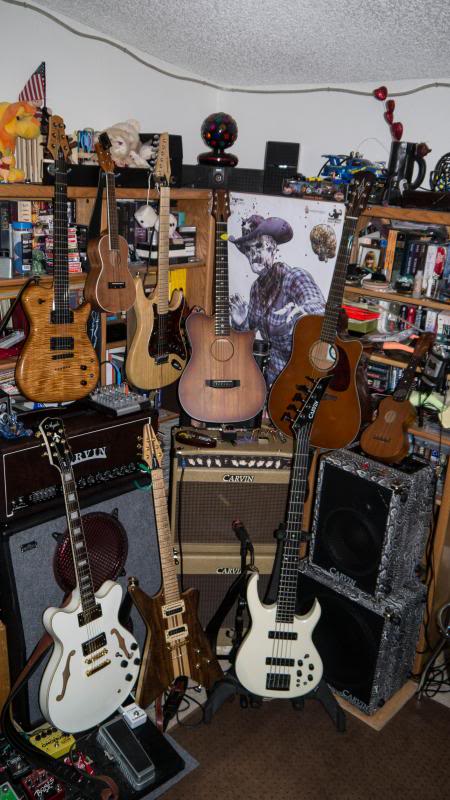
...and just for fun, here's my whole collection.
I'm 53 and started playing guitar when I was about 12. Not really a natural, but I always enjoyed playing even though there were several hiatuses during my life. I first picked up a bass in 1983. I had met a few guys who had a band (but no bass player), and after sitting through one of their practices and jamming a bit on one of their guitars, they told me "Get a bass and you can join the band". I found an old Precision and a cheap Westbury amp and began playing with these guys and played with them and a few other bands over the next 6 or 7 years. Mostly small gigs playing 70's and 80's rock covers. Ended up with a Peavey Combo 300 and 118 cab. Coming from guitar, I became a pick player and never really got the hang of fingerstyle playing. Starting around 1990, I got away from playing, and really played very little guitar and almost no bass until 2007. During that period I sometimes owned a guitar and would play a bit, but not very much.
In 2007 I decided I wanted to start playing again and I bought a custom Carvin SC90, promising myself that I would play for at least an hour a day. I've done pretty well with that promise and have become a better guitar player than in my youth, but still by no means as good as I would like. I've gotten a bit addicted to Carvin products and have 4 Carvin guitars.
After not playing bass for the last 25 years I recently I stopped by the pawnshop with my wife and hanging on the wall was a pearl white 1988-89 Carvin LB75, 5 string bass. I pulled it down and played it a little and was pretty impressed my the condition of this 25 year old bass. They were asking $695 which seemed awfully high to me, but after some negotiation I was able to get the bass for $400. I then bought a new Carvin MB1015 Microstack amp and have been having a great time getting reacquainted with the bass.
I am finding myself really enjoying the bass after all this time, re-learning some of the tunes from the old days and working on learning the basics. I still find myself mostly playing with a pick, as it feels natural to me and I really like the percussive sound it gives me.
Here are a couple shots of my new rig.....
...and just for fun, here's my whole collection.
Imho Leo Fender always achieved perfection in design (or at least very close to)... so a Strat is a Strat, a MM is a MM and crossing parts of them does bend its beauty to randomness.
This is a lot truer design than most of those 'Pawn Shop' monstrocities. Remember, it is patterned after a Jazzmaster guitar, which uses 2 Strat knobs and a switch (and some other bits that I left off. ) Likewise, the MM bridge is rounded, suggesting the JM tailpiece.
I always thought the black knobs on the Jazz bass were cheese, and the functional setup is stupid, it would be much better with a volume and blend than two volumes. But Leo used the parts he had on the shelf, with a strong eye towards cost control.
On the other hand, the Jazz bass metal control plate was a stroke of genius from any angle - manufacturing, functionality, and aesthetics. All electronics mounted on a single plate that doubles as ground and shield. The material cost of a stubby J-bass PG is a fraction of that huge swoopy P-bass PG, and the whole thing is much easier to assemble and maintain. I recently had to resolder a connection in a real JB: remove 3 screws and you're in, no hassles.
Leo was a genius, no doubt about it. I like to take his best bits and put them together differently. Fender is doing the same thing at the factory, but they're doing it wrong.
Link Removed
This is the red JM's older brother. It is built up the same as the red one, but with a full-scale Mighty Mite neck. These necks are one of the best bargains out there, much better than the stock Squier neck.
The PG is custom tortoise, to really nail the JazzMaster vibe. This is one of the best basses I have ever had, I would put it up against anything. And it is gorgeous, if I don't say so myself. I love projects that don't involve paint.
The Strat is much more modified. No idea what the body is, a Squier I suppose. The neck pocket is let into the pickup cavity and then rebuilt. Lots of routing and rebuilding for the neck and pickups and battery. Lots of shielding too.
Pickups are GFS, very nice. 4-way blade switch with series/parallel options, pull the volume for passive output, otherwise the electronics are the same as the JM. The PG is obviously completely custom.
The bridge is a narrow-gauge string-through-body MusicMaster. The J pickup sits in the enlarged Strat tremolo route. The tremolo cavity is filled in with a block of plywood to mount the pickups to, covered with the original back cover plate. The J pickup is actually a neck pickup, to match the narrower string spacing. The P-pickup is mounted narrow for the same reason.
The neck in the picture is a short-scale Squier from eBay. Unfortunately, it was a POS that never played right, and I destroyed it trying to fix it. A new neck is in the works that will make the bass right, but the workshop (errr, garage) is just too hot right now.
Apart from the neck issues, the Strat sounds awesome and feels great. This is the short-scale bass that Fender always should have made.
Lame Disclaimer that probably wouldn't stand up in a court of law:
The reproduction Fender decals are not an attempt to fake-out anything - Fender obviously never made anything like this, ever, so it couldn't possibly be real. This is clearly not an attempt to re-badge some cheap import and pass it off as a real Fender. The decals complete my tribute to the original and greatest electric guitar designer of all time - Leo Fender. I build these for myself as a hobby. Items are not for sale, and never will be, so please, no one sue me, FMC.
This is the red JM's older brother. It is built up the same as the red one, but with a full-scale Mighty Mite neck. These necks are one of the best bargains out there, much better than the stock Squier neck.
The PG is custom tortoise, to really nail the JazzMaster vibe. This is one of the best basses I have ever had, I would put it up against anything. And it is gorgeous, if I don't say so myself. I love projects that don't involve paint.
The Strat is much more modified. No idea what the body is, a Squier I suppose. The neck pocket is let into the pickup cavity and then rebuilt. Lots of routing and rebuilding for the neck and pickups and battery. Lots of shielding too.
Pickups are GFS, very nice. 4-way blade switch with series/parallel options, pull the volume for passive output, otherwise the electronics are the same as the JM. The PG is obviously completely custom.
The bridge is a narrow-gauge string-through-body MusicMaster. The J pickup sits in the enlarged Strat tremolo route. The tremolo cavity is filled in with a block of plywood to mount the pickups to, covered with the original back cover plate. The J pickup is actually a neck pickup, to match the narrower string spacing. The P-pickup is mounted narrow for the same reason.
The neck in the picture is a short-scale Squier from eBay. Unfortunately, it was a POS that never played right, and I destroyed it trying to fix it. A new neck is in the works that will make the bass right, but the workshop (errr, garage) is just too hot right now.
Apart from the neck issues, the Strat sounds awesome and feels great. This is the short-scale bass that Fender always should have made.
Lame Disclaimer that probably wouldn't stand up in a court of law:
The reproduction Fender decals are not an attempt to fake-out anything - Fender obviously never made anything like this, ever, so it couldn't possibly be real. This is clearly not an attempt to re-badge some cheap import and pass it off as a real Fender. The decals complete my tribute to the original and greatest electric guitar designer of all time - Leo Fender. I build these for myself as a hobby. Items are not for sale, and never will be, so please, no one sue me, FMC.
Link Removed
I posted this one elsewhere, but I'll repeat myself.
Epi Pro body & pups, fully active electronics, Mark Hoppus P-neck & tuners. I hacked off the broken T-bird neck and routed a pocket for the Fender. Since the body is oiled wood, the scar was easy to make disappear. Used ferrules rather than a rectangular plate. The result looks factory. Look at the gorgeous wood grain on this body.
Drilled an extra hole for the classic 3-in-a-row Gibson control layout, with the correct silvertop knobs. It's the little details that really set off a project like this.
Filled the extra control holes with output jack & pickup switch. It was a real trick folding all the extra electronics into the tiny shallow Gibson control cavity. No series/parallel switch - it just wouldn't fit, and doesn't work well with humbuckers anyway. The original side jack is now passive output, for a dead battery.
The pickups are actually powered EMGs, but I left the power leads disconnected. I thought about adding a switch to make the pickup power selectable, but they sound much better unpowered, so I didn't bother. Epiphone must have thought the same thing, because they never connected the pickup power either. What that would do is power up a tiny pre-amp/eq built into each pickup, with the unintended side-effect of electrically siamesing the two pickups so that they can never be fully isolated from each-other. This only becomes obvious with a pickup switch installed, you can't select just one, you always get both. EMG's designs do not impress me, and I don't care for humbuckers in a bass either, but the factory pickups fill the factory holes perfectly, and they sound good enough.
I had the original Epi electronics as well, and they were ok, but I blew them up, and the replacement is much better anyway.
A Gotoh Fender-style bridge replaces Gibson's atrocious bass bridge. You might also notice the svelt Fender-influenced PG, rather than the ungainly thumb-shaped Gibson.
Sounds great, plays great, as long as you don't want to get at the high frets. Rotosound 66's for 60's vibe. RIP John Entwistle. I've got a couple more Fenderbirds in the works.
more pix:
Link Removed
Link Removed
before
I posted this one elsewhere, but I'll repeat myself.
Epi Pro body & pups, fully active electronics, Mark Hoppus P-neck & tuners. I hacked off the broken T-bird neck and routed a pocket for the Fender. Since the body is oiled wood, the scar was easy to make disappear. Used ferrules rather than a rectangular plate. The result looks factory. Look at the gorgeous wood grain on this body.
Drilled an extra hole for the classic 3-in-a-row Gibson control layout, with the correct silvertop knobs. It's the little details that really set off a project like this.
Filled the extra control holes with output jack & pickup switch. It was a real trick folding all the extra electronics into the tiny shallow Gibson control cavity. No series/parallel switch - it just wouldn't fit, and doesn't work well with humbuckers anyway. The original side jack is now passive output, for a dead battery.
The pickups are actually powered EMGs, but I left the power leads disconnected. I thought about adding a switch to make the pickup power selectable, but they sound much better unpowered, so I didn't bother. Epiphone must have thought the same thing, because they never connected the pickup power either. What that would do is power up a tiny pre-amp/eq built into each pickup, with the unintended side-effect of electrically siamesing the two pickups so that they can never be fully isolated from each-other. This only becomes obvious with a pickup switch installed, you can't select just one, you always get both. EMG's designs do not impress me, and I don't care for humbuckers in a bass either, but the factory pickups fill the factory holes perfectly, and they sound good enough.
I had the original Epi electronics as well, and they were ok, but I blew them up, and the replacement is much better anyway.
A Gotoh Fender-style bridge replaces Gibson's atrocious bass bridge. You might also notice the svelt Fender-influenced PG, rather than the ungainly thumb-shaped Gibson.
Sounds great, plays great, as long as you don't want to get at the high frets. Rotosound 66's for 60's vibe. RIP John Entwistle. I've got a couple more Fenderbirds in the works.
more pix:
Link Removed
Link Removed
before
- Status
- Not open for further replies.


