• TalkBass has been independent since 1998. Add your voice.
    Create a free account to reply to discussions, view embedded media, and browse with fewer display ads.
    Join freeLog in
    Want zero display ads or expanded classifieds tools? Compare plans.

The Passinwind Open Source Preamp

Thank you for your recommendations in terms of IC's. I never worked with SMD's so for instance that's not an option. But thank you anyway.

PCB's are now on their way to Germany. While looking forward to get them I'm thinking about what "extra" parts to source really. In luthery work I'm quite used to struggle with "strange" values due to the inches/decimal conversion thing. But 261K? 3.01K? Really? How critical do you judge those values? Is it ok to use their nearest neighbor or will that prevent the circuit from working properly?

Then I was thinking about how to pair that preamp with the existing pickups. Unlike other preamps Lemme's SVF seems to pretty much overwrite the pickups' native resonance peak so using that one you don't have to care too much about pickup load. Is that the same case here? Or what would you recommend in terms of resistance of the volume poti?
 
Last edited:

Then I was thinking about how to pair that preamp with the existing pickups. Unlike other preamps Lemme's SVF seems to pretty much overwrite the pickups' native resonance peak so using that one you don't have to care too much about pickup load. Is that the same case here? Or what would you recommend in terms of resistance of the volume poti?

I'm attempting to build my own revision of the OS preamp without the eq controls(LPF w/variable resonance only) and I have to put it on a Spector 1977LE with a single Dimarzio Model P. IMHO, you have to carefully measure the resonant peak of the existing pickup to avoid double dipping and fine tune the res value to carefully center the peak. Having low-Z pickups(like Alembic, as usual...) with a resonant peak at the very upper edge of the audio band helps a lot...
 
Low-Z's definitly help. However in my guitar I have some Alumitone Clones inside that I wound by my own and very hot so that their native resonant peak is around 3kHz. The SVF seems to allow me to dial in higher peaks. How ever that may work ...

BTW If you want only a LPF you could try to replicate the Lemme. Probably you know that layout already but just to be sure this could be a help for you: Invalid Link Removed
 
  • Like
Reactions: ric426 and Gfkfloyd
PCB's are now on their way to Germany. While looking forward to get them I'm thinking about what "extra" parts to source really. In luthery work I'm quite used to struggle with "strange" values due to the inches/decimal conversion thing. But 261K? 3.01K? Really? How critical do you judge those values? Is it ok to use their nearest neighbor or will that prevent the circuit from working properly?

Those are just ISO standard values for tight tolerance resistors, i.e. 1% or better. I think you'll find that they are not all that odd, actually. But by all means use 270K and anything close to 3K but a little lower if that's easier. I buy resistors in bulk and for me those values were the easiest and cheapest to procure from my usual vendors.

Then I was thinking about how to pair that preamp with the existing pickups. Unlike other preamps Lemme's SVF seems to pretty much overwrite the pickups' native resonance peak so using that one you don't have to care too much about pickup load. Is that the same case here? Or what would you recommend in terms of resistance of the volume poti?

I've never seen the Lemme preamp AFAIK (at least under that name), please post a schematic link if possible. Please read through the prior art links I posted very early on in this thread. In any case, pickup loading is critically important and it's up to you whether to neuter the native peak or leave it in place. I tend to split the difference, hence the 261K input resistor, which is definitely just a generic value.
 
Morning! May have missed it, but looking for a pedal box to contain my first board (testing multiple basses). What box dost thou suggest? How baby small of a tip for soldering iron is best for the tiny purple boards?
thanks,
fnord!

I'd suggest something at least as big as this one: Invalid Link Removed . The generic 125BB or 1590BB boxes are OK too, but the extra depth of the 1590S may make things a little easier. OTOH, the BB boxes have more top area to work with.

I use either 1.6mm or 2.4mm conical tips for boards like this with my Hakko 888. The plated through holes tend not to wick solder all that well when using anything smaller.
 
Last edited:
  • Like
Reactions: fnordlyone
Charlie, I sent you that schematic in our pvt conversations :smug:

Is the preamp with that 10K volume post filter. That's why I prefer your solution, because it can easily bypassed for passive operations.,

The one you sent me isn't a state variable filter though...
Yel_wink.gif
 
I'd suggest something at least as big as this one: Invalid Link Removed . The generic 125BB or 1590BB boxes are OK too, but the extra depth of the 1590S may make things a little easier. OTOH, the BB boxes have more top area to work with.

I use either 1.6mm or 2.4mm conical tips for boards like this with my Hakko 888. The plated through holes tend not to wick solder all that well when using anything smaller.
thanks again charlie.
 
Monthly update:

Finally back in the shop for my first post-NAMM builds of the year. First up is implementing an external power supply for my Marco fretless:

MV4FL_cableparts.JPG


The 4 pin XLR connectors will allow for a wide variety of options, but I'll probably start conservatively with simple 9V battery power and a single output. I've also been looking at rechargeable power bricks, bipolar supplies, solar charging, stereo wiring (Pass-O-Sound) and various other scary diversions. Once I get some of that sorted out I'll probably take a stab at a standalone filter section or two, but that may end up being better suited to the Effects Forum, or even Amps.
 
Monthly update:

Finally back in the shop for my first post-NAMM builds of the year. First up is implementing an external power supply for my Marco fretless:

View attachment 3346118

The 4 pin XLR connectors will allow for a wide variety of options, but I'll probably start conservatively with simple 9V battery power and a single output. I've also been looking at rechargeable power bricks, bipolar supplies, solar charging, stereo wiring (Pass-O-Sound) and various other scary diversions. Once I get some of that sorted out I'll probably take a stab at a standalone filter section or two, but that may end up being better suited to the Effects Forum, or even Amps.

I'm in the UK so a solar option will only work during the last week of February
 
Last edited:
An interesting way would be the one to supply a 48 V phantom power to direct connect a bass to a recording console. The main drawbacks are the inconsistencies in the standard PP voltage, but a regulator built inside the bass would be sufficient to give opamps the right amount of juice...
 
  • Like
Reactions: Passinwind
An interesting way would be the one to supply a 48 V phantom power to direct connect a bass to a recording console. The main drawbacks are the inconsistencies in the standard PP voltage, but a regulator built inside the bass would be sufficient to give opamps the right amount of juice...

Yep, I've often thought of trying that approach and this looks like a good opportunity to do that. The current limitations are not necessarily a deal breaker, but for me at least, one big attraction of using external power is being able to use opamps with higher current demands than standard phantom power accommodates. A power brick would only need to be recharged a few times a year, and since I often play through other peoples' amps I think I'm going to need a breakout box anyway.
 
  • Like
Reactions: 12bass
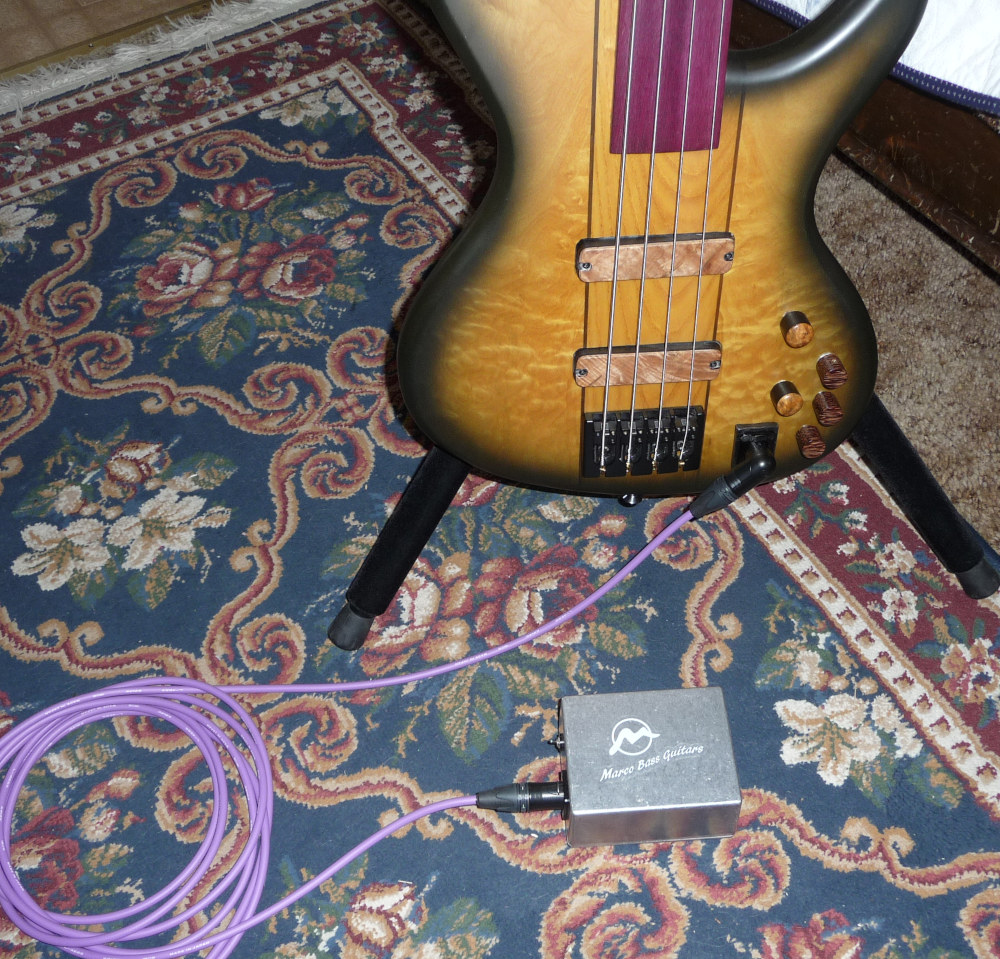
So here's how the implementation of a 4 pin XLR connector set worked out on my new bass. The cable loops perfectly around my strap and the right angle connector is pretty much completely out of the way.

MV4FL_cabling1.JPG


For my next trick I'll wire up the unused D-Sub connector cutout on the back of my amp to supply power to the bass directly off the amp's low voltage supply.
 
Last edited:
Just finished mine last night and installed on my newly created 5 string. Haven't fully explored it but so far I'm loving it. Easy build and worked first time I powered it up.

Hey Jon, what a cool build and a great job incorporating the preamp into it. I'm really happy to hear that it worked straight away too.

Do you mind if I use your pic on my Facebook feed? I'm sure a lot of my followers would enjoy seeing it.