
Enjoy the benefits of a premium membership!
Upgrade Account
-
TalkBass has been independent since 1998. Add your voice.
Create a free account to reply to discussions, view embedded media, and browse with fewer display ads.
Join free Log in
Want zero display ads or expanded classifieds tools? Compare plans.
You are using an out of date browser. It may not display this or other websites correctly.
You should upgrade or use an alternative browser.
You should upgrade or use an alternative browser.
The Real James Jamerson Amp
- Thread starter -=DanAtkinson=-
- Start date
More options
Who Replied?
also after further reading and review, it was a transformer balanced 12ax7 tube preamp, the signal then fed to the board. so that means power tubes or tube recitifiers (in the macintosh) didn't have anything to do with Jamerson's tone.

also after further reading and review, it was a transformer balanced 12ax7 tube preamp, the signal then fed to the board. so that means power tubes or tube recitifiers (in the macintosh) didn't have anything to do with Jamerson's tone.
Yes, and apparently a lot of experimentation went into producing the transformer, to get a pleasing sound with a solid low end.
Search here on TB for Motown DI and Wolf for more info.
Despite some of the back and forth that went on in this thread about Ampeg and the B-15, I do believe there are some real similarities between the Motown setup and a B-15, both had well designed and fairly simple signal pathways tuned by ear to give a fairly broad and solid natural bass tone with good fidelity to the source, good iron, and that breaks up pleasantly when pushed.
The more I grow as a player the more fully I appreciate Jamerson, and what went on at Motown regarding those exceptional musicians, writers, singers, arrangers and often producers.
I also think everyone should play a good P with great big honking LaBella flats through a good classic tube p at least once in their life. It's a delightful and visceral experience and it's a sweet sound for a bass to make.
yeah OneDrop a lot of great info in there. I think my quest to try and find the perfect tone had more of an "epiphany" here. instead of trying to mess with amps and mics and such, just find the best direct tone i love, and then amplify it. very simple. just like what they did here, they had the best preamp and tone, and then just amplified it to hear it back.
my poor man's jamerson preamp might be the universal audio solo 610 to start, maybe i'll try the radial firefly as well. i've had the REDDI and i'm good, i need that tube distortion jamerson style
my poor man's jamerson preamp might be the universal audio solo 610 to start, maybe i'll try the radial firefly as well. i've had the REDDI and i'm good, i need that tube distortion jamerson style

Not while he was at Motown Detroit, except for the very earliest stuff, but he also cut a butt-ton of stuff in Motown and non-Motown stuff in LA where he went DI and ran through a B-15, so it's also a fallacy to assume that he never used amps in the studio just because he didn't at Motown Detroit.also after further reading and review, it was a transformer balanced 12ax7 tube preamp, the signal then fed to the board. so that means power tubes or tube recitifiers (in the macintosh) didn't have anything to do with Jamerson's tone.

as a player who is normally inclined to clean tone, it's always interesting to me to hear some of the isolated classic tracks by Jamerson, Duck Dunn, McCartney etc. They are quite often pretty "dirty" and not always played with great precision/note articulation (and I don't mean sloppy). Carol Kaye tracks are some exceptions, she seemed to play a bit more precisely (at least on the tracks I have heard).
one takeaway (for me at least) is that a bit of dirt and pulse/groove over exact note precision is not a bad way to go. I have been trying to get a touch of purposeful dirt in my tone for several years now.
one takeaway (for me at least) is that a bit of dirt and pulse/groove over exact note precision is not a bad way to go. I have been trying to get a touch of purposeful dirt in my tone for several years now.
Not while he was at Motown Detroit, except for the very earliest stuff, but he also cut a butt-ton of stuff in Motown and non-Motown stuff in LA where he went DI and ran through a B-15, so it's also a fallacy to assume that he never used amps in the studio just because he didn't at Motown Detroit.
may have worded that funny, here's what i meant
i'm simply stating that when using the mike mclean created preamp there were no power amp tubes or rectifiers involved in the tone (or signal to the board) which is completely surprising to me. there were tubes in the console (possibly) and tape machine (possibly) and when mixed definately in the fairchild compressor and langevin EQ. But i am struck that it was simply a tube preamp direct sound to the board. Again all the tone processing afterwards and hitting tape definately add character, but it's changed my current view of the DI. Then again it's jamerson and probably playing a fodera through an epifani super clean hi-fi rig would still sounds ballsy and badass.
Carol worked at her sound to insure that it was clean. Quite frankly though, while I like her tones, I like Jamerson's, Dunn's, and McCartney's way betteras a player who is normally inclined to clean tone, it's always interesting to me to hear some of the isolated classic tracks by Jamerson, Duck Dunn, McCartney etc. They are quite often pretty "dirty" and not always played with great precision/note articulation (and I don't mean sloppy). Carol Kaye tracks are some exceptions, she seemed to play a bit more precisely (at least on the tracks I have heard).

Tru dat. Would like to point out, though, that (I think) Ed Wolfrum commented about someone saying that a compressor was a big part of the Motown sound and a big part of Jamerson's sound, and he said they never did anything to the sounds the musicians got because they were perfect as they were and they would have never insulted those guys by further processing. So it sounds like it was more about the tape than any outboard gear.may have worded that funny, here's what i meant
i'm simply stating that when using the mike mclean created preamp there were no power amp tubes or rectifiers involved in the tone (or signal to the board) which is completely surprising to me. there were tubes in the console (possibly) and tape machine (possibly) and when mixed definately in the fairchild compressor and langevin EQ. But i am struck that it was simply a tube preamp direct sound to the board. Again all the tone processing afterwards and hitting tape definately add character, but it's changed my current view of the DI. Then again it's jamerson and probably playing a fodera through an epifani super clean hi-fi rig would still sounds ballsy and badass.
A small and miniscule point, yes, but just thought I'd put that out there as well.
Carol worked at her sound to insure that it was clean. Quite frankly though, while I like her tones, I like Jamerson's, Dunn's, and McCartney's way better
fair enough Mr. JM, we all have our favorites. IMO, all of them are just different flavors of great, and I find things to learn from all of these great players. the purposeful addition of dirt is the key thing I was commenting on relevant to James playing (whether he used a B15 or not).
When I listen to those isolated tracks, the other thing I personally "hear" is that they are generally not so hyper focused on execution of the lines. Jamerson often sounds like he is just going for it to me. Think of the scenario where he is said to have played the track for Marvyn Gay's "Whats Going On", somewhat drunk and laying on his back.
I sometimes feel that our subsequent transcription and very focused learning of these lines note for note, while a great learning opportunity, can also tend to squeeze the "in-the-moment"-ness out of how many of them sound when you hear them in isolation (which of course, is not how they were originally done either).
interesting stuff
Carol worked at her sound to insure that it was clean. Quite frankly though, while I like her tones, I like Jamerson's, Dunn's, and McCartney's way better
Tru dat. Would like to point out, though, that (I think) Ed Wolfrum commented about someone saying that a compressor was a big part of the Motown sound and a big part of Jamerson's sound, and he said they never did anything to the sounds the musicians got because they were perfect as they were and they would have never insulted those guys by further processing. So it sounds like it was more about the tape than any outboard gear.
A small and miniscule point, yes, but just thought I'd put that out there as well.
Invalid Link Removed
Invalid Link Removed
yes jimmy BUT on gearslutz is none other than bob olhsson who was one of their engineers has stated many times that Bob babbitt was never compressed (and his tone sounded ballsier) but Jamerson had very light compression because his bending of the strings to intonate caused variations in his volume. he also stated everything was high passed at 70Hz with bass boosted at 100k 200k to add low mids to help it stand out.
Read both of the above threads, great stuff in there.

Compression is often found a stages along the signal pathway. Recording console pre-amps could compress; analog tape machines are loved for their wonderful sounding compression. That's without using any outboard compressors. Compression is so common that many more modern recording consoles have compressors built into each channel strip.
One thing that Motown pioneered was getting a lot of low end onto their vinyl records. The Beatles envied what Motown could do on their records in the low end that EMI wouldn't. When mastering for vinyl, if you have too much energy in the low end, the record needle skips. Too much and people are bringing their records back so many companies took a conservative approach.
One thing that Motown pioneered was getting a lot of low end onto their vinyl records. The Beatles envied what Motown could do on their records in the low end that EMI wouldn't. When mastering for vinyl, if you have too much energy in the low end, the record needle skips. Too much and people are bringing their records back so many companies took a conservative approach.
It's been reported that Jamerson moonlighted at other studios in Detroit so other signal chains than that used at Motown were used. He has also stated that he used a B-15 for recording (at times I assume) and live playing. Below can be found on Rick Suchow's site (Rick Suchow - NYC Bassist / Writer - Bass).
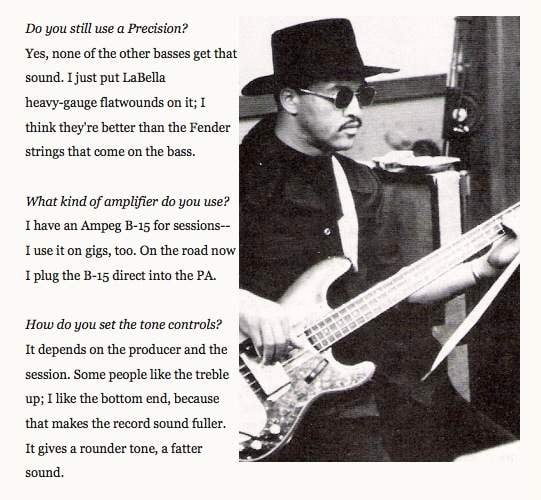
It's been reported that Jamerson moonlighted at other studios in Detroit so other signal chains than that used at Motown were used. He has also stated that he used a B-15 for recording (at times I assume) and live playing. Below can be found on Rick Suchow's site (Rick Suchow - NYC Bassist / Writer - Bass).
yes no argument there. but if you actually read those threads above you will get first hand info from a motown engineer. not 30 year later info from rick suchow who investigated or dr. licks or whomever. you get info from the dude at the session compressing or not compressing jamerson and he says he compressed jamerson. wolfrum shows up a couple times on there as do some other motown guys, do yourself a favor and read them, they are a wealth of knowledge.
its stated that the big motown preamp was also created for a couple other detroit studios and there was even a SS version at one of the studios. So it's not just motown that had that unit and the direct boxes. No argument to the moonlighting sessions and b15 crowd, just trying to give some actual factual info and not just second hand stories and myths passed down from bassists to bassists.
also your low end claim is debunked there. they HP filtered 70Hz and below, they boosted the low mids. said the first harmonic of 80HZ was their goal and they ripped everything below that. I highly recommend you read what Bob Has to say in the above, might change your world a little bit (it did mine for sure).
fair enough Mr. JM, we all have our favorites. IMO, all of them are just different flavors of great, and I find things to learn from all of these great players. the purposeful addition of dirt is the key thing I was commenting on relevant to James playing (whether he used a B15 or not).
When I listen to those isolated tracks, the other thing I personally "hear" is that they are generally not so hyper focused on execution of the lines. Jamerson often sounds like he is just going for it to me. Think of the scenario where he is said to have played the track for Marvyn Gay's "Whats Going On", somewhat drunk and laying on his back.
I sometimes feel that our subsequent transcription and very focused learning of these lines note for note, while a great learning opportunity, can also tend to squeeze the "in-the-moment"-ness out of how many of them sound when you hear them in isolation (which of course, is not how they were originally done either).
interesting stuff
I'm not sure I really agree with that, though I do completely about the spontaneous feel of those recordings, a kind of teetering on the edge of bravado and saling close to the wind, on s musical tightrope with no net.
I think JJ had so much experience and had developed such a precise touch and such a mastery of feels by playing in a studio all day and at night in the clubs and maybe still in the studio, that it almost impossible to approach the quality of his playing, at least through to the early '70s.
His dynamic sense, the perfect length of each note, varied within a phrase and developed through a song, his unerring taste and incredible consistency when needed, and the purity of every note he played reveals itself to me the more I listen and try to play his parts.
That's what true mastery is- we have to sweat and study to approach a level of ability that had become effortless and second nature to Jamerson, and allowed him to give full reign to his incredible imagination and melodic inventiveness, not to mention his perfect time and ability to swing and groove no matter the tempo or complexity of his lines.
I think a lesser player can easily sound like a busy hot mess without that perfect touch, feel, and judgement that Jamerson brought to the stage and studio seemingly so effortlessly.
Last edited:
I've seen those sites and they are fascinating to read. Like being a fly on the wall. The quote above came from a Jamerson interview so it is worth noting. His interviews were few and far between.
There are some additional comments from Bob Ohlsson here: [Invalid or Expired Link Removed] He touches on disk cutting and how they got more sound onto the disk.
ADDED link to BobO comments.
I think that you misunderstood my point but I probably wasn't being clear. I was referring to the amount of low end presence that Motown got onto their records, not necessarily the low frequencies. He said that the 70Hz high pass filter was used to eliminate 60Hz hum from their equipment. They made up for what they took away in other ways. There's no question that Motown did a better job in low end presence on their records than what other companies were doing at the time. When you listen to the original vinyl and examples from other companies the difference is striking. They pushed the envelope on the engineering side, it wasn't just about crafting songs.also your low end claim is debunked there.
There are some additional comments from Bob Ohlsson here: [Invalid or Expired Link Removed] He touches on disk cutting and how they got more sound onto the disk.
ADDED link to BobO comments.
Last edited:
So this product is not exactly based on the "system" being discussed in this thread, right ?
Invalid Link Removed
Invalid Link Removed
So this product is not exactly based on the "system" being discussed in this thread, right ?
Invalid Link Removed
it is, its essentially the Solid State Version.
Wow, those Gearslutz threads were excellent!
yeah, I got on there a couple years back, sometimes its AMAZING who chimes in.


