
That is the same one that I use, and in my opinion, is pretty much the best out there. It will power pretty much anything, including multiple sushi boxes with ease.

Enjoy the benefits of a premium membership!
Upgrade Account
-
TalkBass has been independent since 1998. Add your voice.
Create a free account to reply to discussions, view embedded media, and browse with fewer display ads.
Join free Log in
Want zero display ads or expanded classifieds tools? Compare plans.
You are using an out of date browser. It may not display this or other websites correctly.
You should upgrade or use an alternative browser.
You should upgrade or use an alternative browser.
The Sushi Box FX Secret Society
- Thread starter kranahan
- Start date
More options
Who Replied?

On an unrelated note, I finally got this video together of my updated build process. I was lazy and didn't change the backing track, but it shows how current SMD build pedals (specifically @Ryan L.'s Black Eye) are made.
This is awesome. What was that treatment you did with the circuit board? Some sort of sealing and heating to cure?
D
I second this. The only thing I don’t like is the cables, but it works well for all types of pedals.That is the same one that I use, and in my opinion, is pretty much the best out there. It will power pretty much anything, including multiple sushi boxes with ease.

Even simpler, I use water-soluble soldering flux so I wash the boards with distilled water and dry them off in the oven to clean the flux off.This is awesome. What was that treatment you did with the circuit board? Some sort of sealing and heating to cure?

There are some benefits to the cables. I use a Cioks DC7 with an 8 Expander to power pedals at my desk, and it’s very cheap and easy to get RCA extensions at whatever length I need.I second this. The only thing I don’t like is the cables, but it works well for all types of pedals.
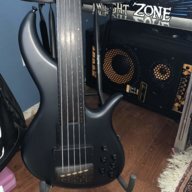
Hmmm. I think I’ll need to power the More from something other than my Noble? Looks like the warmup power consumption of the More will exceed the DC specs of the Noble.
Anyone use Noble to power More?
Anyone use Noble to power More?

The cables is one of the thing I most appreciate about the Cioks system. The RCA ends make it easy to create my own cables and I can use common RCA female/female adapters if I’m playing around on the desk to test pedals or if I’m messing with synth stuff.I second this. The only thing I don’t like is the cables, but it works well for all types of pedals.

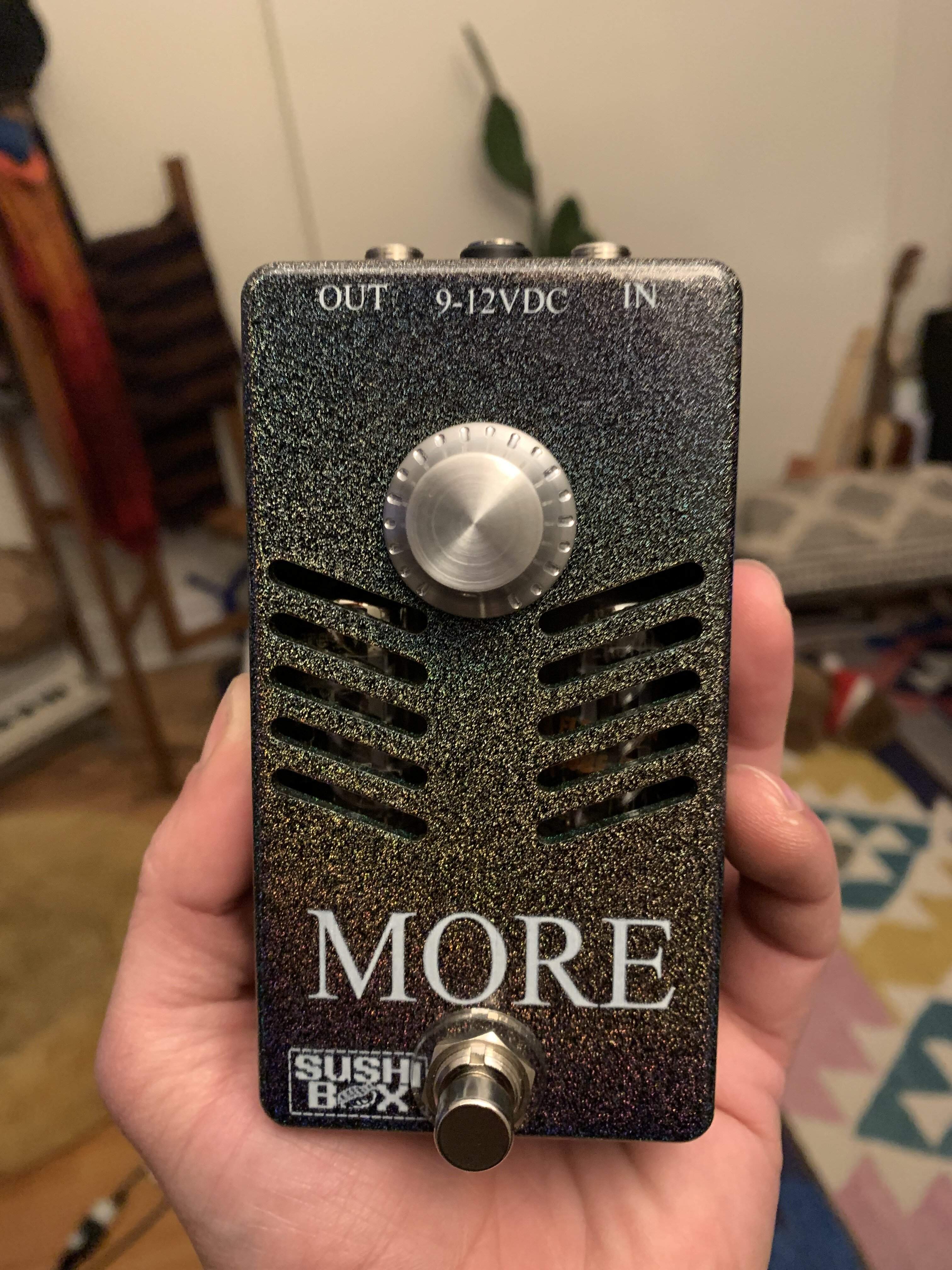
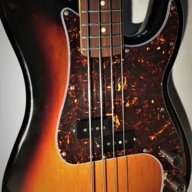
I got my MORE today. I plugged it in and played some P Bass thru it, then rolled some NOS tubes into it. I ended up settling on an Amperex and RCA for the AT7 and AU7, respectively. I will say the difference is very subtle, so I wouldn't worry about rolling expensive tubes thru it. Less of a change than other circuits I've used.
Subtle is the word as well, for how I would describe what More does.
My P bass doesn't need a lot of help. But More focuses the tone somehow. Very subtle rounding out attack and warming up the mids. I think this is exactly what I've been after especially for upright bass.
I'm glad I tried the other Sushi Boxes I've had and sold, but being a 'flat eq' kind of guy I'm very happy with More. I've got some gigs coming up on upright and electric I'm looking forward to giving it a go.
The finish is great too, dark with subtle shimmer. I like the stock knob but couldn't help switching out to another one that looks great with the finish.
BTW a Cioks is sufficient to power it.
Subtle is the word as well, for how I would describe what More does.
My P bass doesn't need a lot of help. But More focuses the tone somehow. Very subtle rounding out attack and warming up the mids. I think this is exactly what I've been after especially for upright bass.
I'm glad I tried the other Sushi Boxes I've had and sold, but being a 'flat eq' kind of guy I'm very happy with More. I've got some gigs coming up on upright and electric I'm looking forward to giving it a go.
The finish is great too, dark with subtle shimmer. I like the stock knob but couldn't help switching out to another one that looks great with the finish.
BTW a Cioks is sufficient to power it.
I got my MORE today. I plugged it in and played some P Bass thru it, then rolled some NOS tubes into it. I ended up settling on an Amperex and RCA for the AT7 and AU7, respectively. I will say the difference is very subtle, so I wouldn't worry about rolling expensive tubes thru it. Less of a change than other circuits I've used.
Subtle is the word as well, for how I would describe what More does.
My P bass doesn't need a lot of help. But More focuses the tone somehow. Very subtle rounding out attack and warming up the mids. I think this is exactly what I've been after especially for upright bass.
I'm glad I tried the other Sushi Boxes I've had and sold, but being a 'flat eq' kind of guy I'm very happy with More. I've got some gigs coming up on upright and electric I'm looking forward to giving it a go.
The finish is great too, dark with subtle shimmer. I like the stock knob but couldn't help switching out to another one that looks great with the finish.
BTW a Cioks is sufficient to power it.
View attachment 4879206
Looks great! I'm after a 60s tone so I hope my Slampegg, coming next month, does the job.
Hey Sushi Box afficionados - I understand the difference between the UA and Slampegg tonestacks but could the UA cover tones that you can get from the Slampegg? I really want to jump on a Dec slot and can't make my mind up on which one to grab.
Also - not sure if this has been covered but roughly what frequency centres does the Slampegg bass and treble use? I'm merely interested to know.
Also - not sure if this has been covered but roughly what frequency centres does the Slampegg bass and treble use? I'm merely interested to know.
Last edited:
The UA uses the Fender TMB. Slampegg uses the James dual bass iirc.Hey Sushi Box afficionados - I understand the difference between the UA and Slampegg tonestacks but could the UA cover tones that you can get from the Slampegg? I really want to jump on a Dec slot and can't make my mind up on which one to grab.
Also - not sure if this has been covered but roughly what frequency centres does the Slampegg bass and treble use? I'm merely interested to know.
TSC in the web
Last edited:
Slampegg may be able to cover a couple of the tones of Underground Accelerator, but they're fairly different beasts, there isn't a lot of overlap. If you're looking for nice clean headroom, Slampegg may be a little disappointing. If you're looking for punchy growling bite, Underground Accelerator falls a bit short. In my personal opinion I would say Underground Accelerator is a little more flexible than Slampegg, but if you're specifically looking for Ampeg-y grind, UA doesn't do it very well.Hey Sushi Box afficionados - I understand the difference between the UA and Slampegg tonestacks but could the UA cover tones that you can get from the Slampegg? I really want to jump on a Dec slot and can't make my mind up on which one to grab.
Also - not sure if this has been covered but roughly what frequency centres does the Slampegg bass and treble use? I'm merely interested to know.
Slampegg uses a "James" tonestack, this is what the sweep looks like:
If you want to play with it yourself and see what the response is across the sweep of the controls, I've plugged the component values into the fabulous Tone Stack Calculator (an excellent resource if you've never played with it) here: TSC in the web
I have been looking into getting a tube preamp pedal lately, and Sushi Box FX has come to my attention is a great possibility. My question right now is: which one?
I am looking to try for what I call a "70's" tone. I wish for a smooth, warm, big, and perhaps "creamy" sound. I am not looking for much overdrive/breakup. I wish for it to sound mostly clean, but with the option to get into a slight breakup, and the ability to be pushed into a touch of overdrive, for the occasions when I want that.
Based on my perhaps nebulous goals, is there one particular pedal that would be the closest to what I am looking for here? Or more generally, what are the primary differences in how they sound?
I am trying to decide between the Dr. Wattson, Elementary, Slampegg Bee Pre X, and the Underground Accelerator. I would appreciate any info/input. Thanks!
Having spent time with Slampegg and SlampeggX, a PAX, an HW Space Heater and now a new Underground Accellerator with the tone stack defeat... and having an F1X and an Oracle in my stable... I would give the nod to the UAX with tone stack defeat. It is capable of a wider range of tone than the Slampegg X. The UAX is closer to my F1X than the SlampegX is to my Oracle.
The Space Heater aspect of the latest gen UAX is a plus in my book. Combining a Space Heater and Mesa Subway DI+ is quite a nice combination.
I'm looking forward to some studio play time and trying various combinations woth a soon to arrive More.
Personally ... If I was serious about going after a dedicated vintage'y rock tone... I would be skipping pedals and just get an F1x. Yes there are good Ampeg'ish preamps out there but... The F1X has a killer rock tone and combined with the right cabinet( s ) and power amp, the biamping ability is killer. Yes it is a committment to size and expense but this is simply on a different plane from pedals...
Slampegg may be able to cover a couple of the tones of Underground Accelerator, but they're fairly different beasts, there isn't a lot of overlap. If you're looking for nice clean headroom, Slampegg may be a little disappointing. If you're looking for punchy growling bite, Underground Accelerator falls a bit short. In my personal opinion I would say Underground Accelerator is a little more flexible than Slampegg, but if you're specifically looking for Ampeg-y grind, UA doesn't do it very well.
Slampegg uses a "James" tonestack, this is what the sweep looks like:
View attachment 4879331
If you want to play with it yourself and see what the response is across the sweep of the controls, I've plugged the component values into the fabulous Tone Stack Calculator (an excellent resource if you've never played with it) here: TSC in the web
That's a great answer man, thank you. It's funny - I was kinda heading towards UA as I liked the idea of the tonestack defeat, but "punchy growl" is exactly what I'm after. I'm really not into clean, modern sounds. I like thick, bassy, growly overdriven tones with tamed treble. I'm currently getting that with a Billy Sheehan Ultimate Drive and an Aguilar Tone Hammer DI, but the Sheehan pedal's overdrive doesn't sound like growly tube OD.
So I would say the Slampegg will get me there. Now I just need to convince Santa . I will go to work on her tonight.

when using the Slampegg with a Fender, does the Fender need to be flat (0-10-10) to get the sweep the Slampegg creates when bass/treble is zero?Slampegg may be able to cover a couple of the tones of Underground Accelerator, but they're fairly different beasts, there isn't a lot of overlap. If you're looking for nice clean headroom, Slampegg may be a little disappointing. If you're looking for punchy growling bite, Underground Accelerator falls a bit short. In my personal opinion I would say Underground Accelerator is a little more flexible than Slampegg, but if you're specifically looking for Ampeg-y grind, UA doesn't do it very well.
Slampegg uses a "James" tonestack, this is what the sweep looks like:
View attachment 4879331
If you want to play with it yourself and see what the response is across the sweep of the controls, I've plugged the component values into the fabulous Tone Stack Calculator (an excellent resource if you've never played with it) here: TSC in the web
Almost, the James stack (Slampegg) is more or less flat with both controls at noon, whereas the Fender stack (UA) is flat with treble and bass at minimum and mids cranked (0-10-0).when using the Slampegg with a Fender, does the Fender need to be flat (0-10-10) to get the sweep the Slampegg creates when bass/treble is zero?

- Dec 21, 2007
- 15,227
- 45,064
- Disclosures
- Lark in the Morning Instructional Videos; Audix Microphones
I’m (clearly) not a big time purveyor of pedals but Nathan I really appreciate the information and updates you provide here. I’m hoping to get back into the studio within the next couple of weeks and try my Finally in the wild!
Ooops. Typo. Yes 0-10-0.Almost, the James stack (Slampegg) is more or less flat with both controls at noon, whereas the Fender stack (UA) is flat with treble and bass at minimum and mids cranked (0-10-0).

That is the deep fryer, the real secret to the tube flavor.This is awesome. What was that treatment you did with the circuit board? Some sort of sealing and heating to cure?

I'm unsure if I made myself understood...what I'm trying to ask is my amp, a Fender tube, needs to be at 0-10-0--or essentially neutral for a sushi box pedal to work properly? and the Slampegg at neutral, just like a James tone stack, is neutral at noon?Almost, the James stack (Slampegg) is more or less flat with both controls at noon, whereas the Fender stack (UA) is flat with treble and bass at minimum and mids cranked (0-10-0).


