
Enjoy the benefits of a premium membership!
Upgrade Account
-
TalkBass has been independent since 1998. Add your voice.
Create a free account to reply to discussions, view embedded media, and browse with fewer display ads.
Join free Log in
Want zero display ads or expanded classifieds tools? Compare plans.
You are using an out of date browser. It may not display this or other websites correctly.
You should upgrade or use an alternative browser.
You should upgrade or use an alternative browser.
The "Tone wood" Bass!
- Thread starter scottyd
- Start date
More options
Who Replied?
Have you seen Brubaker's countertop bass? The FACT that materials play a less important role than what is preached in the market has been proven by that bass, the Benedetto hardware store pine topped archtop guitar, the shipping crate/pellet acoustic guitar built by (was it Taylor or something?) and others, so I hope you're doing this for fun and your own experimentation and not trying to 'prove' anything  The design looks great, BTW.
The design looks great, BTW.i have never heard of hickory as a fingerboard, or worked with it, or know what it looks like even. oak in the neck, good luck. don't see just why it would not work, just have an odd feeling. oak top. sweet. (i would inlay some maple under the bridge goes, for sustain) pine body core. been wanting to do a short scale cheap[o with it. good luck, and if i were you, i would glue in a feww pices of maple here and there, especialy around the center, so they act as reinforcers, like carbon rods in the neck, just to be on the safe side.
please tell me u are using an oak or maple nut, to go with the other woods
please tell me u are using an oak or maple nut, to go with the other woods

A part-time lumberman friend of mine has a large slab of True/White/Shagbark Hickory that just chews his sawblades to uselessness. It's rather plain looking, but it's straight, flat and clean of knots. What more could you ask for from a board on a fretless, eh?

Hopefully you're wood is aged correctly and not kiln dried! Otherwise longevity might become an issue
Hopefully you're wood is aged correctly and not kiln dried! Otherwise longevity might become an issue

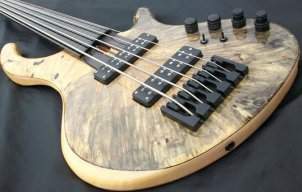
Being from Waco, you could throw in a few pieces of Maclura pomifera, Bois D'Arc
My "horse apple tree" I've got in the shed is still drying, pretty stuff kind of a mustard color. That's what we call it, or BoDark. I may have some dry enough for neck stringers.
Have you seen Brubaker's countertop bass? The FACT that materials play a less important role than what is preached in the market has been proven by that bass, the Benedetto hardware store pine topped archtop guitar, the shipping crate/pellet acoustic guitar built by (was it Taylor or something?) and others, so I hope you're doing this for fun and your own experimentation and not trying to 'prove' anything
I've seen them but I've never HEARD them. I'm doing it because I want to, and I've been wanting to for a long time. And its not experimentation, because I KNOW it will sound and play great.

I've seen them but I've never HEARD them. I'm doing it because I want to, and I've been wanting to for a long time. And its not experimentation, because I KNOW it will sound and play great.
carry on, brother
Little change in plans! The neck will be 3 laminates of pecan and Bodark. Thanks to Mr. Majestic for reminding about the Bois D'ark aka osage orange. This gives it a little more Texas flavor as well.
I've had this stuff stashed for about a couple of years. My brother in law makes hunting bows with it he hooked me up with some and said "Here make a guitar with this." I then put it in the loft and quickly forgot about it. Shame on me!
Pecan on the outsides bodark in the middle. The bodark shows to be nice and dry. Hard to see in the picture but it is almost solid fleck from being Q.S.
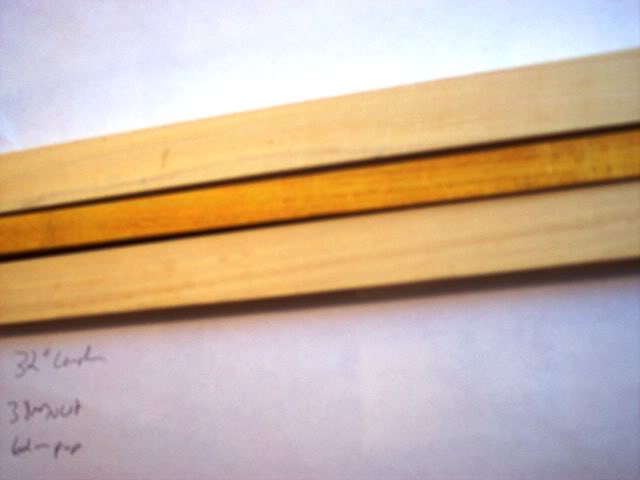
It’s being glued up now. Which means this project is officially on the burners.
I've had this stuff stashed for about a couple of years. My brother in law makes hunting bows with it he hooked me up with some and said "Here make a guitar with this." I then put it in the loft and quickly forgot about it. Shame on me!
Pecan on the outsides bodark in the middle. The bodark shows to be nice and dry. Hard to see in the picture but it is almost solid fleck from being Q.S.
It’s being glued up now. Which means this project is officially on the burners.


Have you seen Brubaker's countertop bass? The FACT that materials play a less important role than what is preached in the market has been proven by that bass, the Benedetto hardware store pine topped archtop guitar, the shipping crate/pellet acoustic guitar built by (was it Taylor or something?) and others, so I hope you're doing this for fun and your own experimentation and not trying to 'prove' anything
While the countertop bass does sound good, it also sounds different from other basses Kevin has built. I'd think it addresses what you can/can't use more than whether or not woods matter. Kevin is a firm believer that they do in fact matter. He also likes to experiment with woods that arent the obvious choice for builders. And he likes trying different combinations of woods to see the results.
As far as what woods can or can't be used, it would seem it really depends on what it's being used for. For example, an untreated Balsa fingerboard may not be an optimal choice for a fretless
. Then again it could be great for a disposable one (we've actually discussed that before ).My first build used 5 different local woods and the only one used commonly was purpleheart. If we count peruvian wood (edit: it is peruvian walnut not peruvian wood) as a common wood for builder, the other three were never used by the big names or even small names. Only say one build here using the same wood (bulletwood) as me for the FB. My build sounds better than my LTD F254 and some other basses Ive heard. I'm pretty convinced with this that even when the woods matter, they doesnt matter that much as some guys/companies accept as a fact.
Scotty I'm sure that this will be a good looking/sounding build.
Scotty I'm sure that this will be a good looking/sounding build.
My first build used 5 different local woods and the only one used commonly was purpleheart. If we count peruvian wood as a common wood for builder, the other three were never used by the big names or even small names. Only say one build here using the same wood (bulletwood) as me for the FB. My build sounds better than my LTD F254 and some other basses Ive heard. I'm pretty convinced with this that even when the woods matter, they doesnt matter that much as some guys/companies accept as a fact.
Scotty I'm sure that this will be a good looking/sounding build.
If you're using that many different woods, it can be hard to tell what makes a difference.
If you're using that many different woods, it can be hard to tell what makes a difference.
The build is a neckthrough with peruvian walnut for the wings and a rare specie of mohena (can't remember the latin name) for top and back. The neck is purpleheart, peruvian walnut and pumaquiro (local wood called peruvian maple by some US dealer over internet) being the last one close to 50% of the neck if not more. The purpleheart and walnut are only 5mm laminates. The FB is bulletwood (local and not common on guitars).
If the type of wood used would be such important as with acoustic instrument problably my bass would sound like sh*t no matter the pickups and electronics. Thanks God it is not the case
 but you got the point... with all those woods (most not considered tonewoods) is hard to tell which one makes the difference ergo even when the type of wood is important is not THAT important and you can have a great sounding bass made out of not common woods (aka tonewoods).
The build is a neckthrough with peruvian walnut for the wings and a rare specie of mohena (can't remember the latin name) for top and back. The neck is purpleheart, peruvian walnut and pumaquiro (local wood called peruvian maple by some US dealer over internet) being the last one close to 50% of the neck if not more. The purpleheart and walnut are only 5mm laminates. The FB is bulletwood (local and not common on guitars).
If the type of wood used would be such important as with acoustic instrument problably my bass would sound like sh*t no matter the pickups and electronics. Thanks God it is not the case
I don't get how you're coming to your conclusions. Because a wood isn't classified as a tonewood, you think it must sound bad?
I don't get how you're coming to your conclusions. Because a wood isn't classified as a tonewood, you think it must sound bad?
Not at all but when I started to do my research about woods I do had that in mind because all that have been said and written about tonewoods. I remember I was a bit worried because there is no maple or ash or alder wood here. When I started to read forums like this and did some more research I realize that woods are not as important for an electric guitar as others claim. Im not saying it is not important at all, it is just not that important so an electric bass or guitar built with wood not known as a tonewood can sound great and I have to admit that even in the middle of my project I was still worried about its sound because of the chosen woods. For me the proof that a bass built with no tonewood at all can have a great sound is my project itself. I really like how it sounds and besides purpleheart there is no common wood on it.
Little change in plans! The neck will be 3 laminates of pecan and Bodark. Thanks to Mr. Majestic for reminding about the Bois D'ark aka osage orange. This gives it a little more Texas flavor as well.
I've had this stuff stashed for about a couple of years. My brother in law makes hunting bows with it he hooked me up with some and said "Here make a guitar with this." I then put it in the loft and quickly forgot about it. Shame on me!
Pecan on the outsides bodark in the middle. The bodark shows to be nice and dry. Hard to see in the picture but it is almost solid fleck from being Q.S.
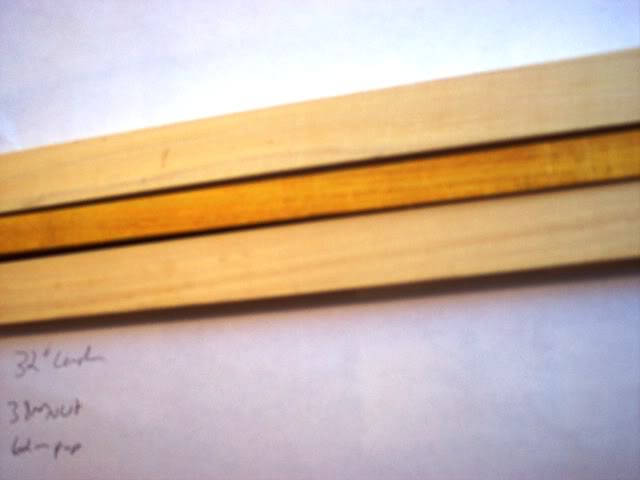
Its being glued up now. Which means this project is officially on the burners.
I had a piece of the stuff for over ten years and never used it. My uncle has a ranch close to Texarkana and they used for fence posts. I bet they had ten thousand of them and I picked up one of the biggest pieces. I talked to a local guy about sawing it for me and he said he would only saw up the green stuff. That was unless I wanted to buy him a few extra blades......no thank you. But it is a rather unique wood and is very strong.
The pecan is also cool. In the cabinet business they lump hickory and pecan, both in the same family, together. We have to specify either hickory or pecan when we order it. It will dull cutters faster than any other domestic wood.

Subscribed.. I gotta see this!
Me too!!
Can't wait for the sound clips.
This might be the design for mine, Scotty - (now if I could only get some gigs....)
Z
Latest posts
-

-
 Uber Eats class action lawsuit alleges their priority delivery is a scam
- Latest: buldog5151bass
-

-

