This is incorrect. You set the book on the shelf where it now sits.The book is "setting" on the shelf.
Read your own example.

TalkBass has been independent since 1998. Add your voice.
Create a free account to reply to discussions, view embedded media, and browse with fewer display ads.
Join free Log in
Want zero display ads or expanded classifieds tools? Compare plans.
This is incorrect. You set the book on the shelf where it now sits.The book is "setting" on the shelf.
That there is one ah them runyan cintacents.View attachment 816047 Personally? I try to do my best, grammatically. Also, I'm one of those people who, when I come across something written so badly it's hard to understand, have to wonder if the person who wrote it has anything to say that's worth reading. However, I usually just remind myself that I'm old; the education system in this country isn't what it used to be; and recite what's in the picture to myself - over, and over, and over...
This is incorrect. You set the book on the shelf where it now sits.
Read your own example.
Not all languages see a double negative as a reversal. Some, Russian for example, see multiple negatives as just more negative. What is interesting is no language sees double positives as a negative.I finally got tired of trying to clue folks in to their improper use of double negatives.
"I ain't got no time for that!"
Hmm, so you do have time for it?

It seems you are talking past each other. There is nothing in the original sentence to indicate that the book is (being) placed on the shelf. However it came there, it is now sitting on the shelf. You set down a cup. The cup was set down, and now the cup sits on the table.No, it would be The book "sets" on the shelf. It can't "sit" because it is placed there.
The book was placed on the table. You set it there. Set requires an object. Sit does not. The book is sitting on the table. Set is a transitive verb. Sit is an intransitive verb.No, it would be The book "sets" on the shelf. It can't "sit" because it is placed there.
Thanks for the link. That looks good. There's a book called Mind the Gaffe, by RL Trask, that's also prone to giving one a shove in the right direction. I can't locate my copy at the moment - I recently lost my perspective on the difference between pleonasms and neoplasms - could've been a fatal malapropism - but I'm determined again to track that book down and re-read it. This stuff does help. Here's a brief review from the Guardian.OP: If you enjoyed that, check this out: Link Removed
Rather than stomp on other people's posts with grammar correction I thought I would post something helpful for TBers to refer to.
There, They're, Their - The Easiest Way To Learn How To Use These Words
Any others?

I'm with you 100%. Unfortunately the dumbing down of America has created a society where people rarely even care anymore whether people around them use good grammar or not. They will even go so far as to insult you for pointing it out.

im prolly gonna take a brake and eat a stake purty so on.
Me too. I use it all of the time. I know it's wrong but I cannot help myself.I think "prolly" is my favorite newspeak word!

It is: sing, sang, sung.I hear people say "I brung" it".
It is: sing, sang, sung.
It is not: bring, brang, brung.
Yep! I always thought it was funny when Neil Diamond sang "Songs she brang to me" in the song "Play Me".
That is a strange song. Why was she "lying beside my bed" instead of in the bed?
BTW, some people are not unintentionally using poor grammar, but are writing idiomatically.
Is now the time to bring up the use of the Oxford comma?

Here is one that people misuse often
Sit vs. Set
The easiest way to remember is to use "sit" for people or animals and "set" for things or objects.
Examples:
He is "sitting" in the chair.
The book is "setting" on the shelf.
The waiter "sat" down and "set" the dishes on the table.
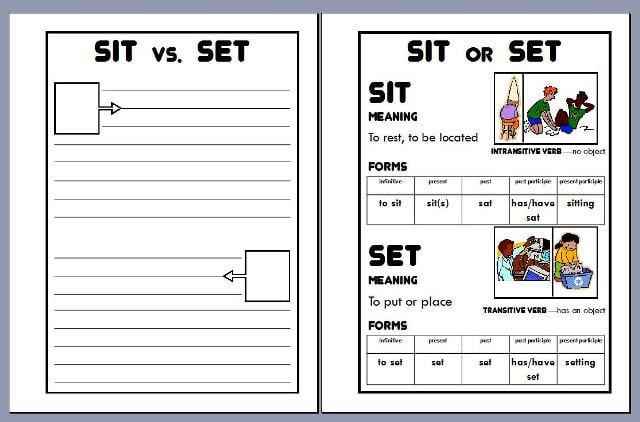
The book was placed on the table. You set it there. Set requires an object. Sit does not. The book is sitting on the table. Set is a transitive verb. Sit is an intransitive verb.
There is not object in the book is sitting on the table. Book is the subject.