• TalkBass has been independent since 1998. Add your voice.
    Create a free account to reply to discussions, view embedded media, and browse with fewer display ads.
    Join freeLog in
    Want zero display ads or expanded classifieds tools? Compare plans.
Double Bass Thinking about a five string

Well, the different basses provide different options. When I’m playing a piece with many notes written below and above low ‘E’ in quick succession I don’t want to have to think about which capo to use. That leaves something like an imbalance of the amount of attention I can devote to what any one hand is doing at any one time so to the totality of what comes out of the bass is unbalanced. Being able to put a balanced amount of attention into all the facets of whatever it is I’m tasked with doing at any one time scores above everything else I think.

Similarly when it’s Vaughan Williams 4th on the stand and there are many fast notes but none of them really below e, I’ll sacrifice hugeness of tone for clarity and bring a smaller bass like the French one as that might suit the situation better.

Sometimes I use cello rosin on the bow. Sometimes i wouldn’t want anything but pop’s. The more I prioritise having a variety of ways of attacking a problem the more I leave myself with different avenues of escape. Hopefully I’m solving the problem at hand, at least as much as I’m avoiding another problem of being a jack of all trades and master of none. That merits constant attention too it seems...!
 
Several years ago, I play a dragon headed "twin" to the Bohmann that Paul and Bob Ross (in Denver) made. It was a real floor shaker, but heavy as all get out. I've also played a four string Bohmann in Chicago that was great, but also very heavy.
 
  • Like
Reactions: martinez
Just fyi - I happened to catch the NHK Symphony on PBS yesterday, performing the Sibelius 2nd. I may be hallucinating, but the five string basses they played seemed even bigger than the ones at the Berlin and Vienna Phils. See @12:45 below (the pizz passage in the second movement):

[Invalid or Expired Link Removed]

I think probably the size of the basses stands out against the stature of the players. There’s at least one Poellmann at the back of the group (with the ornamented rib linings), a Bussetto looking thing and all manner of other basses typical of the large end of the size distribution not atypically found in instruments of Germanic extraction. But no unusually big basses within that context as far as I can tell looking at components such as the tailpiece length in relation to the belly length etc.
 
  • Like
Reactions: piggywiddle
Just fyi - I happened to catch the NHK Symphony on PBS yesterday, performing the Sibelius 2nd. I may be hallucinating, but the five string basses they played seemed even bigger than the ones at the Berlin and Vienna Phils. See @12:45 below (the pizz passage in the second movement):

[Invalid or Expired Link Removed]

Perhaps smaller sized musicians as well? Kazuo Okuda owned Rainer Zepperitz 5 string and that thing was a MONSTER
 
View attachment 3859616 View attachment 3859613

I’m rather enjoying this thread on 5 string basses, thanks!

A few months ago I stumbled across Mr Warburton’s 1915 Bohmann 5 string bass,
currently available at the Cincinnati Bass Cellar. This one certainly is investment quality. Now and then I contemplate playing this bass. Perhaps heavy & old fashioned but a beauty.


@Paul Warburton

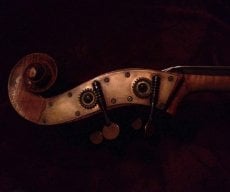
Love the tuners. Don't think I have the cojones for that bass!
 
Perhaps smaller sized musicians as well? Kazuo Okuda owned Rainer Zepperitz 5 string and that thing was a MONSTER

That’s what I meant, yes. I’ve always wondered what that bass owned by Mr Zepperitz sounded like. I clearly watched too many Berlin Phil videos when I was a teenager - I seem to remember always wanting to play on one of those giant basses. Have you experienced ‘the’ Bussetto in person?
 
  • Like
Reactions: piggywiddle
I doubt you can make any hard and fast rules about playability in low passages. My own experience is that the majority of the time I’m really happy about the straight forward fingering my 5-strings allow. Other times I find myself yearning for a strategically placed capo on the low note of a passage.

When shoulder issues forced me to try to learn German bow after 40 some years of using French, you can guess how many daunting obstacles had to be faced. One directly relates to this thread: access to the low string. Much, much less clearance (from your own torso) with a German bow than French. At least seated.

The Martin video was interesting. I was already a convert to having a narrower, more arched fingerboard/bridge with the strings biased towards the bass side (B string close to the edge, even off the fingerboard towards the end). But the main fix they applied to the low string clearance issue was using a 50mm overstand. That’s fine for new building, but retrofit means a neck reset with shimming and a new bridge. Pricey.

My own fix was to start using a hybrid bow that allows switching grips. Unless its a long drone with plenty of time to get there, I almost always use a French grip on my B string. Sorry, old dog, new tricks.

A couple last, not so obvious, arguments in favor of 5-strings:

I find I can get a lot more punch attacking a note if it’s closed rather than open. A closed E on the B string is a whole different animal than an open E.

Also, though you can get into heated discussions about the advisability of when and how much to vibrate low notes, doing so on a B string is very easy and effective.
 
Last edited:
  • Like
Reactions: piggywiddle
access to the low string. Much, much less clearance (from your own torso) with a German bow than French. At least seated.


You can turn the bass away from your body to get more clearance. Many bassists in German orchestras do this when they play on the E and B strings. Instead of having a locked position, the bass is on a swivel. I like this approach very much for the way I play and for my technique. I am sure other people have different and equally valid ways which work for them!

 
  • Like
Reactions: bengreen
You can turn the bass away from your body to get more clearance. Many bassists in German orchestras do this when they play on the E and B strings. Instead of having a locked position, the bass is on a swivel. I like this approach very much for the way I play and for my technique. I am sure other people have different and equally valid ways which work for them!

Yep, works...just not for me. Did I mention old dog? Seriously, it’s more than I want to coordinate: anticipating when I need to do it, moving bass and body, stabilizing bass in new position.... The reality is I’m never going to be an effective German player this late in the game. A hybrid bow lets me play reasonably well with less pain. But more to the point of this thread, what you mention does need to be considered: a switch to 5-string may involve some adjustment of how you address the instrument as a whole. Plus get used to the idea there may be some wrong notes happening at first when you find yourself playing the wrong string (yes, I know some of you never had any problem there...must be me!).
 
  • Like
Reactions: piggywiddle
@piggywiddle, since some have suggested starting with a less-expensive bass, I'll share my experience:

I couldn't resist having a go with a 5-stringer. I tried a couple as a student 30 years ago, and they seemed to agree with me; however, my teacher probably would've berated me if I'd bought one back then. Now that I'm all grown up (ha!) and there are affordable Chinese instruments, I decided life is too short, and I wanted to explore playing like the European orchestral players do. I bought a Shen model sight unseen from Bob Beerman's shop a few years ago, and I absolutely love it. The string length is 42" but I'll bet it could be fudged a bit shorter in the setup.

I mentioned Bob specifically, because the setup is so critical, of course. Although I bought the bass without trying it first, Bob and I traded correspondence with detailed info about the bridge arc, etc. and how it compared with my 4-string (which is the same model Shen with the same overall dimensions). I found Bob's setup to be really fine; I've made a few tweaks with the bridge adjusters, but it feels terrific. And the neck profile on the Shen 5-er is exceptional—although it's physically larger, the profile shaping gives it the feel of a 4-string neck (much the same way that George Martin describes in the video posted earlier). This was a welcome surprise for me, compared to the other 5-stringers I had tried in the past; very comfortable.

A new Shen 5-er retails for about $6k USD; however, there is one that has been listed in TB classifieds for a few years for considerably less: For Sale - Shen Willow Gemunder 7/8 5-String PRICE DROP 00 No idea about the setup, however.

Sorry; long post. Just thought I'd share my personal experience. Best of luck, and I hope you find a marvelous bass!

 
@piggywiddle, since some have suggested starting with a less-expensive bass, I'll share my experience:

I couldn't resist having a go with a 5-stringer. I tried a couple as a student 30 years ago, and they seemed to agree with me; however, my teacher probably would've berated me if I'd bought one back then. Now that I'm all grown up (ha!) and there are affordable Chinese instruments, I decided life is too short, and I wanted to explore playing like the European orchestral players do. I bought a Shen model sight unseen from Bob Beerman's shop a few years ago, and I absolutely love it. The string length is 42" but I'll bet it could be fudged a bit shorter in the setup.

I mentioned Bob specifically, because the setup is so critical, of course. Although I bought the bass without trying it first, Bob and I traded correspondence with detailed info about the bridge arc, etc. and how it compared with my 4-string (which is the same model Shen with the same overall dimensions). I found Bob's setup to be really fine; I've made a few tweaks with the bridge adjusters, but it feels terrific. And the neck profile on the Shen 5-er is exceptional—although it's physically larger, the profile shaping gives it the feel of a 4-string neck (much the same way that George Martin describes in the video posted earlier). This was a welcome surprise for me, compared to the other 5-stringers I had tried in the past; very comfortable.

A new Shen 5-er retails for about $6k USD; however, there is one that has been listed in TB classifieds for a few years for considerably less: For Sale - Shen Willow Gemunder 7/8 5-String PRICE DROP 00 No idea about the setup, however.


Sorry; long post. Just thought I'd share my personal experience. Best of luck, and I hope you find a marvelous bass!

awesome! That’s a great idea.
 
@piggywiddle,

A new Shen 5-er retails for about $6k USD; however, there is one that has been listed in TB classifieds for a few years for considerably less: For Sale - Shen Willow Gemunder 7/8 5-String PRICE DROP 00 No idea about the setup, however.

This does bring up a topic we should be aware of. This bass looks to be still available, but it has been for sale for six years (!)

The bass may be just fine. But something is wrong when something can’t sell.

I know when I sell a car, a house, or heaven forbid, a bass I kinda want it sold within a few weeks. When I retire from playing bass I can’t have a bass sit for sale for six years. Nor do I want to dump that responsibility on my family after I’m gone.

Also, the bass has gone down in value. I like my stuff to go UP in value. I’ve noticed this with Martin basses too. They don’t go up in value like a fine bass should. Maybe they made too many. Maybe a new bass goes down in value for a few years then up over time.

Just some thoughts on the elephant in the room.
 
Last edited:
I play a 5 string Shen copy of a bass made by Robert Spear: Singing Woods Violin : Base Template His shop is in Ithaca, New York.

It's a Hutchins-style bass, designed to be tuned in 5ths C-G-D-A-E, low to high. I tune in 4ths with a C on the bottom. When I bought the bass, the previous owner had it at C, and I decided to try it for a few months, then a few months at B to compare. I liked the low C so much I never got around to the B trial run. For orchestra, where we double the cellos so much, it is really convenient to have a low C string. Also, the resonance between the low C and high G is nice. I play 5 string BG and usually tune the low string to B. If I ever play Pines of Rome again, I'll retune to B, or maybe learn the program at B.

I love the bass! Thin, wide body. Loud. The neck is thick. It took me a couple months to get used to the neck diameter and the string spacing. I didn't like playing on an extension, so the 2 month adjustment period was well worth.
 
I have five-string (low B) bass. This is the German Rubner of 1967. The body size is 7/8, but the string length is 104.5 cm (41 1/8 "). String space on bridge 25,4 mm (1" ) ,this more than many four-string basses. This bass is very convenient for me. No problem playing. He has a very big and dense sound with any strings. I compare w other carved bass that I had. I think this is determined by a thick neck. But you should know that I am not a professional musician.
 
Last edited:
I play a 5 string Shen copy ... I tune in 4ths with a C on the bottom. When I bought the bass, the previous owner had it at C, and I decided to try it for a few months, then a few months at B to compare. I liked the low C so much I never got around to the B trial run

Can't believe that after 20 years with 5-strings I never thought to tinker with this. Knee jerk bottom end thinking: lower is better. But one of the arguments I've always heard favoring a C-extension is regarding that resonance between the open strings. You'd think it would depend on the key of the passage you're playing, but it's been a pretty pervasive meme all the same. I'll have to mess with it, I guess. Any other folks with druthers about what the low 5th string should be tuned to? Or using a string manufactured for C vs B?
 
Last edited:
Can't believe that after 20 years with 5-strings I never thought to tinker with this [...] Any other folks with druthers about what the low 5th string should be tuned to? Or using a string manufactured for C vs B?
When I first started using 5-strings I tuned the low string to B natural, it simply made sense to me to keep the 4th tuning all the way across the strings. However, I changed to C at some point to try it out and this is what I now prefer. I do feel like the bass resonates better, especially in certain keys - it's so nice to feel the low C swinging along when playing C on the A-string. You rarely need to play a low B (it does happen though) and the open C just sounds awesome to me. Another thing that I heard as an argument for C over B, was that if you tune a low B you get the low Eb (which you will need a lot!) sort of in that akward area where you have Ab on the E-string - that Ab that somehow always or at least often tends to sound a bit off or may feel difficult to get really in tune (does anyone have a good explanation for this btw?). But if you tune to a low C the Eb will be in position with the G on the E-string, and it gets easier to make it sound good. I do find some truth in this - or maybe I just convinced myself that I do to keep the low C tuning.
 

Latest posts