• TalkBass has been independent since 1998. Add your voice.
    Create a free account to reply to discussions, view embedded media, and browse with fewer display ads.
    Join freeLog in
    Want zero display ads or expanded classifieds tools? Compare plans.

Thinking of going from P to double-reverse -P

It's a bit similar what Neil Murray did with his Kramer bass in the late seventies. It had a reverse P in the "correct" P-position and another reverse P right behind it so everything same as here but one "block" closer to the bridge. His later BC Rich had a similar confiquration.
All those variations can be interesting and useful too. From what I've learned is that I never really cared for the sound of two pickups very near each other so the "all on" sound might be disappointing. Or not!
But do it if you ask me. And cream colored DiMarzios would look fab.
I’ve got to get a look at, and a listen to, these Neil Murray basses.
 
I’m sorry about your shoes though.

OP nice pics. Maybe somedays the music gig will pay enough so you can afford shoes :-)

Shorts and no shoes on stage and you make it look soooo coool!

These are a refreshing break from the usual YOUREGOINGTOGETELECTROCUTED comments 😆 somehow Scott Reeder and my friends in Slumbering Sun and I have managed to avoid it 🤞
 
I really like the look of that, even as it goes against numerous general aesthetic preferences of mine (P+MM, light inlays on light fretboard, painted headstock with light board). Somehow that all comes together really nicely. It looks a lot like the current generation of Yamaha BBs, of which I own and enjoy two. As I do also have my Ibanez ATKs and Roadstar that do something in the realm of a Stingray, I think I’d rather go with a reverse-P thereabouts for yet another option.


Correct: passive tone knobs are purely decorative for me 😆 I may yet do this.


Cream DiMarzios would be the ‘80s-est 😎 I suspect the most useful sounds for me if I made this happen would be the reverse-P nearest the bridge, the Fender orientation and placement in the middle, and maybe the reverse-P nearest the neck, in that order.


I think I’m of a “why not both?” mind when it comes to series/parallel switching and the additional pickup halves.
If you’re not shy about figuring out the wiring go for it. Mostly depends on the combinations you you want available.

Easiest to reason about (and probably wire) is front pair / back pair individually switchable (to their respective volume knob), and then combing that into serious/parallel to the output.

Any combination of wiring is going to have its own eccentric behavior, and it’s for you to determine how useful you think it is.

I have a double P project that’s waiting to be wired, and it’s just two P pickups wired in parallel as standard volume blend tone, each individually switchable between series/parallel. Should have more options than I’ll need it to do.
 
  • Like
Reactions: Riff Ranger
PJ’s often sound “nasal” on the Gand D strings, because the pickups are too close to each other.
Too true!!
I put the pickups on my basses as close as possible to minimize hollowing out the mids due to phase cancellation.
That worked well for the bass with one pickup in the normal "P" position and the other closer to the neck.

But on the bass with a pickup closer to the bridge, it was TOO effective.
I've struggled to find a bridge pickup that doesn't sound like a honking goose.

Most P-bass pickups are wired in series and tend to have a solid midrange - and that tonality doesn't necessarily work in a double-P setup.
The Bartolini 8S is the best I've found - it's the only P pickup that sounds good to me in either spot.

IMO, you have to decide which pickup is going to form the primary voice of your bass, then find a pickup you love in that spot.
The second pickup has to play nicely with the "main" pickup since it's just there to add spice.
 
  • Like
Reactions: Riff Ranger
But on the bass with a pickup closer to the bridge, it was TOO effective.
I've struggled to find a bridge pickup that doesn't sound like a honking goose.
The "honking" you're hearing is almost certainly the pickup position, not the pickup itself. Pickups are very linear devices in the bass and low mids - they don't do anything in terms of imparting character until the upper mids. Coloration in the low mids (where your "honk" comes from) is due to pickup position.

 
  • Like
Reactions: Riff Ranger
The "honking" you're hearing is almost certainly the pickup position, not the pickup itself. Pickups are very linear devices in the bass and low mids - they don't do anything in terms of imparting character until the upper mids. Coloration in the low mids (where your "honk" comes from) is due to pickup position.

Maybe everything wide open wouldn’t sound bad, then 🤔
 
View attachment 7414246

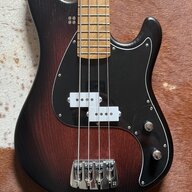
I really like how this Electra X700JB looks and plays. I also like the sound—like a thick, dark precision, especially tuned BEAD as I have it—but I would probably use it more if I could also get some more defined and atypical sounds out of it. It occurred to me that I could retain the current sound and add some others I don’t already have by adding a pickup half to either side of the existing pickup, like this:

View attachment 7414247

I’m mostly interested in how that resulting reverse-P nearest the bridge would sound, as it puts the pole pieces under the B and E strings pretty much in Stingray territory, but it seems like I might as well add two pickup halves rather than leaving one to rot in a parts bin.

Electronics remain mostly incomprehensible magic to me, but It seems this would allow the following possible configurations:

•two reverse-Ps in combination i.e. all four pickup halves in the circuit
•a reverse-P with the A and D nearer the neck than standard Fender orientation
•standard Fender orientation
•a reverse-P with the B and E nearer the bridge than standard Fender orientation, in the approximate Stingray position
•a wide reverse-P engaging the B-E half nearer the bridge and the A-D half nearer the neck (weird, but might sound interesting)

The double-reverse-P would also sort of echo or follow the body shape, which I like in theory.

Please note that I’m not just looking to brighten up a dark-sounding bass—I would like to retain the current sound as an option among a few new ones—and I neither expect nor want to nail a Stingray with a passive Precision pickup in the approximate Stingray position (I already have other instruments that get me sounds in that realm).

All that said:

•do I have the possible pickup configurations this would add correct?
•what are my options for a switch? 5-way blade and 5-way rotary?
very broadly speaking, how would each of the possible combinations sound? (I understand that answers to this question would be highly subjective.)
•should I try to track down an exact copy of this pickup, or would an actual DiMarzio Model P come close enough? I think it’s a Schaller copy of a Model P used in many instruments made in Japan in the 1980s.
•does anyone have personal experience with something like this they would care to share?

Thanks in advance for your helpful replies.
I prefer your idea with 3 way switch add for 3 different P vibe

Hoppus vibe <> P vibe <> Proto Ray vibe
Screenshot_2026-01-25-15-05-09-717_com.android.chrome-edit.jpg
 
Now I wonder if I might want to give both this one and the pointy one the Wattplower treatment (i.e. add a pickup half closer to the bridge, with the option to switch between standard Precision position and orientation, and reverse-P in more of the Stingray position) 🤔
View attachment 7418078
Do it!

Incidentally, I'm very curious what the wiring will end up looking like...
 
  • Like
Reactions: Riff Ranger