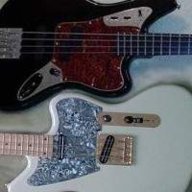
Fender Limited Edition Parallel Universe Meteora - Butterscotch Blonde with Maple Fingerboard
Interesting, but I think I'd rather see how @JIO spins it. As a bass of course!
Interesting, but I think I'd rather see how @JIO spins it. As a bass of course!


 It's got all the trad Fender touchstones like ash body, butterscotch finish, TM hs, and basically Tele configuration. (if it quacks like a duck...) I find it interesting that Fender is moving in on my territory
  making a "space-age" referenced quirky offset like this one - where's my lawyers!
  Don't know about that body style being a bass... guitarists can always get away with wacky shaped bodies because they are smaller and have less 'neck-dive' restraints. As much as I appreciate it for being different, it's problematic in a couple ways to my aesthetic/funtional demands - primarily the extreme offset. Similarly to a T-bird, you have to have a neck-yoke stand - period. (no leaning against amp, wall etc) And the short upper horn wouldn't cut it for a full scale bass. (if they made one with the same body design) And lastly, I experimented with an elevated 'peak' like the one that occurs on this body as a result of the elevated off-set (at the forearm area) and it can work or not depending on a players style. Some player (like me) like to palm-mute and rest my forearm on the body when I do. The one I made ended up hitting in a location that caused discomfort, so I had to alter it.