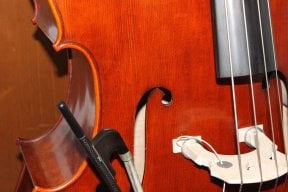
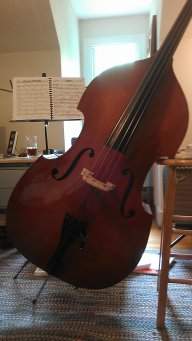
I am looking at purchasing my first double bass. I've had access to one for awhile and played on one in school (I'm 27 now) so I'd say I'm at the intermediate level. I have seen a few plywood basses on craigslist and other sites and was wondering what you thought about them?
I will primarily be playing bluegrass and jazz (very little bowing) and will be gigging regularly with it. Because of this my main criteria is: price, durability, loudness and tone. If you have experience with plywood basses or recommendations on what type of bass would best suit these needs please comment. All input is appreciated!
Thanks
As a self-professed intermediate player I am surprised you don't already have a fairly strong opinion on this, but maybe you haven't had the opportunity to play on a nicer hybrid or carved bass.
IMHO the main benefit of laminate is they tend to be a bit more resilient or robust. Also since they tend to be less expensive you tend to not worry so much about them getting beat up.
They may also be desirable because they have a characteristic tone that is associated with the music you play.
Over all this discussion can get quite heated, but sometime people see the light. Here's a recent thread to illustrate the latter:
Ply vs hybrid - I admit the errors of my ways! (Longish - apologies)
In general the quality can go up substantial as you move from laminate to hybrid. I have played some hybrids that were really very good (perhaps >80% of the quality of a decent carved bass). I have never come across a laminate bass that I would describe as much better than marginal; perhaps 40-45 of the quality of a decent carved bass.
That's not to say I would not play a laminate bass. In fact the only upright I have owned to date was an old Kay. I won an audition in a military band on that bass and also played it for a few years in a community orchestra. It was a lot of work to play and sounded sort of like a cross between a wet cardboard box and an angry goose.
The thing to keep in mind is the build method alone is not a guarantee of quality. You can find examples of plywood basses that play and sound better than fully carved BSOs. BSO stands for bass shaped object.
One final bit of knowledge I would like to share at this time. A truly fine instrument may not be a good choice for amplification. The last upright I played professionally was a 7/8 Lakeburg Baer one of my peers had commissioned for the organization. I think it would have been fabulous in an orchestra because it was a real cannon acoustically. But we always played with an amp, even when we played arco. The bass was extremely resonant, and this quality does not typically work well with amplification. Sort of like concert halls with lot's of natural reverb sound great with small to medium acoustic ensembles, but if you put an amplified ensemble in such a hall, it turns into a boomy mess.
So my point is just because an instrument is fabulous, does not guarantee it will amplify well or meet your needs. Some people argue that laminated basses amplify better than carved basses. In some instances I agree, but as I general statement I don't accept this as fact. A well chosen carved instrument will out perform the best laminate bass, unless you specially want the sound of a laminate bass--which some do.
Really the best thing you can do is take some road trips and visit some of the big bass houses. Play a bunch of basses and eventually one or more will seduce you.
Before covid hit, I had hoped to visit Ross Double Bass in Denver, Double Bass Workshop in Madison, Robertson & Sons in Albuquerque, Cincinnati Bass Cellar, and possibly String Emporium in Chandler AZ, and KC Strings in Kansas City.
Do the research, and maybe you can find a few gaggles of uprights relatively near you. Play every bass you can get your hands on.