• TalkBass has been independent since 1998. Add your voice.
    Create a free account to reply to discussions, view embedded media, and browse with fewer display ads.
    Join freeLog in
    Want zero display ads or expanded classifieds tools? Compare plans.

Thunderbird Club

I didn't like the active circuit that much, and when the battery died, there was no signal. So the Pro IV became the Fretless 'Bird with Alumitones. Those are fairly low output. They have their own sound and vibe, which I cannot describe any better than any other sound. A little on the soft greenish side perhaps.
 
I didn't like the active circuit that much, and when the battery died, there was no signal. So the Pro IV became the Fretless 'Bird with Alumitones. Those are fairly low output. They have their own sound and vibe, which I cannot describe any better than any other sound. A little on the soft greenish side perhaps.
In all seriousness, just to help me follow the discussion...
Would you consider a brittle or bright tone whiteish?
A warm smooth tone orangish?
A low mids focused tone brownish?
A mids focused tone greenish?
And a deep strong bass tone blackish?

So maybe a soft greenish tone would be a fairly neutral sounding pickup with a bit of mid focus?

As odd as it may sound, using colors to describe tone is actually more accurate than many people would assume. Place a color wheel (like the 32 or 64 bit type you have on your computer excel or word pull down menu) and play various types of music or specific instruments. You'd be surprised how many people will associate the same general location on that color wheel with specific tones.
 
In all seriousness, just to help me follow the discussion...
Would you consider a brittle or bright tone whiteish?
A warm smooth tone orangish?
A low mids focused tone brownish?
A mids focused tone greenish?
And a deep strong bass tone blackish?

So maybe a soft greenish tone would be a fairly neutral sounding pickup with a bit of mid focus?

As odd as it may sound, using colors to describe tone is actually more accurate than many people would assume. Place a color wheel (like the 32 or 64 bit type you have on your computer excel or word pull down menu) and play various types of music or specific instruments. You'd be surprised how many people will associate the same general location on that color wheel with specific tones.

...and this may be the reason I'll never really be truly adept at figuring out bass lines without a tab to point me in the right direction. I've heard of people that see sound in colors and sadly that's not me. I think I started too late. :(
 
  • Like
Reactions: Stevis
In all seriousness, just to help me follow the discussion...
Would you consider a brittle or bright tone whiteish?
A warm smooth tone orangish?
A low mids focused tone brownish?
A mids focused tone greenish?
And a deep strong bass tone blackish?

So maybe a soft greenish tone would be a fairly neutral sounding pickup with a bit of mid focus?

As odd as it may sound, using colors to describe tone is actually more accurate than many people would assume. Place a color wheel (like the 32 or 64 bit type you have on your computer excel or word pull down menu) and play various types of music or specific instruments. You'd be surprised how many people will associate the same general location on that color wheel with specific tones.

An interpretive dance would be better for describing the sound [/smartass mode]
 
In all seriousness, just to help me follow the discussion...
Would you consider a brittle or bright tone whiteish?
A warm smooth tone orangish?
A low mids focused tone brownish?
A mids focused tone greenish?
And a deep strong bass tone blackish?

So maybe a soft greenish tone would be a fairly neutral sounding pickup with a bit of mid focus?

As odd as it may sound, using colors to describe tone is actually more accurate than many people would assume. Place a color wheel (like the 32 or 64 bit type you have on your computer excel or word pull down menu) and play various types of music or specific instruments. You'd be surprised how many people will associate the same general location on that color wheel with specific tones.
Sounds just have colors and textures. I would also say the sound from an Alumitone is not particularly shiny. Brittle, bright tones sound more pale, hard blue. Whitish, yes, but toward blue like fluorescent light. That's not bad, it just is. A thicker, richer bright tone, like a trumpet, heads over toward yellow or even yellow-orange. It can be shiny or less shiny, depending on the trumpet player and mouthpiece. My son goes from an amber, matte sound to a bright yellow, shiny sound on his trumpet. Mid-focus is probably more on the brown to yellow side. Bass tends toward red, purple, and especially maroon. Depending. An upright is more maroon, while a Thunderbird gets more purple or over toward green, depending on eq, strings and attack. It can be a shiny sound, too. Or matte, depending on attack. Precisions are redder than a Jazz, which generally are greener.

Which brings us back to the Alumitones. They are clean, clear sounding pickups without a whole lot of power, although they are extremely sensitive to height. Get them up near the strings and they produce more signal and the signal is more scooped toward green or even aqua. Lower them and they are still green, just softer.

Confused yet? You probably don't want to try to get into my skull too far. It's a really odd place to live, full of blind alleys and trap doors. I always assume that whatever I think offhand about anything will be very different from how most of the rest of the world sees things, and that's usually a reasonably accurate assumption.
 
Cool looking bass. What kind of pickups did you use there?

You might be right about basswood. I think that it is abundant in Asia, which is probably why they use it in Squiers and other brands at similar price points. It also grows in U.S. and maybe it is different in density?

This clip pretty much sums up all that I ever learned about wood/trees:


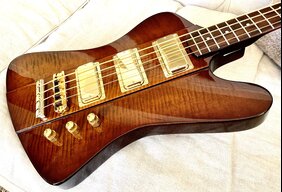
:) Thanks! Love "The Larch" - thanks for posting! :D It's an eighties Peavey T-40 pu in the classic T-bird II position (4" center from the neck butt) - a really nice sounding hum-bucker. (500k pots and a .047cap) It's a very bossy bass!

fullsizeoutput_be1.jpeg
 
Nice...

Did you ever try the original PU's passive?

I'm considering trying a set of DeepSix'es in mine with black chrome covers and rings, for that stealth look...
Where are you getting black-chrome covers? I must know- they've been in the front of my mind for the last three days now!
 
It's an eighties Peavey T-40 pu in the classic T-bird II position (4" center from the neck butt) - a really nice sounding hum-bucker. (500k pots and a .047cap) It's a very bossy bass!

View attachment 1071676
It strikes me as a variation on the Fenderbirds many have posted on the list. Instead of the bird body and a Fender neck, the body has the offset vibe of a Jaguar but with a bird neck.
 
My Pro-V just doesn't see that loud for an active bass (compared to passive Yamaha TRBX it is about the same, perhaps a little quieter). I have thought about replacing the onboard pre-amp. But I also have a volume knob on the amp.
True that. I have considered the same thing but I honestly don't have a clue as to what I'd replace it with and what to even expect from a different preamp. What the differences are in sound between brands, which each one individually would add or change that would make it worth the expense etc. Really don't feel the need to change out the pickups so it would have to work with what's there now. Too much info, too little time. And too little $$$$ to experiment.
 
True that. I have considered the same thing but I honestly don't have a clue as to what I'd replace it with and what to even expect from a different preamp. What the differences are in sound between brands, which each one individually would add or change that would make it worth the expense etc. Really don't feel the need to change out the pickups so it would have to work with what's there now. Too much info, too little time. And too little $$$$ to experiment.
I spent much time contemplating what to do and in the end decided that the volume knob on the amp will do the work.
 
True that. I have considered the same thing but I honestly don't have a clue as to what I'd replace it with and what to even expect from a different preamp. What the differences are in sound between brands, which each one individually would add or change that would make it worth the expense etc. Really don't feel the need to change out the pickups so it would have to work with what's there now. Too much info, too little time. And too little $$$$ to experiment.

I did try to find info on the preamp and came up pretty much blank. It may be an SD BEQ-2:
Invalid Link Removed

I couldn't see a trimpot or other way of changing the overall level on it. The Italia preamp is considerably hotter with the gain all the way down.
 
My day after the show............
I'm trashed, really glad I planned on nothing more ambitious than unloading the rest my gear out of the Subaru and a nap with my kitty. The band played well and we had a good turnout, esp since it was a Friday and our first time at this venue. The stage was reasonable size but being built up in a slight alcove made entirely of brick and having 8 very large subs mounted right underneath made sound onstage very boomy and I lost a bit of definition and high end that I like in my tone onstage, this was without earplugs - I added them shortly! Next time I'll use my IEMs and get a better in ear mix.
I played the purple '77 for the first set and the white '89 for the rest of the night, the '77 generates a bit more sub and playing a B note on either bass seemed to create an almost warbling bassy effect on stage.
Here's a couple pics

swiss.1_zpsdq6tfweq.jpg


17103241_10210647268132221_5648982511302785066_n_zpsrrtt8ili.jpg


Don't know if this work, the venue shot a bit of the end of Gary Numan's "Cars"