
Hopefully we can keep it from getting too serious!It's on now, or will be! Get popcorn and sit back and watch boys.

TalkBass has been independent since 1998. Add your voice.
Create a free account to reply to discussions, view embedded media, and browse with fewer display ads.
Join free Log in
Want zero display ads or expanded classifieds tools? Compare plans.
Hopefully we can keep it from getting too serious!It's on now, or will be! Get popcorn and sit back and watch boys.

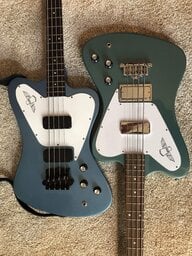
Those look the same size as the TB+.The pickups in my Orville are thicker than most chrome/nickel tbird pickups I’ve seen:

I made a poll, let's see what happens:
https://www.talkbass.com/threads/do-you-think-finish-thickness-affects-tone.1627759/
Make sure y'all vote

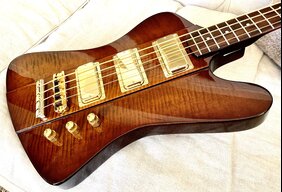
Yikes, that’s not what I thought it was. I really need to get my mind out of the gutter.Definitely. Straight from my son in law’s mom’s farm in Hebron. Holy olive oil?
View attachment 5236691


Yikes, not what I thought it was. I really need to get my mind out of the gutter.
 Hope you aren’t cursed by Abraham for such thoughts.
Probably.I don’t know the thickness, but I’m pretty sure that they are the same dimensions as the 760’s that came out of my VP.

Those look the same size as the TB+.

It’s good, isn’t it. Kat’s band is really coming along.

I made a poll, let's see what happens:
https://www.talkbass.com/threads/do-you-think-finish-thickness-affects-tone.1627759/
Make sure y'all vote
This is how thick it is on the TV Silver Epi IV (Geo has finished the repair, no pics yet. Now all I need to do is retrieve it).Spot on. The satin black finish on my Eppi Goth varied from approximately 1/16” thick to as much as 1/8” thick in some parts…
View attachment 5236698 It’s almost more of an encapsulation than a paint job.
Thank you. Bit of a retro-modern sound going on there. Glyn Johns drums with my two ribbons, an RE20 and a Beyer88, with 2 studio ribbons for the room mics. Bass is a Reddi DI, my Orange TB500 DI and the RE20 on my Toob 112. Guitar is a semicircle of Marshall JCM900, Roland JC120, Vox MV50/Rohan's Toob 112 and Orange Crush 120, all with a single SM57 but mainly captured through a ribbon/C414 mid/side stereo pair. Vocals are a Neumann (only condenser we used) plus ribbon set side by side, with a second track using an East German tape recorder mic the engineer has been wanting to use for years.
The engineer says we are the most 'extreme' band he has worked with. When we were recording the guitar for the second half of Icarus 2, he was looking very confused -- 'what is going on here?'
'We're crashing a spaceship into the sun.'
Mixing was done in Logic, with Arturia (Trident A Range channel strip, Space Echo, EMT Plate reverb, + Gates STA and 1176 comps) and Eventide (Harmoniser and Hansa TonStudio reverb) plugins.
If I was mixing someone else I'd be more 'conventional', unless they asked for Goth Bonham drums.
That would be an invalid test, too many variables.Voted. Hats off to anyone who can listen to an isolated bass recording and tell if it's poly/natural or nitro finish used
Grace Slick on Vox. Lemmy on bass. That’s what first comes to mind.Thank you. Bit of a retro-modern sound going on there. Glyn Johns drums with my two ribbons, an RE20 and a Beyer88, with 2 studio ribbons for the room mics. Bass is a Reddi DI, my Orange TB500 DI and the RE20 on my Toob 112. Guitar is a semicircle of Marshall JCM900, Roland JC120, Vox MV50/Rohan's Toob 112 and Orange Crush 120, all with a single SM57 but mainly captured through a ribbon/C414 mid/side stereo pair. Vocals are a Neumann (only condenser we used) plus ribbon set side by side, with a second track using an East German tape recorder mic the engineer has been wanting to use for years.
The engineer says we are the most 'extreme' band he has worked with. When we were recording the guitar for the second half of Icarus 2, he was looking very confused -- 'what is going on here?'
'We're crashing a spaceship into the sun.'
Mixing was done in Logic, with Arturia (Trident A Range channel strip, Space Echo, EMT Plate reverb, + Gates STA and 1176 comps) and Eventide (Harmoniser and Hansa TonStudio reverb) plugins.
If I was mixing someone else I'd be more 'conventional', unless they asked for Goth Bonham drums.
George Washington maybe, not so much Abraham Lincoln.

Grace Slick on Vox. Lemmy on bass. That’s what first comes to mind.
Hopefully we can keep it from getting too serious!
Perhaps I should have spelled it Ibrahim...George Washington maybe, not so much Abraham Lincoln.

I made a poll, let's see what happens:
https://www.talkbass.com/threads/do-you-think-finish-thickness-affects-tone.1627759/
Make sure y'all vote


