
You could order all sorts of configurations with that body, so I'm sure the cavity was cut out to accommodate anything. The LB20 is passive, the LB70 was active.I do all my basses and guitars with copper foil. Nice job plus nice big control cavity!

TalkBass has been independent since 1998. Add your voice.
Create a free account to reply to discussions, view embedded media, and browse with fewer display ads.
Join free Log in
Want zero display ads or expanded classifieds tools? Compare plans.
You could order all sorts of configurations with that body, so I'm sure the cavity was cut out to accommodate anything. The LB20 is passive, the LB70 was active.I do all my basses and guitars with copper foil. Nice job plus nice big control cavity!

maybe these help?….The 3 points on my Casadys are about 2.05”
This a MIJ 3 point with a VP stop bar. It would work, but I like a straight string path. (Probably being too fussy)
View attachment 5459563

Not fussy at all.
I’m no technical expert on any of this.
But I’m sure a straight path coming from the stop piece is important.
I’m sure Geo and Chuck could chime in on this.
so true….as you may know, grounding makes for an excellent dissertation topic…
 I do usually star-ground which is debated but I first started doing it following the written advice of Rick Turner.
I usually run a ground wire to the slug tape in the control cavity. I found that the adhesive used on the tape is conductive. Verified with a continuity test.I sometimes completely slug-tape the cavities, and other times do 3 coats of carbon shielding paint with a slug-tape floor to ground to. Both work, sometimes it had to do with being out of one or the other at the time of need.
View attachment 5459654
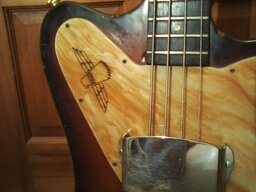
Look at it like this-instead of one straight string path, ya'd have 2.The 3 points on my Casadys are about 2.05”
This a MIJ 3 point with a VP stop bar. It would work, but I like a straight string path. (Probably being too fussy)
View attachment 5459563


Star ground is the way!I sometimes completely slug-tape the cavities, and other times do 3 coats of carbon shielding paint with a slug-tape floor to ground to. Both work, sometimes it had to do with being out of one or the other at the time of need.
View attachment 5459654
so true….as you may know, grounding makes for an excellent dissertation topic…




They're still made of cow meat.Dairy cows. But I can get you some cheese and ice cream.
I don't talk about it, but I do like to sing ( a little, to serve the song) and play the bass.

I don't talk about it, but I do like to sing ( a little, to serve the song) and play the bass.
Speaking on that subject- I find it difficult, if not impossible to do so for some (actually many) songs due to the brain multi-tasking issue.
Gail Ann Dorsey recommended starting off really slow with a metronome until you can sing with facility. Other advice I got from a musician was to start off with just the root notes and gradually fill in as you get accustomed to doing two different things at the same time-
Thoughts? Other suggestions?
I realize that for some people, it comes naturally, even some drummers like Don Henley and Roger Taylor could sing and play at the same time. But Frank Zappa once stated that he could not -

I want them all, so I'll always advocate getting it. The AO is a bit more of that modern distortion. With the MT500, I almost always use the B7K voice over the MT because it sits better in what we do. As long as modern (as opposed to vintage old style) distortion is what you're after, then the AO will be a winner for you. Doubly so if LnM returns are as easy to do as they are at Guitar Center (GC is a pizza cake to deal with).I’m debating between the alpha omega 900 and Microtubes 900v2. The Mesa Strategy is a little too much noodling around at night.
I already have a B7K ultra so I’m leaning towards the AO and there’s a used one at Long & McQuade for a decent price I could get them to ship it to a local store.
It's possible that I can do it fairly easily 'cos I sang in choir long B4 I started playing bass. Someone once mentioned how it would be difficult to sing "My Girl" against the accepted bass pattern. Nope, not for me. BUT. I can't sing "Get Ready" against the correct bass line, and I have a little bit of trouble with the answering line for "Sugarpie Honeybunch"(there's a pickup I has to leave out on the oo-oo-oos).Speaking on that subject- I find it difficult, if not impossible to do so for some (actually many) songs due to the brain multi-tasking issue.
Gail Ann Dorsey recommended starting off really slow with a metronome until you can sing with facility. Other advice I got from a musician was to start off with just the root notes and gradually fill in as you get accustomed to doing two different things at the same time-
Thoughts? Other suggestions?
I realize that for some people, it comes naturally, even some drummers like Don Henley and Roger Taylor could sing and play at the same time. But Frank Zappa once stated that he could not -

Ooh! Pizza Cake! Sounds delicious.I want them all, so I'll always advocate getting it. The AO is a bit more of that modern distortion. With the MT500, I almost always use the B7K voice over the MT because it sits better in what we do. As long as modern (as opposed to vintage old style) distortion is what you're after, then the AO will be a winner for you. Doubly so if LnM returns are as easy to do as they are at Guitar Center (GC is a pizza cake to deal with).

You pretty much need to do one thing or the other on autopilot. It usually helps to simplify the bass line.Speaking on that subject- I find it difficult, if not impossible to do so for some (actually many) songs due to the brain multi-tasking issue.
Gail Ann Dorsey recommended starting off really slow with a metronome until you can sing with facility. Other advice I got from a musician was to start off with just the root notes and gradually fill in as you get accustomed to doing two different things at the same time-
Thoughts? Other suggestions?
I realize that for some people, it comes naturally, even some drummers like Don Henley and Roger Taylor could sing and play at the same time. But Frank Zappa once stated that he could not -

I always am wireless these days. The copper foil in my hat eliminates problems with routers, wifi, space lasers, etc.I did a handful but then weened off of that
Probably the tin foil hat speaking, but I swear I hear the difference and not in a good way.
Almost like it sterilizes the tone
2 fact worth noting:
I don't run a 100% clean signal chain anyway. yay dirt
I have clean power here. The only noise the basses pick up are RFi from wireless devices
I know it's not a functional issue for the string path to flare out or in between the tailpiece and bridge. It's just a visual detail I can't unsee, so I won't install a tailpiece wider than the bridge.Actually considering how close the difference is, no... it only is a visual difference. The whole 'straight string path' usually is focused on the nut-to-tuners part of a guitar/bass. Even that is over-considered. The string-path issue that does hold some merit is a bass with string-thru. Depending on the angle coming off the bridge, it can bend pretty sharply which puts stress on the string. I own a few basses with string-thru and a few I made and have never had a problem with that particular issue.


