
Gaolee
Official leathers tester and crash dummy
You play a Thunderbird and he doesn't. There would be no competition.I doubt that her husband-a Prince-would like that.

TalkBass has been independent since 1998. Add your voice.
Create a free account to reply to discussions, view embedded media, and browse with fewer display ads.
Join free Log in
Want zero display ads or expanded classifieds tools? Compare plans.
You play a Thunderbird and he doesn't. There would be no competition.I doubt that her husband-a Prince-would like that.
I'm thinking you pulling my string just a bit and being intentionally vague so as to not let the real secret out. The chip says BBE 2150 on it. That clearly means part of the magic is the chip takes the sound and transports it to the carefully selected time of 2150 where it would sound the best and then transports it back after it's corrected in 2150. I see what's going on. You can't fool me that easily.The black rectangle that has BBE 2150AD JRC 2503C is an audio processing chip. Of the smaller components, R is for resistor, C is for capacitor, L is for lunch.
If Larry Graham played a Thunderbird, it would look like one of those.
That's just really, really nice looking.
Too bad it isn't a reverse. Well, good thing. I would have GAS if it was a reverse.At Mod shop....very coolView attachment 7120126
Disgusting. How on earth you can stand all this is beyond me.

Valid point right there.You play a Thunderbird and he doesn't. There would be no competition.
With a mic sticking out.If Larry Graham played a Thunderbird, it would look like one of those.

Well now you did it.I'm thinking you pulling my string just a bit and being intentionally vague so as to not let the real secret out. The chip says BBE 2150 on it. That clearly means part of the magic is the chip takes the sound and transports it to the carefully selected time of 2150 where it would sound the best and then transports it back after it's corrected in 2150. I see what's going on. You can't fool me that easily.


yeah wasn't impressed, maybe the recording?....Yes, either for you or when we did a Dano-Day.

There's a sparkle green Jackson posted for sale on the TB Players FB group.Too bad it isn't a reverse. Well, good thing. I would have GAS if it was a reverse.

Another ego bruising from the talent section of the house...yeah wasn't impressed, maybe the recording?....

There's a sparkle green Jackson posted for sale on the TB Players FB group.

You bring up a good point and something to clearly watch out for when modding basses to three or more pickups. There’s actually two major factors to consider, one as you noted is the magnetic pull on the strings which can cause chorus and warble effects and even effect intonation, the other is signal phasing and cancellation due to multiple pickups offsetting each other at various frequencies.
The magnetic pull is an easy issue to design out by not using exceptionally strong magnetic pickups and positioning the height of the pickup correctly to avoid unwanted string pull. The cancellation issue is best dealt with by using non similar pickups in close proximity to each other.
In Jeff’s case (@JJR58 ) he wisely used a thunderbird sidewinder pickup between the two Thunder ranch pickups. This dissimilar pup layout eliminated any cancellation effect and gave his Tbird a truly unique and beautiful voice. I’ve had similar luck with ChinaBucker pickups. Again, dissimilar layout is the key. Mine are bridge at the neck, neck at the middle and bridge at the bridge positions. Works phenomenally good with each pickup having its own volume and tone stack and allowed me to use a unique tone cap for each pickup as well. Super flexible sound palette that goes from bark to thick fat bottom and everything in between even simultaneously. She’s called the BlingBird…
View attachment 7119601
I’m in the middle of a four pickup build now that will use a similar control spec except it will have a bridge/neck/bridge/neck pickup configuration. The magnetic pull will be the real challenge on this one since I’m using Epiphone Goth pickups (not overly strong but certainly not weak magnets). The pup cavities will be routed extra deep to allow possibly needed space between the strings and pickups.
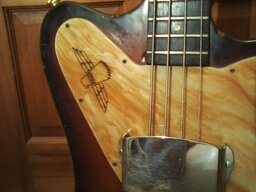
You play a Thunderbird and he doesn't. There would be no competition.
 I wish.
"another"? hmm....just sounded tinny, like I said, maybe the recording...Another ego bruising from the talent section of the house...
Just yanking the chain on a nice Thunderbird Thursday. The recording was just an old iPhone 12. It was really just indicating that your fantastic repair work worked."another"? hmm....just sounded tinny, like I said, maybe the recording...
Sweeeet!Just yanking the chain on a nice Thunderbird Thursday. The recording was just an old iPhone 12. It was really just indicating that your fantastic repair work worked.

Mmmm, lunch.I’m fond of lunch


